JHA Best Practices for Safety Professionals in 2026
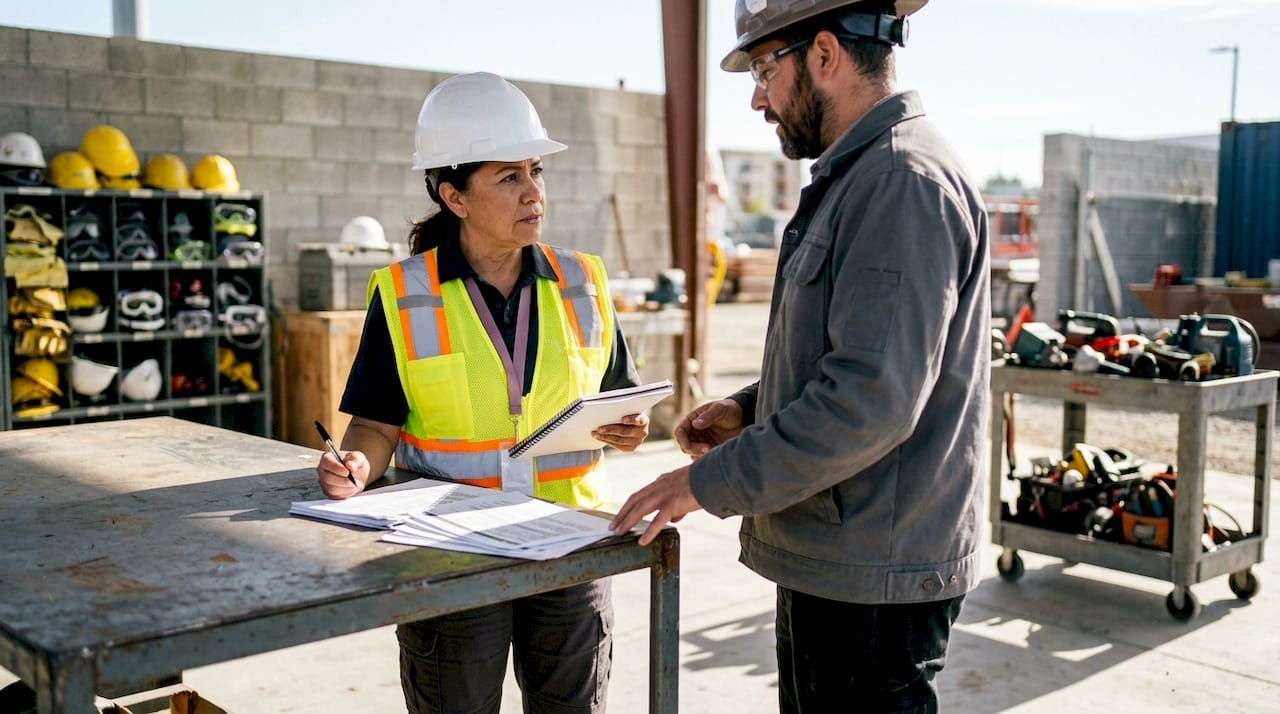
A Job Hazard Analysis, or JHA, is a systematic process that breaks down workplace tasks into discrete steps, identifies hazards at each step, and applies controls to prevent injury before work begins. Also called a Job Safety Analysis (JSA), the JHA is the foundational tool in any serious Environmental Health and Safety (EHS) program. OSHA’s Publication 3071 codifies the five-step methodology that safety professionals rely on today. Organizations that conduct thorough job hazard analyses reduce injury rates, improve safety morale, and lower insurance costs by catching risks before they become incidents.
What OSHA regulations apply to JHA compliance?
OSHA does not mandate a single, universal JHA form. That distinction matters. What OSHA does require is documented hazard assessment under the General Duty Clause and several specific standards. The absence of a JHA is not automatically a violation, but it becomes one the moment an inspector finds a recognized hazard with no documented control.
Three standards drive most JHA compliance requirements in general industry:
- 29 CFR 1910.132(d): Requires a written hazard assessment to determine appropriate personal protective equipment (PPE) before workers perform tasks with exposure risk.
- 29 CFR 1910.119: OSHA’s Process Safety Management standard requires hazard analysis for facilities handling highly hazardous chemicals above threshold quantities.
- 29 CFR 1910.147: The lockout/tagout standard requires documented energy control procedures, which align directly with JHA task breakdowns for equipment servicing.
During OSHA inspections, the absence of documented JHAs is frequently cited as evidence of General Duty Clause failure when a recognized hazard exists but no control is on record. That citation can carry significant penalties and, more importantly, signals that workers faced preventable risk.
Contractor compliance programs add another layer of pressure. Platforms like ISNetworld and Avetta require documented JHA programs for high-risk tasks including work at height, electrical work, and confined space entry. For contractors, an undocumented JHA program is not just an OSHA problem. It is a disqualifier from client worksites.
Pro Tip: Review your JHA library against 29 CFR 1910.132(d) first. PPE assessments are the most commonly audited JHA-adjacent document, and they are also the easiest to produce with a solid template.
How to conduct a JHA: the five-step OSHA method
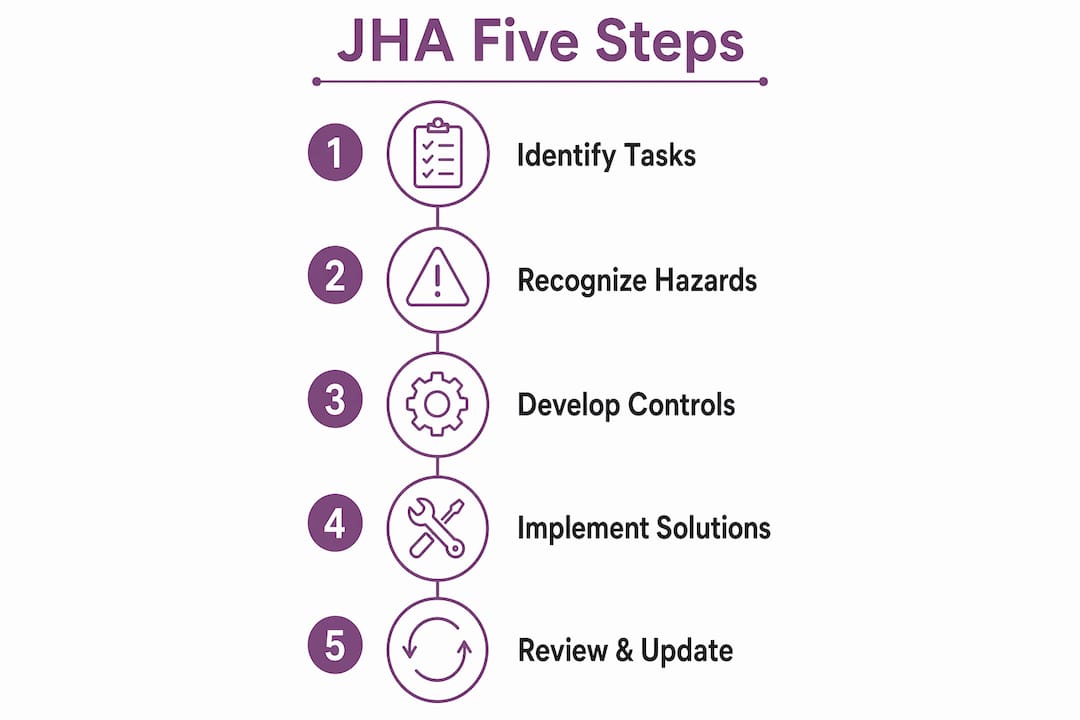
The OSHA 3071 five-step methodology is the accepted standard for conducting an effective job hazard analysis. Each step builds on the last, and skipping any one of them produces a document that looks like a JHA but fails under real-world conditions.
-
Involve the employees who do the work. Workers who perform a task daily know its hazards better than any supervisor observing from a distance. Frontline worker involvement prevents the blind spots that supervisory-only analysis consistently misses. Sit with the crew, ask open questions, and document what they describe.
-
Review accident and injury history. Pull your OSHA 300 logs, near-miss reports, and workers’ compensation records for the job in question. Past incidents are the clearest signal of where hazards exist. A task with three near-misses in two years needs a JHA immediately, regardless of how routine it appears.
-
Observe and break the job into discrete steps. Watch the task performed under normal conditions. Divide it into sequential steps, typically no more than ten to fifteen for a single job. Each step should describe one action: “lift drum onto pallet,” not “move materials.” Vague steps produce vague hazard identification.
-
Identify hazards for every step. For each step, ask what could go wrong. Consider physical hazards (pinch points, fall exposure), chemical hazards (vapor exposure, skin contact), ergonomic hazards (repetitive motion, awkward posture), and environmental hazards (temperature, noise). A hazard is not an injury. It is the condition that causes one.
-
Apply the hierarchy of controls. Controls must follow a priority order: elimination first, then substitution, engineering controls, administrative controls, and PPE last. A JHA that jumps straight to “wear gloves” without considering whether the chemical exposure can be eliminated or enclosed is a weak document that will not hold up under audit.
Pro Tip: When breaking a job into steps, film the task on a phone and review the footage frame by frame. Workers often skip steps they consider automatic, and those “invisible” steps are where the most serious hazards hide.
How to integrate JHA into safety training and continuous improvement

A completed JHA form sitting in a binder is not a safety program. The highest value of a JHA comes from using it as an active risk communication tool, not a one-time compliance exercise. Safety professionals who treat JHAs as living documents see measurably better outcomes than those who treat them as annual paperwork.
Practical integration starts with how you use the JHA in training:
- Use the JHA as the training script. Walk new workers through each task step and its associated hazard before they touch the equipment. The JHA becomes the lesson plan, not just the record.
- Train supervisors to detect hazards in the steps between the steps. Supervisors who recognize subtle transition hazards, such as the moment a worker shifts grip between two tasks, prevent accidents that generic JHAs overlook. This skill requires deliberate coaching, not just document review.
- Schedule mandatory JHA reviews after any equipment change, process modification, or incident. Regularly updating JHAs after changes in equipment or workflow keeps hazard controls current. A JHA written for last year’s process is not a control for this year’s risk.
- Document training completion and worker feedback. Record who received JHA-based training, when, and what questions or concerns they raised. That documentation protects the organization during audits and feeds the next JHA revision.
- Rotate JHA development responsibility. Assign different crew members to lead JHA reviews on a rotating basis. This builds hazard recognition skills across the workforce and surfaces site-specific risks that management would never identify alone.
The Job Hazard Analysis benefits extend well beyond regulatory compliance. Organizations that embed JHA into their safety culture report stronger worker engagement, faster incident response, and lower total recordable incident rates over time.
Pro Tip: Create a “JHA feedback card” that workers complete after performing a newly analyzed task. Ask one question: “Was anything different from what the JHA described?” Responses drive your next revision cycle and signal emerging hazards before they cause harm.
What do JHA training courses cost and cover?
Safety professionals seeking formal JHA training have a clear range of options. Professional JHA training courses typically run approximately four hours and cost around $225 per person. Shorter, introductory options are available at approximately $25 per person for teams that need awareness-level training rather than practitioner certification.
| Format | Duration | Approximate cost | Assessment | Certification |
|---|---|---|---|---|
| Full practitioner course | ~4 hours | ~$225 per person | Final exam, 80% pass required | Certificate issued on pass |
| Introductory awareness course | Under 1 hour | ~$25 per person | Quiz-based | Completion record |
| Group or organizational training | Variable | Negotiated per group | Varies by provider | Varies by provider |
The 80% passing requirement on practitioner-level assessments is standard across most accredited providers. That threshold reflects the expectation that JHA practitioners can apply the methodology independently, not just recall definitions.
Group training carries a specific advantage for compliance managers. When supervisors and safety coordinators complete JHA training together, they develop a shared vocabulary for hazard identification. That alignment reduces inconsistency across JHAs produced by different departments, which is one of the most common audit findings in multi-site organizations.
Certification from a JHA training course also creates a verifiable record of competency. For contractors working on client sites that require ISNetworld or Avetta prequalification, individual JHA certifications strengthen the organization’s safety documentation package considerably.
Key Takeaways
A Job Hazard Analysis is most effective when it combines OSHA-aligned methodology, frontline worker input, and regular review cycles tied to real operational changes.
| Point | Details |
|---|---|
| OSHA compliance requires documentation | Standards 29 CFR 1910.132(d), 1910.119, and 1910.147 all require written hazard assessments. |
| Five-step method is the standard | OSHA 3071 guides practitioners through worker involvement, task breakdown, hazard ID, and controls. |
| Worker involvement prevents blind spots | Frontline employees identify site-specific hazards that supervisory-only analysis consistently misses. |
| JHAs must be updated after changes | Equipment changes, process modifications, and incidents all trigger a mandatory JHA review. |
| Training certification strengthens compliance | Documented JHA training records protect organizations during OSHA inspections and contractor audits. |
Why most JHA programs fail before the first inspection
The most common JHA failure I see is not a missing document. It is a document that was written once, filed, and never touched again. Safety professionals spend real time building a solid JHA for a task, then treat it as finished. Two years later, the equipment changes, the crew turns over, and the JHA still describes a process that no longer exists.
The second failure is generic controls. A JHA that says “wear appropriate PPE” for a chemical exposure hazard tells a worker nothing. It does not specify which glove material, what cartridge type for the respirator, or how long the exposure window is before decontamination is required. Effective JHAs cite specific, actionable hazard mitigations that protect both the worker and the organization during audits. Vague language is not a control. It is a liability.
The fix is simpler than most programs make it. Assign one person to own each JHA. Give that person a review calendar tied to operational change triggers. Require them to walk the task with a frontline worker at least once per year, even if nothing has changed. That annual walk catches the drift between documented procedure and actual practice before an inspector does.
JHA templates for safety assessments are useful starting points, but they are not substitutes for site-specific observation. The template gives you the structure. The frontline worker gives you the content. Neither one alone produces a document that actually controls risk.
— James
How Certicerts helps safety teams manage JHA certifications
Safety professionals invest significant effort in JHA training and certification. Keeping those records organized, current, and verifiable is a separate challenge that paper binders and spreadsheets handle poorly.

Certicerts is built for exactly this problem. The platform lets safety teams issue professional training certificates with QR verification, generate wallet cards for every certified worker, and track expiry dates across the entire workforce from a single compliance dashboard. When an auditor or client site asks for proof of JHA certification, workers can present a wallet card and the QR code confirms authenticity instantly, even offline. Certicerts runs as a local-first Windows application, so your training records stay under your control. Explore certificate and wallet card management to see how safety teams use Certicerts to close the gap between training completion and verifiable compliance.
FAQ
What is a JHA in workplace safety?
A JHA, or Job Hazard Analysis, is a structured process that breaks a job into steps, identifies hazards at each step, and documents controls to prevent injury. OSHA’s Publication 3071 provides the accepted five-step methodology for conducting one.
Is a JHA legally required by OSHA?
OSHA does not require a specific JHA form, but standards including 29 CFR 1910.132(d) require written hazard assessments. The absence of documented hazard analysis is cited as a General Duty Clause violation when a recognized hazard exists without a recorded control.
How often should a JHA be updated?
A JHA requires review and update after any equipment change, process modification, or workplace incident. Annual reviews are also recommended even when no changes have occurred, to confirm the document still reflects actual work conditions.
What is the difference between a JHA and a JSA?
JHA (Job Hazard Analysis) and JSA (Job Safety Analysis) refer to the same process. The terms are used interchangeably across industries, with JSA more common in construction and JHA more common in general industry and OSHA guidance.
How long does JHA training certification take?
Practitioner-level JHA training courses run approximately four hours and typically require an 80% passing score on a final assessment before a certificate is issued. Shorter awareness-level courses are available for teams needing introductory coverage.