JHA vs AHA: A Safety Professional’s 2026 Guide

A Job Hazard Analysis (JHA) and an Activity Hazard Analysis (AHA) are both hazard identification tools, but they serve different regulatory environments and carry very different compliance obligations. The JHA vs AHA distinction matters most when your work crosses into federal construction contracts, where using the wrong document can stop a project cold. JHA, also called a Job Safety Analysis (JSA), is the standard OSHA-referenced tool for general industry. AHA is a formal compliance instrument required under EM 385-1-1 for U.S. Army Corps of Engineers (USACE) and Department of Defense (DoD) projects. Both tools share the same core goal: identify hazards before work begins and put controls in place. The gap between them lies in structure, approval authority, and legal weight.
What is the difference between JHA and AHA?
JHA and AHA differ in scope, required components, and who must sign off before work starts. Understanding those differences protects your organization from audit failures and project delays.
JHA structure and process
A JHA breaks a job into sequential steps, identifies the hazard at each step, and documents the control measure. OSHA’s guidance document OSHA 3071 describes a five-step process: select the job, break it into steps, identify hazards, determine controls, and review with employees. Supervisor review is the standard approval requirement. Risk ratings are optional and often qualitative, meaning a supervisor might label a hazard “high” without a defined scoring method. JHA works well as a living document that teams update regularly as conditions change.

AHA structure and process
An AHA carries significantly more required components. AHA format includes a Risk Assessment Code (RAC) matrix, Definable Features of Work (DFOW) scoping, EM 385-1-1 references, competent person designations, and equipment and training checklists. None of those elements appear in a standard JHA. The RAC matrix requires objective risk scoring by multiplying severity by probability, producing a numeric code that auditors can verify. That objective scoring is a primary audit focus on federal job sites, and a qualitative label will not satisfy it.
| Feature | JHA | AHA |
|---|---|---|
| Regulatory basis | OSHA 3071 guidance | EM 385-1-1 (USACE/DoD) |
| Risk rating method | Optional, qualitative | Required RAC matrix (severity × probability) |
| Scope definition | Broad job or task | Specific Definable Feature of Work (DFOW) |
| Approval authority | Supervisor | SSHO or Contracting Officer’s Representative (COR) |
| Equipment checklist | Not required | Required |
| Competent person log | Not required | Required |
| Legal weight | Management tool | Binding compliance document |
Pro Tip: Never scope an AHA to cover an entire project phase. Each specific Definable Feature of Work needs its own AHA. A catch-all document is the fastest path to an audit failure on a federal site.
How do regulatory requirements define when to use JHA versus AHA?
The regulatory context is the clearest dividing line between the two tools. Knowing which applies to your project is not optional.
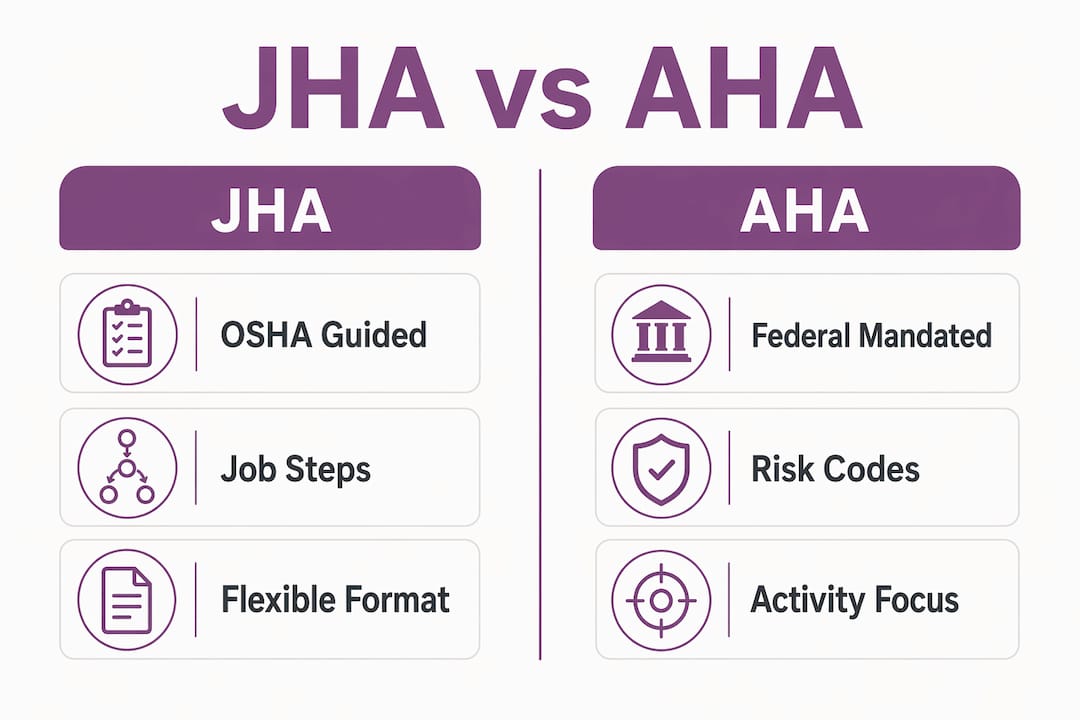
OSHA recommends JHA for general industry hazard management but does not mandate a specific format. That flexibility is useful for manufacturing plants, warehouses, and service industries where internal safety programs drive the process. The five-step OSHA 3071 process gives safety managers a solid framework, but the document itself remains an internal management tool rather than a binding compliance instrument.
AHA is mandatory on USACE and DoD construction contracts. The requirement flows directly from EM 385-1-1, the Army Corps of Engineers Safety and Health Requirements Manual. Federal contractors must submit AHAs for approval before work on each defined activity begins. AHA approval requires a Site Safety and Health Officer (SSHO) or Contracting Officer’s Representative (COR) signature, making it a document of record. Work cannot legally start without that signature in place.
The practical compliance sequence for AHA on a federal project follows this order:
- Identify each Definable Feature of Work for the project scope.
- Develop a separate AHA for each DFOW before that activity begins.
- Complete the RAC matrix with numeric severity and probability scores.
- List all equipment, competent persons, and their training records.
- Submit the AHA for SSHO or COR review and obtain a signed approval.
- Brief the crew on the AHA content before work starts.
- Update the AHA whenever scope, conditions, or personnel change.
DFOW scoping requires each defined activity to have its own AHA, which prevents the catch-all documents that consistently fail federal audits. Safety managers who underestimate the documentation volume of AHA requirements often find themselves scrambling to produce compliant records after work has already begun.
What are the practical compliance implications of choosing between JHA and AHA?
Choosing the wrong tool for your project type creates real consequences. Substituting a JHA where an AHA is required leads to project delays and non-compliance penalties. Federal contracting officers do not accept JHA documents as equivalent, regardless of how detailed they are.
The documentation burden for AHA is substantially higher than most safety managers expect when they first encounter federal contract requirements. Consider what AHA demands beyond the standard hazard table:
- A completed RAC matrix with numeric scores for every identified hazard
- A named competent person for each activity, with training records attached
- An equipment list with inspection and certification status
- EM 385-1-1 section references for each control measure
- Signed approval from SSHO or COR before any work begins
- A crew briefing record confirming workers received the AHA content
Disconnected spreadsheets frequently cause inspection failures because training records, equipment logs, and AHA documents live in separate files that auditors cannot cross-reference quickly. Federal contractors who use integrated management systems consistently perform better during inspections.
Pro Tip: Build your competent person log and equipment checklist as standing records that feed directly into each new AHA. Recreating those lists from scratch for every activity is where compliance gaps appear.
JHA remains the right tool for non-federal work. Manufacturing facilities, construction companies working on private projects, and general industry employers benefit from JHA’s flexibility. The hierarchy of controls that OSHA promotes through JHA guidance applies equally well to both tools, but the documentation formality differs sharply. A JHA that is regularly reviewed and updated satisfies OSHA’s expectation for general industry hazard management without the overhead of federal contract compliance.
How can organizations implement JHA and AHA processes effectively?
Effective implementation depends on matching your documentation system to the regulatory environment your work operates in. A safety program that handles both general industry and federal construction work needs clear separation between JHA and AHA workflows.
For organizations managing JHA processes in general industry, JHA best practices in 2026 center on employee participation, regular review cycles, and clear control documentation. Workers who help write the JHA identify hazards that supervisors miss. Review cycles tied to incident reports or near-miss events keep the document current.
For AHA compliance on federal projects, the implementation priorities shift toward documentation integrity and approval workflow:
- Assign a dedicated SSHO with clear authority to approve AHAs before work starts.
- Create a DFOW register at project kickoff so every required AHA is identified before any activity begins.
- Use a centralized system to link competent person records, training logs, and equipment certifications directly to each AHA.
- Conduct pre-task briefings and record attendance to demonstrate crew awareness.
- Audit AHAs against EM 385-1-1 section references before submission to avoid revision cycles.
- Track AHA expiration and update triggers, including scope changes and personnel turnover.
Job hazard analysis software built for safety professionals can manage approval workflows, store training records, and generate compliant documentation formats. The gap between a paper-based AHA process and an integrated digital system shows up most clearly during federal inspections, where auditors expect to cross-reference multiple record types quickly. Organizations managing construction safety programs at scale benefit from systems that connect hazard analysis documents to training records and competent person logs in one place.
Training and competency tracking deserve specific attention in AHA programs. Integrated record-keeping for equipment use and competent persons with training logs is a compliance requirement, not a best practice. Federal auditors treat missing training records as a deficiency equivalent to a missing AHA.
Key Takeaways
JHA serves general industry hazard management under OSHA guidance, while AHA is a binding federal compliance document required under EM 385-1-1 for USACE and DoD projects, and substituting one for the other creates direct compliance risk.
| Point | Details |
|---|---|
| Regulatory basis differs | JHA follows OSHA 3071 guidance; AHA is mandated by EM 385-1-1 on federal contracts. |
| AHA requires objective risk scoring | The RAC matrix uses numeric severity-by-probability scores that qualitative JHA ratings cannot replace. |
| Approval authority is higher for AHA | AHA requires SSHO or COR signature before work starts; JHA requires supervisor review only. |
| DFOW scoping is non-negotiable | Each Definable Feature of Work needs its own AHA; catch-all documents fail federal audits. |
| Integrated records prevent inspection failures | Training logs, competent person records, and equipment checklists must link directly to each AHA. |
The compliance gap most safety managers learn the hard way
The most common mistake I see safety managers make is treating JHA and AHA as interchangeable documents with different names. That assumption costs real money. I have watched federal projects get stopped because a contractor submitted a detailed, well-written JHA in place of an AHA, and the SSHO had no choice but to reject it. The document was thorough. It just was not the right document.
The shift to objective RAC matrix scoring in AHA represents a genuine evolution in risk assessment rigor, not bureaucratic overhead. When you force a team to assign numeric severity and probability scores, you surface disagreements about risk that qualitative labels paper over. That friction is the point. It produces a more honest hazard assessment.
My advice for safety managers in 2026 is to build two separate document workflows and never let them blur. Your JHA process should be flexible, employee-driven, and updated frequently. Your AHA process should be formal, approval-gated, and tied to a DFOW register that you build at project kickoff. Trying to run one process for both environments creates the exact compliance gaps that federal auditors find. The regulatory enforcement environment has tightened, and contracting officers are less willing to accept corrective action plans in place of compliant pre-work documentation.
— James
How Certicerts supports JHA and AHA compliance workflows
Safety professionals managing both JHA and AHA programs carry a significant documentation load. Training records, competent person designations, and certification logs all need to be current, verifiable, and ready for audit at any time.

Certicerts gives safety teams a direct way to issue, manage, and verify training certificates and wallet cards with offline QR verification built in. Every certificate includes a self-contained training record that auditors and contracting officers can verify on site without an internet connection. Batch certificate generation handles large training events without manual data entry, and the compliance dashboard flags expiring credentials before they create gaps in your AHA competent person logs. For safety professionals who need documentation that holds up under federal scrutiny, Certicerts provides the record integrity that paper-based systems cannot.
FAQ
What is the main difference between JHA and AHA?
JHA is an OSHA-referenced hazard identification tool used in general industry, while AHA is a formal compliance document required under EM 385-1-1 for USACE and DoD federal construction contracts. AHA includes additional components like the RAC matrix, DFOW scoping, and competent person logs that JHA does not require.
Is AHA required on all construction projects?
AHA is mandatory on federal construction contracts governed by USACE or DoD, not on all construction projects. Private sector and state-funded construction projects typically use JHA or JSA formats to meet OSHA guidance requirements.
Can a JHA substitute for an AHA on a federal project?
No. Substituting a JHA for an AHA on a federal project leads to non-compliance penalties and work stoppages. Federal contracting officers require AHA format with SSHO or COR approval before work on each Definable Feature of Work can begin.
What is the RAC matrix in an AHA?
The RAC matrix is a risk scoring tool that multiplies hazard severity by probability to produce a numeric Risk Assessment Code. It is a required element of every AHA and a primary focus during federal safety audits.
How often should a JHA be updated?
OSHA guidance treats JHA as a living document that teams should review and update after incidents, near-misses, scope changes, or personnel changes. Regular review cycles tied to operational changes keep the document accurate and defensible.