JHA Form Guide for Safety and Compliance Managers
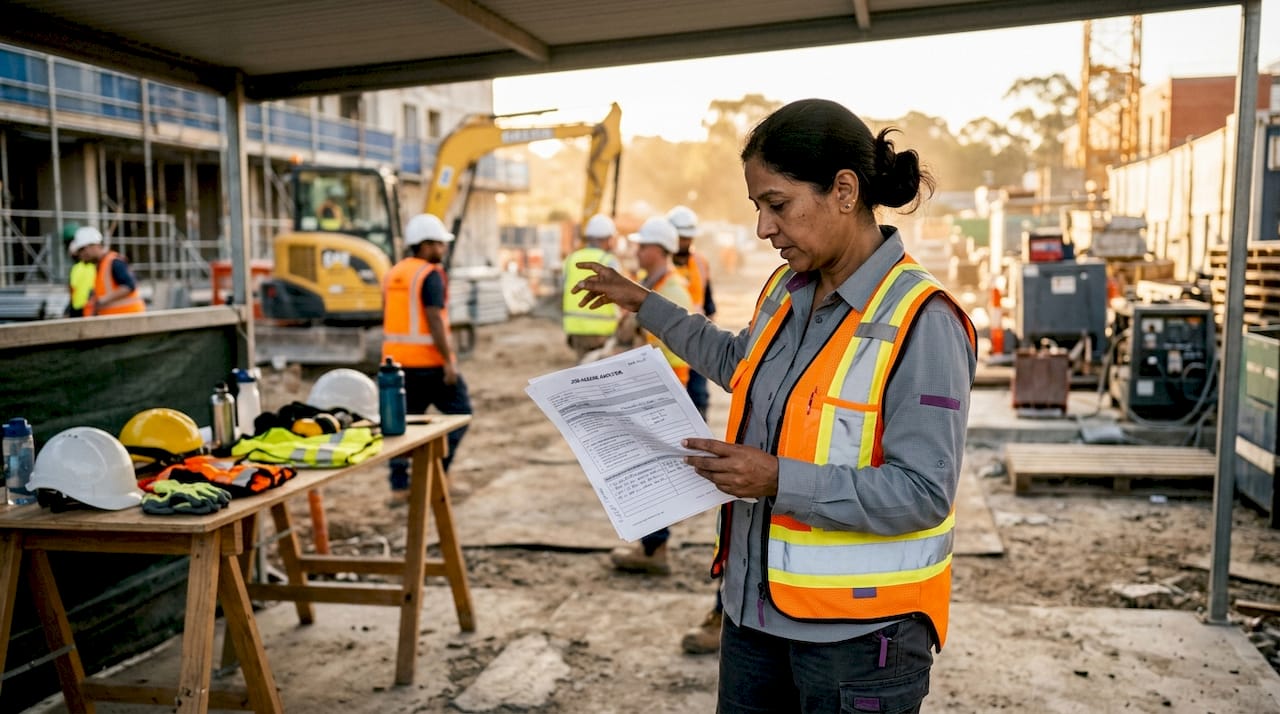
A Job Hazard Analysis (JHA) form is a structured document that breaks a job into discrete steps, identifies the hazard at each step, and specifies controls to prevent injury. Known interchangeably as a Job Safety Analysis (JSA) in construction, the JHA label is more common in manufacturing and general industry. OSHA 29 CFR 1910.132 requires a written hazard assessment covering PPE selection, and a properly completed JHA satisfies that requirement without mandating a specific format. For safety professionals and compliance managers, the JHA form is the most direct tool for connecting task-level risk to documented, enforceable controls.
What are the essential components of a JHA form?
A standard JHA form uses a 3–4 column grid: Job Steps, Potential Hazards, Hazard Controls, and often a Responsible Person column. That structure forces the analyst to think sequentially and link every control to a specific hazard, rather than writing generic safety reminders at the bottom of a page.

Header information
The form header carries the administrative data that makes the document traceable and legally defensible. Every JHA template should include:
- Job title and task description — specific enough that a new worker can identify the exact task
- Work location — department, site, or equipment identifier
- Analysis date and revision number — tracks when the document was created and last updated
- Author and reviewer names — establishes accountability
- Supervisor and worker signatures — confirms the analysis was communicated before work began
Body columns
The body of the form is where the real safety work happens. Each row represents one discrete job step, written as an action (“Connect the hose fitting,” not “Hose work”). The hazard column names the specific energy source or failure mode, such as hydraulic pressure release or pinch point at the coupling. The controls column specifies the exact measure, not a vague instruction.
Compliance and PPE fields
A complete JHA template also lists the required PPE for the task as a whole, references the applicable OSHA standard, and includes a sign-off block for worker training acknowledgment. Signature and training records on JHAs serve as essential proof during inspections and incident investigations. That single field transforms the form from an analysis tool into a compliance record.
| Form Section | Purpose |
|---|---|
| Header block | Identifies task, location, date, and authorship |
| Job steps column | Breaks work into sequential, observable actions |
| Hazards column | Names specific energy sources and failure modes |
| Controls column | Specifies exact preventive measures |
| PPE and signatures | Documents required equipment and worker acknowledgment |
How do you conduct a job hazard analysis using the JHA form?
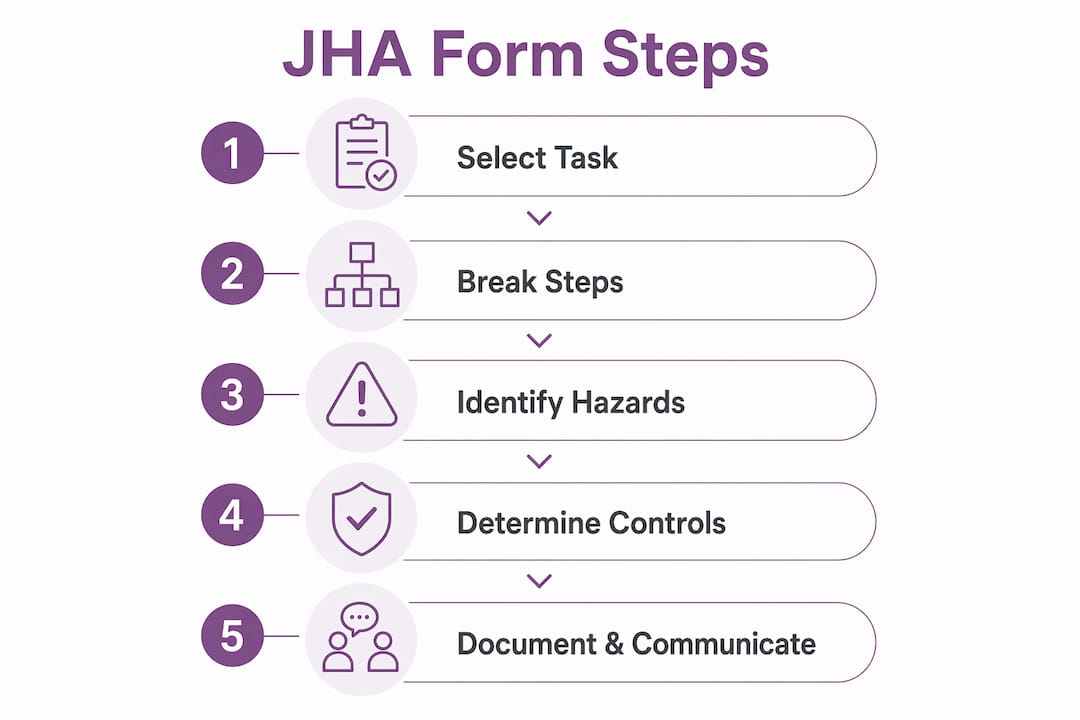
The four-step JHA process is select the job, break it into steps, identify hazards, and determine controls. Each step requires more discipline than it appears.
Step 1: Select the right task
Prioritize tasks with a history of injuries or near misses, jobs that are new or recently changed, and non-routine work performed infrequently. A task that happens once a quarter carries higher risk than a daily routine because workers have less muscle memory and supervisors have less oversight. Start your JHA program with the highest-consequence tasks, not the easiest ones to document.
Step 2: Break the job into steps
Aim for 10 or fewer steps per JHA. If a task requires more, split it into two separate analyses. Each step should describe one observable action, written in plain language. “Lift the panel into position” is a step. “Perform lifting operations” is not. Vague steps produce vague hazard identification, which produces vague controls.
Step 3: Identify hazards at each step
At each step, ask what could go wrong and what energy source could cause harm. Consider mechanical energy (moving parts), gravitational energy (falling objects or falls from height), chemical exposure, electrical contact, and ergonomic strain. Human factors matter too: fatigue, time pressure, and poor sight lines all increase risk. Observing actual task performance reveals hazards that written SOPs consistently miss. Watch the job being done before you write a single word.
Step 4: Determine controls using the hierarchy
Controls must follow the hierarchy: elimination, substitution, engineering controls, administrative controls, and PPE, in that order. Specify controls with precision. “Install a fixed guard on the pinch point” is a control. “Be careful near the machine” is not. Vague controls like “Be Careful” provide no measurable protection and will not satisfy an OSHA inspector.
Step 5: Document and communicate
Write the completed form in plain language that a new worker can read and act on. Include worker sign-off before the task begins. Worker participation at this stage is not optional. Analyses done solely by EHS managers without frontline input tend to be inaccurate because managers rarely see every step of a task as it actually occurs.
Pro Tip: Add photos or short video clips to each job step. Visual references make hazard recognition faster for workers and reduce misinterpretation of written controls.
What are common mistakes and best practices when using JHA forms?
Most JHA failures come down to three problems: vague language, desk-based analysis, and treating the form as a one-time compliance exercise.
Common errors to avoid
- Generic hazard descriptions such as “slip hazard” with no location or condition specified
- Ineffective controls like “wear PPE” without naming the specific equipment required
- Skipping worker input and relying entirely on supervisor memory or written procedures
- Completing the JHA at a desk without observing the actual task in the field
- Filing the form and forgetting it rather than using it as a living training document
Best practices that actually work
Involving frontline workers in JHA development captures real hazards that supervisors miss. Workers know the workarounds, the equipment quirks, and the time pressures that create risk. A JHA written without their input is a guess dressed up as a document.
Write controls with specificity. Instead of “use caution when handling chemicals,” write “wear nitrile gloves (minimum 6 mil thickness) and chemical splash goggles when transferring hydrochloric acid.” That level of detail protects workers and demonstrates due diligence to regulators.
Use the completed JHA as a training tool, not just a filing requirement. Brief workers on it before each job, especially for non-routine tasks. Post it at the point of work when possible.
Pro Tip: Review your JHA forms with a simple test: hand the form to a worker who has never done the task and ask if they could perform it safely using only that document. If they cannot, the form needs more detail.
How and when should you review and maintain JHA forms?
A JHA updated only when job conditions change is more effective than one reviewed on a fixed annual calendar regardless of what has changed. Annual reviews are a floor, not a ceiling.
Triggers that require an immediate review
- A change in equipment, materials, or chemicals used in the task
- A change in the work environment, such as a new layout or confined space designation
- A near miss or injury involving the task
- A change in the number of workers or their experience level
- New regulatory requirements affecting the task
Build review triggers into your safety management system so they fire automatically when a change event is logged. Do not rely on memory or calendar reminders alone.
Managing complex jobs
Split complex jobs into multiple JHAs rather than creating one unwieldy document. A 25-step JHA is too long for a worker to absorb before starting a task. Two focused 10-step analyses are more usable and more likely to be read. Usability drives compliance.
| Review Trigger | Action Required |
|---|---|
| Equipment or material change | Full revision of affected steps |
| Near miss or injury | Immediate review and control update |
| New worker or contractor | Training on current JHA before task |
| Regulatory change | Update controls and PPE requirements |
| Scheduled periodic review | Verify all steps and controls remain accurate |
Store completed and revised JHAs where workers can access them at the point of work. A form locked in a filing cabinet does not protect anyone.
The real value of a JHA form goes beyond the paperwork
Safety professionals often tell me the JHA process feels like a compliance checkbox. I understand why. When forms are filled out at a desk, signed by a supervisor who watched the task once two years ago, and filed in a binder no one opens, they are a checkbox. But that is a failure of execution, not a failure of the tool.
The JHA form is the only structured method that forces you to stand next to a task and ask, at every single step, “What could kill or injure someone here?” That discipline is rare. Most safety programs operate at the level of policies and procedures, which describe how work should happen. A JHA documents how work actually happens and what the gap between those two things costs in human terms.
The most effective JHAs I have seen share one characteristic: frontline workers wrote them. Not reviewed them, not signed them. Wrote them. A maintenance technician who has changed a bearing 200 times knows the exact moment the shaft is unsupported and the exact angle that causes a strain injury. No EHS manager sitting at a desk knows that. The form captures that knowledge and makes it transferable.
Technology matters here too. Adding photos to each step, storing JHAs digitally so they are searchable, and linking training records to specific JHAs all increase the practical value of the document. When an auditor asks whether a worker was trained on a specific task’s hazards, you want to point to a signed training record tied to a specific JHA revision, not a general safety orientation sign-in sheet.
The JHA process also builds safety culture in a way that posters and toolbox talks do not. When workers help write the analysis, they own it. They correct each other on the floor because they helped define what correct looks like.
— James
How Certicerts supports your safety training documentation
Safety training tied to a JHA is only as strong as the records that prove it happened.

Certicerts gives compliance managers a direct way to issue, track, and verify the training certificates that back up every JHA in your program. Workers receive professional certificates with offline QR verification, so auditors and site supervisors can confirm credentials instantly without an internet connection. Certicerts tracks expiry dates, flags recertification gaps, and generates training records that hold up during inspections. For organizations managing JHA-linked training across multiple departments or sites, Certicerts training certificates replace scattered spreadsheets with a single, auditable system.
Key takeaways
A properly completed JHA form is the most direct tool for connecting task-level risk to documented, enforceable controls that satisfy OSHA requirements and protect workers.
| Point | Details |
|---|---|
| Use the standard 3–4 column format | Structure every JHA with Job Steps, Hazards, Controls, and a Responsible Person column. |
| Observe the task before writing | Field observation reveals hazards that written SOPs and desk-based analysis consistently miss. |
| Involve frontline workers | Workers who help write the JHA identify real hazards and are more likely to follow the controls. |
| Specify controls precisely | Name exact equipment, thresholds, and procedures; never use vague instructions like “Be careful.” |
| Review on change, not just annually | Update the JHA immediately after any equipment change, near miss, or injury, not only on a calendar schedule. |
FAQ
What is a JHA form used for?
A JHA form identifies hazards at each step of a job task and specifies controls to prevent injury. It also serves as a compliance record under OSHA 29 CFR 1910.132 for PPE hazard assessments.
What is the difference between a JHA and a JSA?
JHA and JSA refer to the same process. JHA is more common in manufacturing and general industry, while JSA is the preferred term in construction.
How many steps should a JHA have?
A JHA should contain 10 or fewer steps. Tasks that require more steps should be split into multiple separate analyses to keep each document usable and focused.
Who should be involved in completing a JHA?
Frontline workers, supervisors, and the EHS team should all participate. Analyses completed without frontline worker input tend to miss real hazards because managers rarely observe every detail of how a task is actually performed.
When should a JHA be reviewed or updated?
A JHA requires review after any change in equipment, materials, work environment, or personnel, and after any near miss or injury. Annual review is a minimum baseline, not a substitute for change-triggered updates.