JHA Form Examples: A Practical Guide for Safety Teams

What is a JHA form and why does it matter?
A Job Hazard Analysis (JHA) form is a structured document that breaks a job into discrete steps, identifies the hazards at each step, and prescribes controls to prevent injury before work begins. OSHA’s guidance describes it as a systematic technique for evaluating risks and applying a hierarchy of controls, making it one of the most direct tools available for reducing workplace injuries. The form itself is not just paperwork. It is the record that proves your organization identified a hazard, decided what to do about it, and trained workers accordingly.
For compliance managers and safety professionals, the JHA sits at the center of training documentation, audit readiness, and incident investigation. Get it right, and it protects workers and the organization. Get it wrong, and it is a liability.
- Regulatory basis: OSHA recommends JHAs as a core component of any effective safety program, particularly for high-hazard tasks.
- Core goal: Evaluate each job step for risk, then apply elimination, substitution, engineering controls, administrative controls, or personal protective equipment (PPE) in that order.
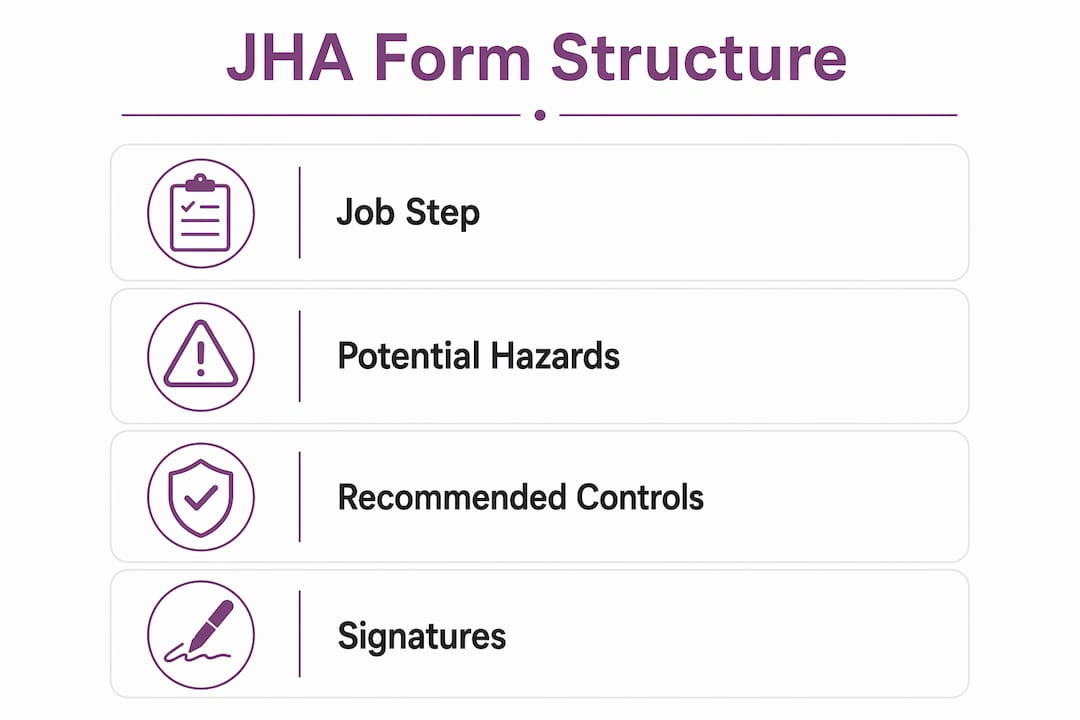
- Standard form approach: The form uses columns for job tasks, potential hazards, recommended controls, and a signature/date block for certification.
- Primary benefit: Catching hazards before an incident occurs, not after.
Table of Contents
- How a standard JHA form is structured
- Common workplace hazards you will document in JHA forms
- How JHA forms support training and compliance management
- Best practices for maintaining and communicating JHA forms
- Practical JHA form examples and templates
- Common mistakes that undermine JHA quality
- Key Takeaways
- Keep your JHA training records organized with Certicerts
How a standard JHA form is structured
Standard JHA templates follow a table format that walks through each job step systematically. The columns are not arbitrary. Each one forces the analyst to think through a specific dimension of the hazard.
| Column | What to capture | Example entry |
|---|---|---|
| Task / Job Step | A clear, sequential action verb phrase | “Lift 40-lb flour bag from pallet” |
| Potential Hazards | Specific trigger, exposure, and consequence | “Repetitive lifting causes lower back strain” |
| Recommended Controls | Concrete measures tied to the hierarchy of controls | “Use adjustable lift table; limit to two-person lifts” |
| Responsible Person | Who implements and verifies the control | “Bakery supervisor” |
| Signature / Date | Employee and supervisor certification | Signed after task-specific training |
The signature block is often underused. When both the worker and supervisor sign, it creates a documented record that training occurred, which is exactly what auditors and investigators look for. Oregon State University’s JHA form separates hazard identification from controls into distinct sections, which helps analysts avoid conflating the two.
Common workplace hazards you will document in JHA forms
NCSU’s occupational safety guidance and OSHA both group hazards into consistent categories. Knowing these categories before you start a JHA prevents gaps.
- Slips, trips, and falls: Wet floors, uneven surfaces, empty flour bags left underfoot, poor lighting in storage areas.
- Mechanical hazards: Pinch points on conveyor belts, rotating equipment that can catch loose clothing or hair, exposed grinding wheels.
- Chemical and toxic exposures: Airborne flour dust causing respiratory irritation or dermatitis, solvent vapors, caustic cleaning agents.
- Electrical hazards: Unguarded wiring, working near energized panels without lockout/tagout, wet environments near electrical equipment.
- Heat and temperature extremes: Burn risk near ovens or furnaces, cold stress in refrigerated storage areas.
- Ergonomic stresses: Repetitive lifting, awkward postures during machine loading, sustained overhead work.
- Falling objects: Unsecured materials on elevated shelves, overhead work without exclusion zones below. See the falling object hazard guide for controls specific to this category.
- Confined space hazards: Oxygen deficiency, toxic atmosphere, engulfment risk in tanks or pits.
- Noise and vibration: Sustained exposure above OSHA’s permissible limits during grinding or heavy equipment operation.
How JHA forms support training and compliance management
The JHA’s value extends well beyond the initial hazard identification. The U.S. Department of Labor identifies several functions that make the JHA a core compliance tool:
- Accident investigation: A completed JHA shows what controls were in place at the time of an incident, helping investigators determine whether the failure was procedural or behavioral.
- New employee onboarding: Walking a new hire through the JHA for their assigned tasks is one of the most efficient ways to deliver task-specific hazard training on day one.
- New equipment or process evaluation: Before introducing a new machine or workflow, completing a JHA forces a structured review of what new hazards are introduced.
- Retraining after incidents: When a near-miss or injury occurs, the JHA becomes the starting point for corrective action and updated training.
- Audit documentation: A library of signed, dated JHAs demonstrates a functioning safety management system to OSHA inspectors and third-party auditors.
- Compliance tracking: Organizations that link JHA completion to their training records can quickly identify which workers have been trained on which tasks, and when recertification is due.
Best practices for maintaining and communicating JHA forms
OSHA is explicit that a JHA is a living document. It requires review whenever a job changes, new equipment is introduced, an incident occurs, or a periodic review cycle is reached. Treating it as a one-and-done exercise is the single most common failure mode.

Frontline workers must be part of the development process. OSHA’s practitioner guidance is clear on this: workers who perform the job hold knowledge that supervisors and safety managers simply do not have. Their input improves both the accuracy of hazard identification and the practicality of the controls selected.
Hazard descriptions need specificity. Vague entries like “lifting hazard” tell workers nothing useful. A well-written description names the trigger (“manually lifting 40-lb bags unassisted”), the exposure (“repetitive stress on lumbar spine”), and the consequence (“lower back strain or disc injury”). That level of detail is what allows a targeted control to be designed.
Pro Tip: After updating a JHA, do not just file it. Brief the affected workers directly, have them sign the updated form, and log the training date. That three-step sequence is what turns a document update into a defensible compliance record.
Management sign-off matters beyond formality. When a supervisor reviews and approves a JHA, it signals organizational commitment to the controls listed. Workers are far more likely to follow controls that management has visibly endorsed. For deeper guidance on JHA best practices in 2026, the Certicerts blog covers the full review and approval cycle.
Practical JHA form examples and templates
The most useful way to understand a job safety analysis form is to see one filled out for a real task. The OSHA JHA Worksheet provides a bakery example that illustrates exactly how specific the documentation needs to be.
Bakery example: Loading flour into a mixer
| Step | Hazards | Controls |
|---|---|---|
| Employee manually lifts 40-lb flour bags from pallet | Repetitive motion, lower back strain (ergonomic) | Adjustable lift table; two-person lifts; frequent breaks |
| Employee pours flour bags into mixing machine | Flour dust inhalation; skin contact (dermatitis); pinch points near mixer opening | Lid for mixer; local exhaust ventilation; respirator; tight-fitting long sleeves and gloves |
| Employee drops empty bags on floor for later removal | Tripping hazard; secondary dust exposure when bags are collected | Waste container positioned near worker; reposition pallet to keep path to receptacle clear; routine housekeeping checks |
Metal shop example: Grinding iron castings
The OSHA sample form for grinding 15-lb iron castings shows three distinct hazard scenarios for a single task: dropping the casting onto a foot (controls: steel-toe shoes, staging castings on a table rather than lifting from a floor-level box), sharp burrs causing lacerations (controls: cut-resistant gloves, clamp device), and lower back strain from repetitive twisting lifts (controls: raise castings to waist height, train workers to avoid twisting).
Customizing a template for your industry means adjusting the task descriptions and hazard categories to match your actual operations. A construction site JHA for trench excavation will look nothing like a laboratory JHA for instrument preparation, but the column structure stays the same. The JHA form guide from Certicerts walks through customization for several industries, including manufacturing, construction, and general industry.
Common mistakes that undermine JHA quality
Even experienced safety teams make predictable errors when completing job hazard analysis forms.
Steps that are too broad or too narrow. “Operate the machine” is too broad to surface specific hazards. “Press the green start button” is too granular to be useful. The right level of detail captures a meaningful unit of work, such as “position workpiece against grinding wheel.”
Vague hazard descriptions. Writing “fall hazard” without specifying the trigger, the exposure, or the likely consequence produces controls that are equally vague. Specific descriptions drive specific controls.
Controls that are not actionable. “Be careful” and “use caution” are not controls. The Canadian Centre for Occupational Health and Safety recommends that every preventive measure describe both what action to take and how to perform it.
Skipping worker input. A JHA written entirely by a manager without consulting the workers who do the job will miss hazards that only become visible at the task level.
Never updating the form. A JHA written two years ago for a process that has since changed is worse than no JHA at all. It creates a false sense of coverage.
Failing to communicate findings. The side-by-side table format works well for documentation, but it is not ideal for training workers. Converting JHA findings into a narrative work procedure or a toolbox talk makes the content far more accessible.
Key Takeaways
A well-built JHA form is the foundation of both hazard prevention and defensible compliance documentation.
| Point | Details |
|---|---|
| Core form structure | Use four columns: job step, potential hazards, recommended controls, and signature/date. |
| Specificity in hazard descriptions | Name the trigger, exposure, and consequence for every hazard to enable targeted controls. |
| JHA as a living document | Review and update the form whenever tasks, equipment, or environments change. |
| Worker involvement is required | Frontline employees identify hazards that supervisors miss; their input improves accuracy and buy-in. |
| Link JHAs to training records | Signed, dated JHAs tied to employee training logs create the audit trail compliance managers need. |
Keep your JHA training records organized with Certicerts

Completing a JHA is only half the job. The other half is proving that workers were trained on it, tracking when recertification is due, and producing that documentation on demand during an audit. Certicerts is built for exactly that. Generate professional training certificates with QR verification, maintain a full training matrix across your workforce, and issue wallet cards that workers can carry as proof of completion. Start managing your compliance records with Certicerts and turn your JHA program into a fully documented, audit-ready system.