Hot Works Permit Template: Safety Manager’s 2026 Guide

A hot works permit template is a standardized authorization document that controls any work involving open flames, sparks, or heat sources to prevent fire and protect workers. Known formally as a hot work permit or hot work authorization form, this document is a mandatory administrative control under NFPA 51B and OSHA regulations. Without a properly completed permit, construction and industrial sites face serious fire risk, failed audits, and legal liability. A well-designed hot works permit template closes those gaps before work begins.
What should a hot works permit template include?
A compliant hot work permit template covers six core categories. Missing any one of them creates gaps that auditors and investigators will find.
Permit details form the foundation. Every authorization form must state the exact work location, the type of hot work being performed (welding, cutting, grinding, or torch work), and a clear validity window. Permit validity is limited to a single shift, typically 8–12 hours. No open-ended authorizations are acceptable, and work must stop the moment a permit expires.
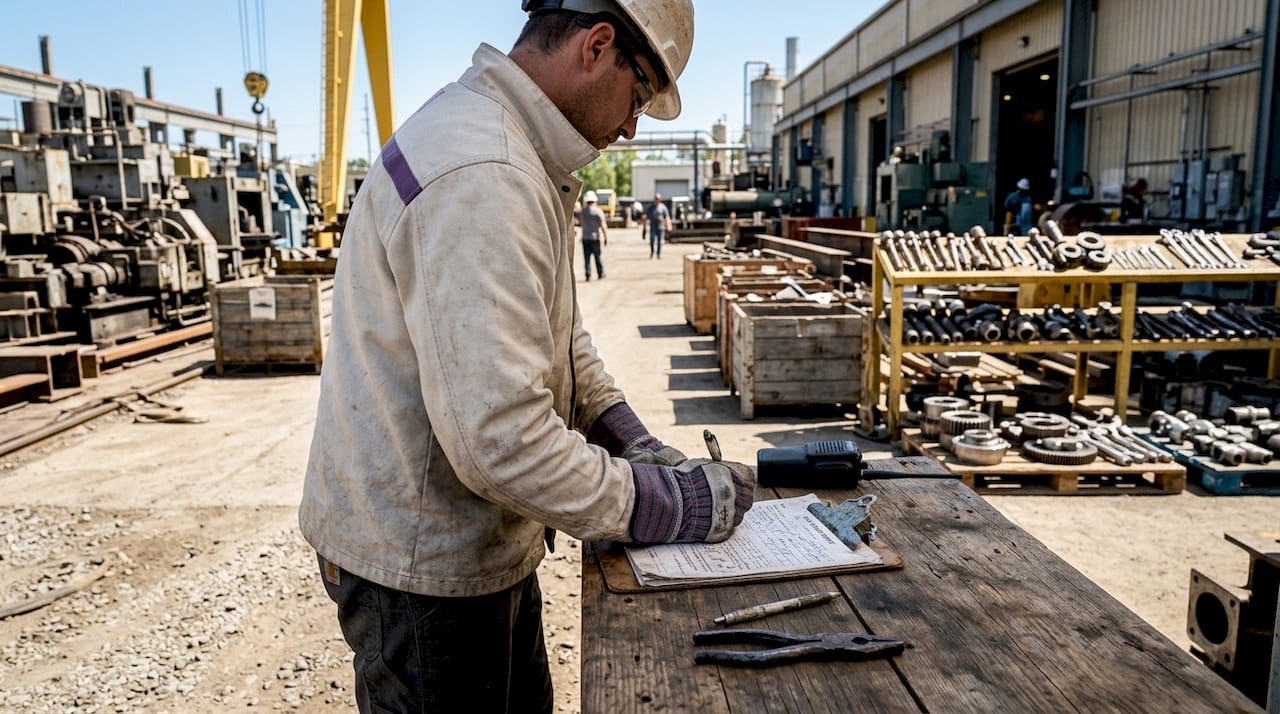
Hazard identification is the second category. The permit must document combustible materials in the area, flammable atmospheres, concealed spaces above or below the work zone, and any adjacent operations that could introduce ignition sources. This section forces the team to think before they strike an arc.
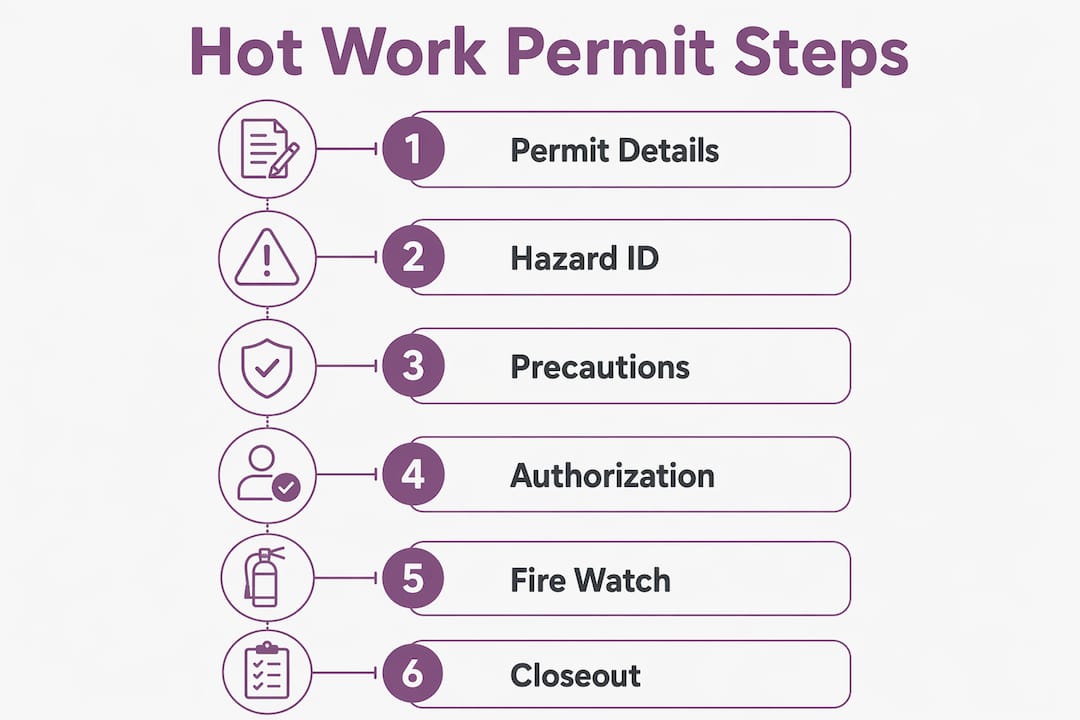
Precautions checklist translates hazard identification into physical actions. Fields here confirm that combustibles have been cleared or shielded, fire detection systems have been properly isolated, and fire extinguishing equipment is staged and ready at the work site.
Signatures and authorizations give the permit legal weight. Three signatures are typically required: the permit applicant (the worker performing hot work), the Permit Authorizing Individual (PAI) who inspects and approves the site, and the designated fire watch. Standardized permit templates improve audit pass rates precisely because mandatory signatures create clear accountability.
Fire watch documentation and close-out complete the form. Post-work fields record the time the fire watch began, the duration of monitoring, and the name of the person who confirmed the site was safe. These fields are not optional. They are the last line of defense against smoldering fires.
- Work location and permit validity window (8–12 hours maximum)
- Hazard identification: combustibles, flammable atmospheres, concealed spaces
- Precautions checklist: clearance, fire detection isolation, extinguisher readiness
- Three required signatures: applicant, PAI, and fire watch
- Post-work close-out: fire watch start time, duration, and site confirmation
Pro Tip: Add a “combined hazard” checkbox to your template. When hot work intersects with confined space entry or chemical exposure, a single permit rarely covers all required controls. A checkbox triggers the team to issue supplemental permits before work starts.
How to conduct site preparation and hazard controls for hot works
Site preparation is where most fire incidents are actually prevented. The permit template documents what was done, but the physical work happens before the first spark flies.
-
Apply the 35-foot clearance rule. The standard clearance radius for combustible materials around any hot work site is 35 feet. Remove combustibles entirely when possible. When removal is not possible, shield them with flame-retardant covers or welding blankets rated for the task.
-
Seal floor openings and wall penetrations. Sparks travel through gaps in floors, walls, and ceilings. Seal every opening within the work zone with fire-resistant material before work begins. Concealed spaces above drop ceilings are a frequent ignition point that safety managers overlook.
-
Manage fire detection systems carefully. Sparks can travel beyond 35 feet when falling from heights or carried by airflow. Smoke detectors must be disabled before work starts and reinstated immediately after. Leaving detectors active causes false alarms. Disabling them and forgetting to reinstate them creates undetected fire risk.
-
Stage fire extinguishing equipment at the work site. A fire extinguisher must be physically present at the point of work, not stored in a cabinet down the hall. Confirm it is the correct type for the materials involved and that it has been inspected within the required service interval.
-
Verify atmospheric conditions in hazardous areas. If the work zone is classified as a flammable or explosive atmosphere, continuous atmospheric monitoring is required throughout the operation. A single pre-work reading is not sufficient.
| Preparation step | Standard requirement | Common failure |
|---|---|---|
| Combustible clearance | 35-foot radius removal or shielding | Combustibles left in place with no shield |
| Floor and wall sealing | All penetrations sealed before work | Concealed spaces above ceilings ignored |
| Fire detection management | Disabled before work, reinstated after | Detectors left disabled post-work |
| Extinguisher staging | Present at point of work | Stored remotely, not at work site |
| Atmospheric monitoring | Continuous in classified areas | Single pre-work reading only |
Who authorizes and manages the hot work permit and fire watch?
Two roles carry legal and operational responsibility for every hot work permit: the Permit Authorizing Individual and the fire watch.
The PAI is the person with authority to inspect the site, approve the permit, and revoke it at any point. The PAI confirms that all precautions on the permit checklist are physically in place before signing. If site conditions change during work, the PAI has the authority and the obligation to stop the job. This role cannot be delegated to the worker performing the hot work.
The fire watch role is where many organizations fail audits and create serious safety gaps. Fire watch personnel have absolute authority to halt work immediately upon spotting any hazard. They must receive annual training covering fire suppression techniques and evacuation procedures. That training must be documented and current.
The fire watch must have no other duties during hot work operations. Assigning multiple tasks to fire watch personnel is a common audit failure and a direct safety hazard. Even a few seconds of distraction can allow a fire to escalate beyond control. A dedicated fire watch is not a luxury. It is a regulatory requirement.
- PAI must physically inspect the site before signing the permit
- PAI retains authority to revoke the permit if conditions change
- Fire watch must be dedicated with no other assigned duties
- Fire watch training must be renewed annually and documented
- Fire watch must be equipped with a fire extinguisher and communication device
- Fire watch authority to stop work is legally binding, not advisory
Pro Tip: Document the fire watch’s training certificate number directly on the permit form. Auditors frequently ask for proof of fire watch competency. Having the certificate reference on the permit itself saves significant time during inspections and demonstrates a mature safety management system.
How to properly issue, monitor, and close out a hot work permit
Issuing a permit correctly is as important as designing the template. A well-structured form filled out carelessly creates false confidence.
-
Issue the permit with a defined validity window. Write the exact start time and expiration time on the form. The permit must not span multiple shifts. If work continues into a second shift, a new permit must be issued with a fresh site inspection and new signatures.
-
Post the permit physically at the work site. Permits must be physically posted at the work location throughout the operation. A permit filed in an office binder does not satisfy this requirement. Any supervisor or inspector walking past should be able to read the active permit without asking for it.
-
Monitor continuously during work. The fire watch monitors the work zone throughout the operation, not just at the start. In classified atmospheres, atmospheric monitoring runs continuously. The fire watch logs any changes in conditions on the permit form in real time.
-
Conduct the post-work fire watch. A mandatory post-work fire watch of at least 60 minutes is required after hot work ends. This requirement exists because 15% of smoldering fires are detected after 45 minutes. The 60-minute minimum is the modern industry baseline, not a conservative suggestion.
-
Complete the close-out and reinstate protective systems. The fire watch signs the close-out section of the permit, recording the end time and confirming no fire hazards remain. Fire detection systems are reinstated immediately. The completed permit is retained as a compliance record.
Pro Tip: Set a phone alarm for the 60-minute fire watch period rather than relying on memory. Post-work is when attention drops. A physical timer keeps the fire watch accountable and gives you a documented timestamp if the close-out is ever questioned.
What are common mistakes when using hot works permit templates?
The most frequent errors in hot work permit management are predictable. Knowing them in advance is the fastest way to prevent them.
- Permit validity spanning multiple shifts. A single permit covering two shifts means the second shift starts without a fresh site inspection. Conditions change. A new permit requires a new inspection.
- Multitasking fire watch personnel. Assigning the fire watch to also assist with the work, answer radios, or manage other tasks is the single most common audit violation in hot work programs.
- Combustibles left in place without shielding. Teams frequently assume a quick job does not require full clearance. The 35-foot rule applies regardless of how short the work is expected to take.
- Fire detection systems left disabled. Detectors disabled before work and not reinstated after create a window of undetected fire risk that can extend hours beyond the job.
- Missing dual signatures. A permit signed only by the applicant, with no PAI signature, is not a valid authorization. Both signatures are required before work begins.
“The hot work permit is a critical communication tool that ensures all stakeholders understand the specific hazards present. Without it, normalization of deviance sets in, and teams begin treating high-risk operations as routine. That is when fires happen.”
Combining permits is another area where teams cut corners. When hot work occurs in a confined space or near chemical storage, a single hot work authorization form does not cover all required controls. Supplemental permits for confined space entry or chemical hazard management must be issued alongside the hot work permit. Using job hazard analysis tools during pre-work planning helps identify when combined permits are necessary.
Key Takeaways
A compliant hot works permit template requires defined validity windows, dedicated fire watch personnel, physical site posting, and a documented 60-minute post-work inspection to satisfy NFPA 51B and OSHA requirements.
| Point | Details |
|---|---|
| Permit validity limit | Issue permits for one shift only (8–12 hours); never allow open-ended or multi-shift authorizations. |
| 35-foot clearance rule | Remove or shield all combustibles within 35 feet before any hot work begins. |
| Dedicated fire watch | Assign fire watch personnel with no other duties and renew their training annually. |
| 60-minute post-work watch | Monitor the site for at least 60 minutes after work ends to catch smoldering fires. |
| Physical permit posting | Display the active permit at the work site throughout the operation, not in an office file. |
Why I think most sites underestimate the permit’s communication function
Safety managers spend a lot of time debating which template format to use. Landscape or portrait. Digital or paper. Checkboxes or free text. That debate misses the deeper point.
The permit is not primarily a filing document. It is a communication tool. When the PAI walks the site and signs the form, they are telling the crew: “I have looked at this specific location, at this specific time, and I confirm it is safe to proceed.” When the fire watch signs the close-out, they are telling the organization: “I watched this site for 60 minutes and found no hazard.” Those statements carry legal weight. They also carry moral weight.
The sites that treat permits as paperwork to be completed after the fact are the sites that end up in incident investigations. I have seen fire watch logs backdated, PAI signatures forged by the applicant, and close-out sections left blank because “nothing happened.” Nothing happened until it did.
Standardized digital permit templates reduce these failures because they enforce sequence. You cannot complete field five until field four is filled. You cannot submit without a second signature. The structure of the form becomes the enforcement mechanism. That is the real value of standardization, not the paper itself, but the discipline it creates.
The best safety managers I have worked with treat the hot work permit the same way a pilot treats a pre-flight checklist. Not as a formality. As the last thing standing between a normal day and a catastrophic one.
— James
Certicerts supports your hot work training compliance
Safety managers who run tight hot work programs know that the permit is only as strong as the training behind it. Fire watch personnel need documented annual training. PAIs need verified competency records. Auditors ask for both.

Certicerts gives safety managers a complete system for issuing, managing, and verifying training certificates for fire watch personnel, PAIs, and hot work operators. Every certificate includes offline QR verification, so auditors can confirm credentials on site without internet access. Wallet cards give workers proof of competency they can carry in the field. Visit Certicerts to see how the platform fits into your existing safety management program.
FAQ
What is a hot works permit template?
A hot works permit template is a standardized authorization form that documents hazard controls, site preparation, and required signatures before any work involving open flames, sparks, or heat begins. It is a mandatory administrative control under NFPA 51B and OSHA regulations.
How long is a hot work permit valid?
A hot work permit is valid for one shift only, typically 8–12 hours. Work must stop when the permit expires, and a new permit with a fresh site inspection is required for any continuation.
Who can authorize a hot work permit?
A Permit Authorizing Individual (PAI) must physically inspect the site and sign the permit before work begins. The PAI has authority to approve, modify, or revoke the permit at any point during the operation.
How long must the fire watch continue after hot work ends?
The fire watch must continue for a minimum of 60 minutes after hot work ends. This requirement exists because 15% of smoldering fires are not detected until after 45 minutes have passed.
Does a designated hot work area still require a permit?
Only areas with documented fire-safe designs qualify as permanent hot work zones that are exempt from per-job permits. All other locations require a permit every time, regardless of how frequently hot work is performed there.