RAMS Requirements: A Compliance Team’s Practical Guide

RAMS requirements are testable, auditable specifications that define what a system must achieve across four dimensions: Reliability, Availability, Maintainability, and Safety. For compliance teams, they are the foundation of any certification case. An auditor opening your requirements document expects to find named metrics like MTBF targets, an availability percentage, an MTTR figure, and a safety integrity level or PFD value, each tied to an acceptance criterion and a verification method.
The four elements each carry a distinct compliance function:
- Reliability: The system performs its required function without failure for a defined period or number of demands.
- Availability: The system is operational and accessible when needed, expressed as a percentage of scheduled operating time.
- Maintainability: Corrective and preventive maintenance can be completed within defined time and resource limits.
- Safety: The system does not cause harm to people, property, or the environment; quantified through SIL or PFD targets where required.
Pro Tip: Open every RAMS requirements artifact with a one-page summary table listing the MTBF target, availability %, MTTR target, and SIL/PFD. Auditors scan this first. If it is missing, the review stalls before it starts.
Table of Contents
- What do RAMS requirements actually measure?
- Why RAMS requirements matter and when to create them
- How do you write clear, testable RAMS requirements?
- What verification methods and standards back RAMS requirements?
- Who owns RAMS requirements, and what records do auditors expect?
- Common mistakes teams make with RAMS requirements
- Key Takeaways
- Where compliance teams should focus their RAMS effort
- Certicerts keeps your RAMS evidence audit-ready
- Useful sources and standards
What do RAMS requirements actually measure?
RAMS engineering defines what a system must achieve across its full lifecycle, from concept through decommissioning. Each element maps to a specific metric family.
| Metric | Element | What It Measures | Example Target |
|---|---|---|---|
| MTBF | Reliability | Mean time between failures | Low criticality system example targets a few thousand hours; high criticality systems require much longer intervals |
| Availability % | Availability | Operational uptime fraction | Targets range from about 95% for low-criticality systems to near 99.9% or higher for critical systems |
| MTTR | Maintainability | Mean time to restore function | Mean time to restore targets vary, with shorter times expected for higher criticality systems |
| SIL / PFD | Safety | Safety integrity level / probability of failure on demand | Safety integrity levels correspond to probability of failure on demand ranging from low to very low values |
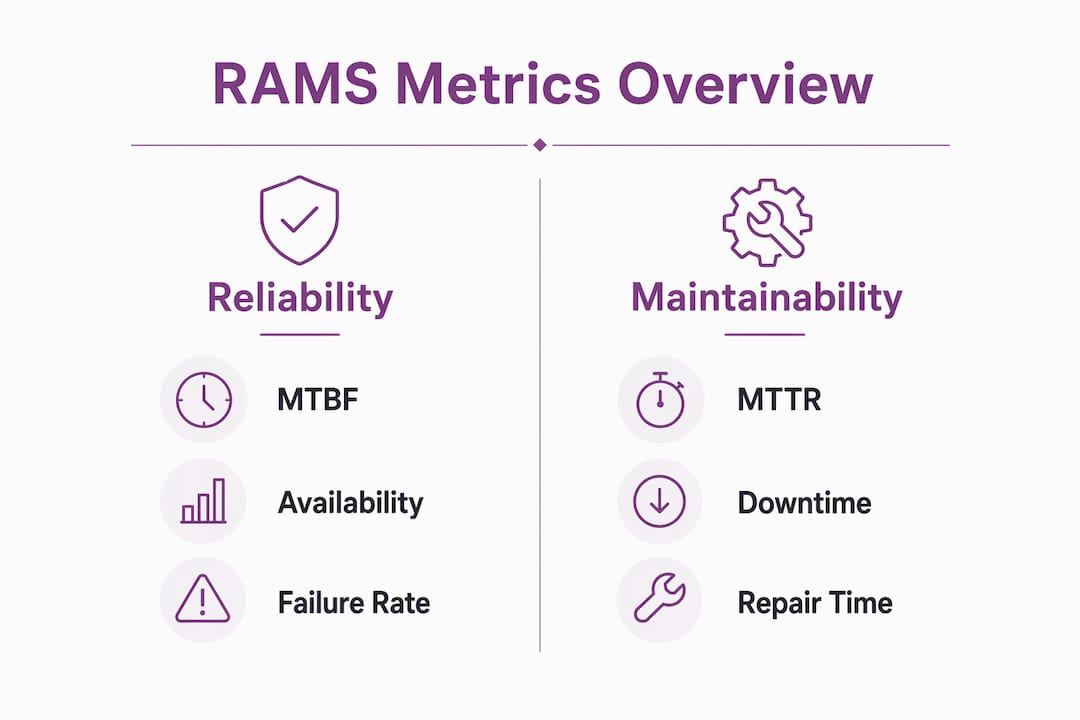
Choosing target values starts with consequence severity. A low-criticality utility system tolerates a 95% availability target; a rail signaling or process-safety system may require 99.9% or higher. Operational hours per year, maintenance crew availability, and spare-parts lead time all feed into realistic MTTR assumptions. When documenting maintainability, state the MTTR calculation method explicitly, including crew availability, access time, and spare-parts assumptions. Those assumptions are typically the first questions an auditor asks.
Why RAMS requirements matter and when to create them
Creating RAMS requirements late is the single most common reason certification programs slip. By the time a design is frozen, retrofitting measurable targets into a requirements document is expensive and often unconvincing to a certifier.
The right approach is to introduce RAMS requirements at concept stage and update them at each project gate:
- Concept: Draft overall RAMS targets; identify critical functions; produce a preliminary Functional Hazard Assessment (FHA).
- Preliminary design: Allocate targets to subsystems; begin FMEA; baseline the requirements document with stakeholder sign-off.
- Detailed design: Finalize acceptance criteria; complete FTA and reliability predictions; lock the requirement baseline for certification.
- Manufacturing/commissioning: Execute verification tests; collect test reports and maintenance trial data.
- Operations: Monitor operational data against targets; update maintenance logs; trigger recertification when thresholds are approached.
Minimum sign-off at the preliminary design gate should include the design authority, safety engineer, maintenance lead, and training manager. All four roles must agree that the targets are achievable before the baseline is locked.
Pro Tip: Lock the requirement baseline with a formal change-control process before detailed design begins. Any post-lock change requires a documented impact assessment. Auditors treat an unlocked baseline as evidence of an immature program.

How do you write clear, testable RAMS requirements?
Good RAMS requirements follow SMART criteria adapted for engineering: Specific (names the function and failure mode), Measurable (states the metric and numeric target), Achievable (grounded in operational data or industry benchmarks), Relevant (tied to a system function or hazard), and Time-bound (references the mission profile or operating period).
Sample requirement statements:
- Reliability: “The pump assembly shall achieve an MTBF of not less than 20,000 operating hours under the conditions defined in Mission Profile MP-01, verified by reliability prediction per MIL-HDBK-217 and confirmed by accelerated life test report ALT-001.”
- Availability: “The control system shall achieve operational availability of not less than 99.5% over any rolling 12-month period, measured against the downtime log maintained by the operations team.”
- Maintainability: “Corrective maintenance of any Line-Replaceable Unit shall be completed within 2 hours by a two-person crew with standard tooling, assuming spare parts are available on-site, verified by maintenance trial report MT-003.”
- Safety: “The emergency shutdown function shall meet SIL 2 per IEC 61511, with a PFD not exceeding 1×10⁻³, verified by quantitative FTA report FTA-ESD-01.”
Traceability example: Requirement REQ-AVAIL-003 (99.5% availability) maps to verification method VM-003 (operational data review), test/evidence artifact LOG-OPS-2025, maintenance procedure MP-12, and training record TR-OPS-07. That chain is what an auditor follows.
Requirement-writing checklist:
- State the function the requirement applies to.
- Name the metric and the numeric target.
- Reference the mission profile or operating conditions.
- Specify the acceptance criterion (pass/fail threshold).
- Identify the verification method (test, analysis, inspection, demonstration).
- Assign a unique requirement ID.
- Link to the subsystem or component responsible.
- Confirm a training or competency record exists for the verifying personnel.
What verification methods and standards back RAMS requirements?
Formal analysis methods are the backbone of any RAMS evidence pack. The core toolkit includes:
- FMEA (Failure Mode and Effects Analysis): Identifies failure modes at component level and their system-level effects; produces a ranked risk register.
- FTA (Fault Tree Analysis): Top-down logic model linking system-level failures to root causes; quantifies PFD for safety functions.
- Reliability prediction: Uses parts-count or stress-analysis methods (MIL-HDBK-217, FIDES) to estimate MTBF before testing.
- Accelerated life testing: Compresses operational time to validate reliability targets before deployment.
- Maintenance verification: Timed maintenance trials confirm MTTR targets under realistic conditions.
- Operational monitoring: Post-deployment data collection against MTBF, availability, and MTTR baselines.
Audit evidence to retain for each requirement:
- Signed test reports with pass/fail against acceptance criteria.
- Traceability matrix linking each requirement ID to its verification artifact.
- FMEA and FTA reports with revision history.
- Maintenance logs with timestamps and technician signatures.
- Training records and competency certificates for personnel who performed verification.
- Safety assessment artifacts: FHA, Common Cause Analysis (CCA), Zonal Safety Analysis.
For US projects, ARP 4761 provides a structured methodology for safety assessment of airborne systems, covering FMEA, FTA, and CCA. IEC 61508 and IEC 61511 govern functional safety in industrial and process sectors. Rail programs reference CENELEC EN 50126. Applicability depends on your sector; confirm the governing standard with your certifying authority before selecting methods.
Note that vendor compatibility checkers and Qualified Vendor Lists are useful point-in-time references for technical compatibility checks, but they do not substitute for formal RAMS verification methods.
Who owns RAMS requirements, and what records do auditors expect?
Role clarity prevents gaps. Each RAMS function needs a named owner:
| Role | Responsibility |
|---|---|
| Design Authority | Authors and approves system-level RAMS targets |
| Safety Engineer | Leads FHA, FMEA, FTA; owns safety case artifacts |
| Maintenance Lead | Validates MTTR assumptions; signs off maintenance trials |
| Training Manager | Maintains training matrix; links competency records to requirement IDs |
| QA / Compliance Officer | Manages traceability matrix; assembles audit packs |
A training matrix for RAMS verification personnel should capture at minimum: competency name, required training course, completion date, recertification interval, and the requirement IDs the competency supports.
| Competency | Required Training | Recert Interval | Requirement IDs |
|---|---|---|---|
| FMEA facilitation | FMEA Practitioner Course | 3 years | REQ-REL-001 to 001 |
| FTA analysis | FTA Fundamentals | 3 years | REQ-SAF-001 to 001 |
| Maintenance trial execution | Maintenance Procedures Cert | 2 years | REQ-MAINT-001 to 001 |
| Operational data review | Data Analysis for RAMS | 2 years | REQ-AVAIL-001 to 001 |
Auditors expect to see certificates, signed verification reports, maintenance logs, and a traceability matrix that links each record to a requirement ID. Records without that link create audit findings even when the underlying work was done correctly.
Pro Tip: Capture four metadata fields on every certificate: issue date, competency code, verifier name, and a direct link to the evidence artifact. That metadata turns a certificate into an audit-ready record rather than a standalone document.
Common mistakes teams make with RAMS requirements
The five pitfalls that generate the most audit findings:
- Vague language: “The system shall be reliable” is not a requirement. Every statement needs a metric and a target.
- Missing acceptance criteria: A requirement without a defined pass/fail threshold cannot be verified or closed.
- Poor traceability: Requirements that exist in isolation, with no link to a verification method or evidence artifact, leave auditors with nothing to follow.
- Late baseline lock: Freezing requirements after detailed design forces retroactive justification that rarely satisfies a certifier.
- Ignoring maintenance realities: MTTR targets set without input from the maintenance team are routinely missed in commissioning trials.
Best practices that consistently reduce audit risk: assign a unique ID to every requirement, include the verification method in the requirement statement itself, schedule verification activities at design gates rather than at the end, and align training completion to acceptance criteria milestones.
Pro Tip: Run a five-point pre-audit check the week before any certification review: (1) every requirement has a numeric target, (2) every requirement has a verification artifact, (3) every artifact is signed and dated, (4) every verifier has a current competency certificate, (5) the traceability matrix is complete and version-controlled. Gaps found here are far cheaper to fix than gaps found by the auditor.
Key Takeaways
Well-written RAMS requirements combine measurable targets, named verification methods, and complete traceability from requirement ID to training record, giving auditors a clear evidence chain at every project gate.
| Point | Details |
|---|---|
| Start with measurable targets | Every requirement needs a numeric metric (MTBF, availability %, MTTR, SIL/PFD) and an acceptance criterion. |
| Lock the baseline early | Freeze requirements before detailed design; post-lock changes require a documented impact assessment. |
| Build a traceability matrix | Link each requirement ID to its verification artifact, maintenance log, and training record. |
| Retain the right evidence | Keep signed test reports, FMEA/FTA reports, maintenance logs, and competency certificates as a linked set. |
| Certicerts for audit-ready records | Certicerts connects training certificates to requirement IDs, making the personnel-competency chain auditor-ready. |
Where compliance teams should focus their RAMS effort
Most compliance teams spread effort too thin across RAMS activities and then scramble on traceability in the final weeks before an audit. The evidence chain from requirement to training record is where audits are won or lost, and it is consistently the last thing teams build.
For the next 30 days, focus on one thing: confirm that every active requirement has a verification artifact assigned, even if the artifact is not yet complete. A placeholder with a due date and an owner is defensible. A blank cell is not. In the following 30 days, close the training gaps: identify every verifier whose competency certificate is expired or missing, and schedule recertification before the audit window. By day 90, the traceability matrix should be version-controlled and reviewed by the QA lead.
The pre-audit checklist in the pitfalls section above is the fastest way to find gaps. Run it monthly during an active certification program, not just the week before the review.
Certicerts keeps your RAMS evidence audit-ready
Compliance teams spend more time hunting for training records than they should. When a certifier asks for proof that the technician who signed off a maintenance trial held a current competency certificate on that date, the answer needs to come in seconds, not days.

Certicerts connects certificate issuance directly to your training matrix, so every competency record carries the metadata auditors need: issue date, competency code, verifier identity, and a QR-verified authenticity code that works offline. Bulk issuing handles large training events without manual data entry, and the compliance dashboard flags expiring certifications before they become audit findings. The result is a personnel-competency chain that links cleanly to your requirement IDs, reducing the administrative load of assembling an audit pack from hours to minutes. Start your free trial and see how the training matrix and audit-ready exports fit your RAMS program.
Useful sources and standards
Standards and references US compliance teams should consult when building RAMS requirements. Applicability varies by sector; confirm the governing standard with your certifying authority.
- IEC 61508 (functional safety of electrical/electronic/programmable electronic safety-related systems): the foundational SIL framework for industrial applications.
- IEC 61511: Process sector application of IEC 61508; governs safety instrumented systems.
- CENELEC EN 50126: Rail-sector RAMS standard covering the full lifecycle from concept to decommissioning.
- SAE ARP 4761: Structured safety assessment methodology for airborne systems; covers FMEA, FTA, and CCA.
- MIL-HDBK-217F: US military reliability prediction handbook; widely used for parts-count and stress-analysis reliability estimates.
- FIDES Guide: European reliability prediction methodology; increasingly used in defense and aerospace programs.
- FAA Advisory Circulars (AC 25.1309, AC 23.1309): Guidance on system safety assessment for civil aviation; references ARP 4761 methods.
- RAMS abbreviation context: For teams working across industries where RAMS means different things, a cross-industry reference helps clarify scope before drafting requirements.
For sector-specific regulatory obligations, consult the relevant US federal agency (FAA, NRC, PHMSA, or OSHA depending on your industry) or a qualified safety engineer. This article is general guidance, not legal or regulatory advice; confirm current requirements with the applicable primary source for your program.