Pre Task Plan: A Step-by-Step Guide for Team Leaders
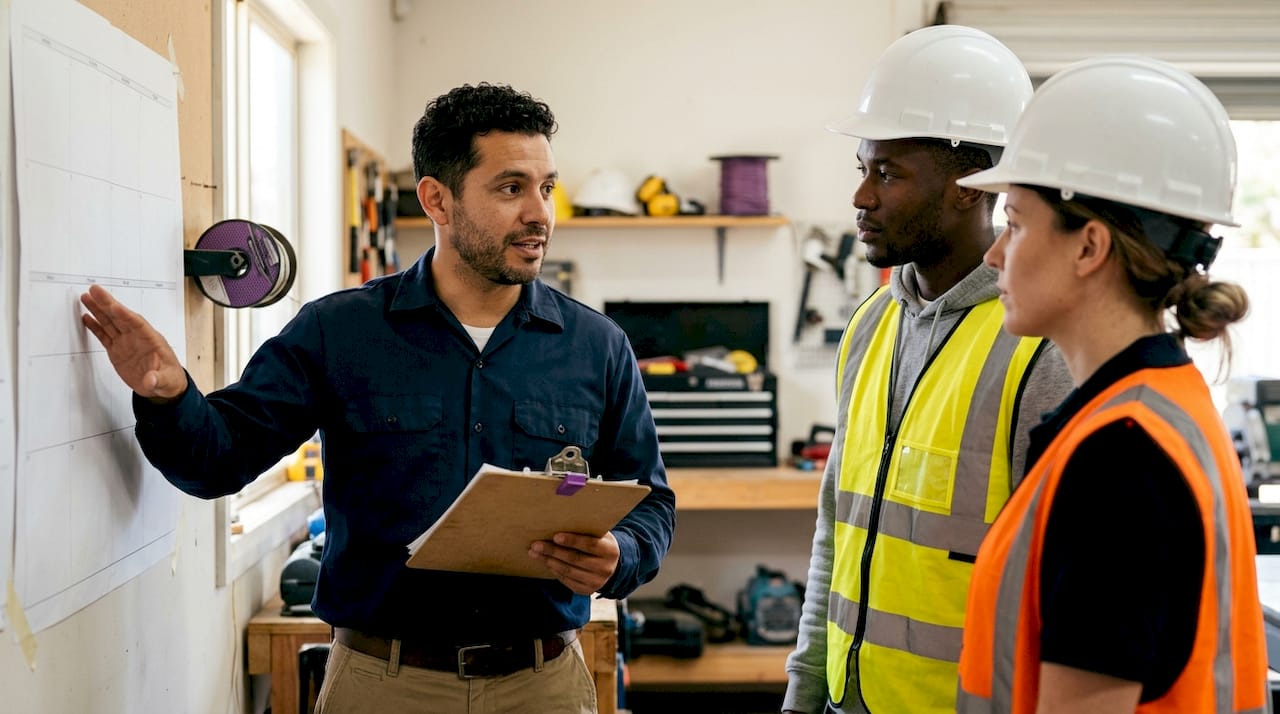
A pre task plan is a concise, task-specific safety process completed immediately before work begins to identify hazards and define controls that ensure safe, efficient project execution. Known formally as a Pre-Task Plan (PTP) or Pre-Task Safety Analysis, this process is a recognized standard in construction, manufacturing, and industrial project management. Regulators treat signed PTPs as evidence of due diligence in hazard identification and control implementation. The process takes 10–15 minutes and stays on site as a compliance record. For project managers and team leaders, mastering this process is the difference between a coordinated crew and a reactive one.
What are the essential components of a pre task plan?
A pre task plan works only when it is specific to the task at hand, not a generic form filled out by habit. Effective PTPs are condensed and focused, covering exactly what the crew will do that day, not the entire project scope. Vague plans produce vague behavior.
Every solid PTP contains five core components:
- Task definition: A clear, bounded description of the specific work being performed. “Install conduit on Level 3, east wall” beats “electrical work.”
- Hazard identification: A list of potential hazards tied to that specific task. Common categories include struck-by, fall, electrical, chemical exposure, and ergonomic risks.
- Risk assessment: A quick evaluation of the likelihood and severity of each hazard. This does not require a formal matrix. A simple high, medium, or low rating works.
- Control measures: Specific actions to eliminate or reduce each hazard, applied using the hierarchy of controls.
- Worker sign-off: Documented acknowledgment from every crew member that they understand the plan.
A project-level pre-planning checklist covers at least 20 items across Foundation, Resources, Execution, and Risk Control categories. That level of detail belongs at the project kickoff stage. A daily PTP draws from that foundation but narrows to today’s conditions.
Tools and formats for pre-task planning
The format you choose affects how well your team engages with the plan. Paper forms with checkboxes for common hazards and open fields for site-specific notes remain the most widely used format on active job sites. They require no connectivity and are fast to complete.
| Format | Best for | Key limitation |
|---|---|---|
| Paper checklist form | Field crews with no device access | No digital backup or audit trail |
| Excel or Word template | Office-based project managers | Requires printing or screen sharing |
| Entry-level field apps | Small teams needing digital records | May lack offline capability |
| Enterprise platforms | Large organizations with compliance reporting | Higher setup cost and training time |
Digital formats add an audit trail and make supervisor review faster. The right choice depends on your site conditions, crew size, and compliance requirements.
How to create a pre task plan step by step
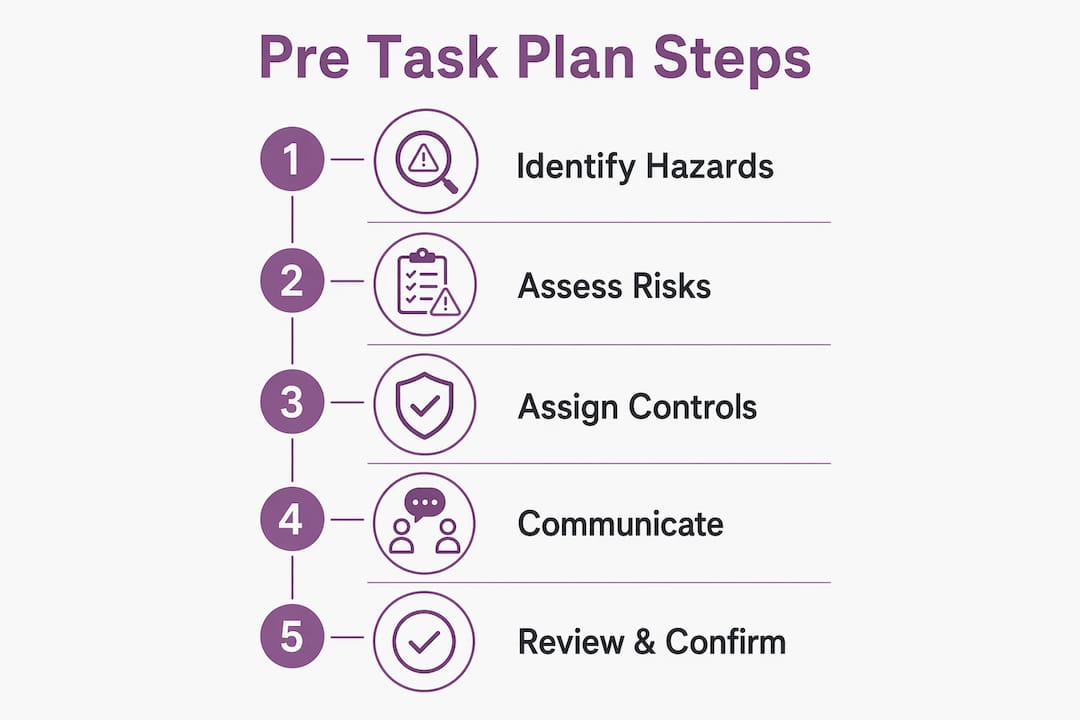
Building an effective PTP follows a repeatable five-step sequence. Each step takes only a few minutes when the team is engaged and the form is well designed.
- Define the task. Write one clear sentence describing exactly what work will happen, where, and with what equipment. Specificity here prevents scope creep during execution.
- Identify hazards. Ask the crew what could go wrong. Walk the work area if conditions have changed since the last shift. Common hazard categories include falling objects, electrical exposure, pinch points, and chemical contact.
- Assess the risk. Rate each hazard by severity and likelihood. A simple three-level scale (high, medium, low) is enough for a daily PTP. This step forces the team to prioritize, not just list.
- Apply controls. Work through the hierarchy of controls: elimination first, then substitution, engineering controls, administrative controls, and PPE last. Assign a specific control to each hazard. “Wear gloves” is not a control plan. “Install guardrail at open edge before work begins” is.
- Communicate and sign. Every crew member reads or hears the plan, asks questions, and signs. This step is not a formality. A plan signed without discussion is an ineffective compliance exercise.
The entire process should take 10–15 minutes. If your PTP consistently runs longer, the form is too complex or the task definition is too broad.
Pro Tip: Run the hazard identification step as a verbal round-table. Ask each crew member to name one hazard before writing anything down. This surfaces site-specific knowledge that supervisors often miss and turns passive sign-off into genuine participation.

The most common failure in this step is what field safety professionals call “pencil-whipping.” That is when workers sign a pre-filled form without reading it. The fix is not a longer form. The fix is a shorter, more specific one that takes less time to complete honestly than to fake.
How to integrate task breakdown into your planning process
Task breakdown is the practice of dividing a complex task into small, physical steps that any crew member can execute without ambiguity. It directly supports PTP execution by removing the gap between “we have a plan” and “we are following the plan.”
Limiting daily focus to 1–6 tasks with sub-steps that take under 2 minutes each improves follow-through by overcoming task inertia. That finding matters because most execution failures happen not from lack of knowledge but from the friction of starting.
Effective task breakdown for pre-task planning looks like this:
- Chunk by physical action. “Set up scaffolding” becomes “position base plates, insert frames, attach cross braces, install guardrails.” Each step is observable and verifiable.
- Sequence by dependency. Steps that must happen before others are listed first. This prevents crews from skipping ahead and creating hazards.
- Assign ownership. Name the person responsible for each step. Shared responsibility often means no responsibility.
- Set a time estimate. Even a rough estimate (5 minutes, 20 minutes) helps the crew pace the work and flag delays early.
Three task planning strategies support this process. The Ivy Lee Method prioritizes the six most critical tasks for the day and works through them in order. The Most Important Tasks (MIT) method identifies the two or three tasks that will have the greatest impact if completed. The Eisenhower Matrix sorts tasks by urgency and importance to prevent low-value work from crowding out high-value execution.
Pro Tip: Most failures in task breakdown come from confusing logical sub-tasks with actionable ones. “Prepare the work area” is logical but not actionable. “Remove debris from the 10-foot radius around the anchor point” is actionable. Write every sub-task as a physical action a person can start in the next 60 seconds.
The first physical action planned should take 2 minutes or less. This granular approach removes the mental barrier of starting and drives the crew into motion with confidence.
What are common pitfalls in pre-task planning and how to avoid them?
Pre-task planning fails in predictable ways. Recognizing these patterns early saves time and prevents incidents.
- Over-complexity. Plans that cover too many tasks or include abstract sub-steps create decision paralysis. Keep each PTP to one bounded task.
- Pencil-whipping. Workers sign without reading. This turns a safety tool into a liability document. Short, specific forms reduce this risk.
- Static plans. Using yesterday’s PTP for today’s work ignores changed conditions, new crew members, or different equipment. Every plan must reflect the current day.
- Unclear hazard controls. Listing a hazard without a specific control is incomplete. Every hazard needs a named action and a named owner.
- No supervisor follow-through. Supervisors must audit pre-task plans regularly and verify that controls are actually implemented on site. A plan filed in a binder and never checked is not a safety system.
“The goal of pre-task planning is to force imagination about potential failures and hazards before work starts, not to write lengthy documents. Genuine worker participation is the only meaningful metric of success, beyond signed paperwork.”
Reviewing your job hazard analysis practices alongside your PTP process helps close gaps between planning and execution. The two tools reinforce each other when used together consistently.
Key Takeaways
A pre task plan succeeds only when it is task-specific, completed in 10–15 minutes, grounded in the hierarchy of controls, and signed after genuine crew discussion.
| Point | Details |
|---|---|
| Keep it task-specific | Define one bounded task per plan to prevent scope creep and vague hazard identification. |
| Use the hierarchy of controls | Apply elimination before PPE; assign a specific control and owner to every hazard. |
| Break tasks into physical steps | Sub-tasks under 2 minutes each overcome execution inertia and drive follow-through. |
| Require genuine sign-off | A plan signed without discussion is a compliance exercise, not a safety tool. |
| Audit regularly | Supervisors must verify controls are implemented on site, not just documented on paper. |
Why I think most teams are doing pre-task planning backwards
Most project managers I have worked with treat the PTP as a documentation requirement. They design the form first, train workers to fill it out, and measure success by the percentage of completed forms. That is backwards.
The form is the output. The conversation is the product. When a supervisor walks the work area with the crew and asks “What could hurt you today?”, the answers that come back are worth more than any checklist. Workers on the tools see hazards that supervisors miss from the office. A crew member who helped identify a hazard is far more likely to respect the control than one who just signed a form.
The teams that get this right treat the 10–15 minute PTP window as a genuine briefing, not a paperwork sprint. They use simple forms that take less time to complete honestly than to fake. They rotate who leads the hazard identification discussion so that the process stays fresh and no single voice dominates.
The other thing most guides miss: task breakdown and pre-task planning are not separate processes. They are the same process at different scales. When you break a task into 2-minute physical steps, you are also identifying the moments where hazards are most likely to appear. The step where a crew member transitions from ground level to an elevated platform is exactly where a fall hazard control needs to be named and assigned.
Pre-task planning done well does not slow teams down. It speeds them up by removing ambiguity before work starts.
— James
Certicerts supports your safety documentation and compliance records
Training certificates and compliance records are the backbone of any safety program. When your team completes safety training tied to pre-task planning, fall protection, or hazard identification, that training needs to be documented, verifiable, and accessible on demand.

Certicerts is a professional certification management platform that generates training certificates and digital wallet cards with built-in QR verification. Auditors, clients, and supervisors can confirm credentials instantly, even offline. Every certificate includes expiry tracking and recertification reminders, so your compliance records stay current without manual follow-up. Explore Certicerts training certificates to see how the platform supports your safety documentation from initial training through renewal.
FAQ
What is a pre task plan?
A pre task plan is a short, task-specific safety document completed in 10–15 minutes before work begins. It identifies hazards, assigns controls, and requires crew sign-off to confirm understanding.
How long should a pre task plan take to complete?
An effective PTP takes 10–15 minutes. Plans that consistently run longer are either too broad in scope or too complex in format.
What is the hierarchy of controls in a pre task plan?
The hierarchy of controls runs from elimination, substitution, and engineering controls through administrative controls, with PPE as the last resort. Each hazard in the plan should be addressed at the highest feasible level.
What is pencil-whipping in pre-task planning?
Pencil-whipping is when workers sign a PTP without reading or discussing it. It turns a safety tool into a liability document and is best prevented by keeping forms short and running a verbal hazard discussion before sign-off.
How does task breakdown improve pre-task plan execution?
Breaking tasks into physical steps under 2 minutes each removes execution inertia and gives crew members clear, observable actions to follow. This directly reduces the gap between planning and doing.