WHMIS Training Record Requirements for Canadian Employers

Employers in Canada are legally responsible for providing WHMIS education and workplace-specific training, and for keeping records that show when, what, and who was trained. Where the federal regulation applies, records must be kept for two years after the employee stops handling or being exposed to the hazardous product. Provincial rules vary, so confirm your specific obligations with your local occupational health and safety authority.
TL;DR:
- Employers must keep detailed, workplace-specific WHMIS training records linked to each product and assessed understanding, retained for at least two years federally.
- Provincial rules vary, often requiring annual review and record retention periods that may be longer than the federal two-year minimum.
- Training should be verified through assessments and linked to SDS numbers, with records easily accessible and backed up digitally to facilitate inspections.
- Incomplete or lost records require proactive retraining and system reviews, avoiding reliance on vague certificates or scattered documentation.
- Using integrated record-keeping systems with QR verification and automated alerts improves compliance and streamlines audit preparation.
Table of Contents
- What Records Do WHMIS Training Requirements Actually Cover?
- What Laws Govern WHMIS Record Keeping in Canada?
- Who Needs WHMIS Training and What Must Employers Do?
- How Often Should WHMIS Training Be Reviewed?
- Best Practices for Storing and Managing WHMIS Records
- Preparing for a WHMIS Inspection: What to Have Ready
- Can Employees Access Their Own WHMIS Training Records?
- What If Your WHMIS Training Records Are Lost or Incomplete?
- Why Specificity in Records Prevents Compliance Findings
- A Record System Built Around This Exact Checklist
- Sources
What Records Do WHMIS Training Requirements Actually Cover?
A training record that survives an inspection needs more than a name and a date. It needs to prove that a specific worker learned specific things about the specific hazards in your workplace, not generic WHMIS theory pulled from a slideshow template.
Here’s what a defensible record should include:
- Employee name and position so the record ties to a specific person and role
- Employer/site name identifying where the training applies
- Course title and content summary, including which hazard classes and workplace-specific procedures were covered
- Date of training and, where applicable, the date of the last refresher
- Trainer name and qualifications, showing the instructor was competent to teach the material
- Assessment method and results, such as a quiz score or a signed sign-off from a practical demonstration
- Expiry or recertification date, if your internal policy sets one
- Links to relevant SDS numbers or product identifiers covered during the session
Acceptable proof takes different forms depending on how the training was delivered. A signed attendance sheet works for group sessions. A completed quiz or short written assessment works for comprehension checks. Dated training slides or a facilitator’s outline show what content was actually taught. For hands-on skills like using a spill kit or reading a label under GHS pictograms, a photo or supervisor sign-off documenting the demonstration carries real weight.
Each field matters for a reason beyond paperwork. The date range matters because it proves training happened before exposure, not after an incident. The trainer’s name matters because CCOHS’s guidance on WHMIS education and training draws a hard line between general education and workplace-specific training, and an inspector will ask who delivered the site-specific portion. The SDS links matter because they connect the record to the actual products your workers handle, not a generic hazard class.
Pro Tip: Don’t file assessment results separately from attendance records. Inspectors move faster, and so do you, when one document shows both that someone attended and that they demonstrated understanding.
What Laws Govern WHMIS Record Keeping in Canada?
WHMIS compliance obligations don’t come from one single national law. They come from a patchwork of federal and provincial regulations that overlap in intent but differ in specifics, and that patchwork is exactly why so many employers get record retention wrong.
At the federal level, Section 10.15 of the Canada Occupational Health and Safety Regulations applies to federally regulated workplaces (think banks, telecoms, interprovincial transportation) and requires employers to keep a paper or electronic record of the education and training given to every employee. That record must be retained for two years after the employee stops handling or being exposed to the hazardous product.
Provincial rules tell a different story. In Ontario, there’s no single statutory line that says “keep WHMIS records for X years.” Instead, Ontario’s WHMIS guidance explains that employers must ensure exposed workers receive instruction, and that training gets reviewed at least annually in consultation with the joint health and safety committee (JHSC) or a worker health and safety representative. Keeping records isn’t mandatory by statute in Ontario, but regulators and safety consultants consistently recommend it because a record is the only real evidence of due diligence if something goes wrong.
Other provinces add their own wrinkles. Some jurisdictions, including examples cited in CCOHS’s WHMIS program guidance, expect longer retention periods for safety data sheets, with Manitoba often cited as an example of extended SDS retention practice. That variation is exactly why a one-size-fits-all retention policy is risky.
Before you finalize a retention schedule, do two things: confirm the specific rule with your provincial or territorial OHS agency, and write down the reasoning behind whatever period you choose. If you’re navigating other provincial compliance obligations alongside WHMIS, resources like this Ontario designated substances survey guide can help you see how jurisdictional nuance plays out in adjacent compliance areas too.
Who Needs WHMIS Training and What Must Employers Do?
Any worker who works with, or may be exposed to, a hazardous product covered under WHMIS needs training, not just the people who handle chemicals directly. That includes maintenance staff who might open a cabinet during a repair, warehouse workers stacking drums they never open, and even office staff in a facility where hazardous products are stored nearby.
There’s a meaningful difference between WHMIS education and workplace-specific training, and conflating the two is one of the most common compliance gaps. Education covers the general system: how to read a label, how the pictograms work, how to interpret a safety data sheet. Training applies that knowledge to your actual workplace: where the SDS binder is kept, what to do if a specific solvent spills, which PPE is required for a specific task on your floor.
Employer duties break down into a few concrete actions:
- Develop a written WHMIS program that names both the education and training components
- Consult the JHSC or worker health and safety representative when building and reviewing the program
- Confirm trainer competence, whether that’s an internal supervisor or an outside instructor
- Verify worker understanding through assessment, not just attendance
CCOHS is explicit that every Canadian jurisdiction requires an employer-run education and training program. The specifics of delivery are flexible. The obligation to prove it happened, and that workers actually understood it, is not.
How Often Should WHMIS Training Be Reviewed?
Annual review isn’t optional in most jurisdictions, and it isn’t a rubber-stamp exercise either. Ontario’s OHSA framework requires that training and instruction be reviewed at least once a year, and that review has to happen in consultation with the JHSC or a worker representative, not unilaterally by management.
A handful of triggers should push you to retrain outside the normal annual cycle:
- A new hazardous product enters the workplace, requiring training on its specific SDS and handling procedures
- A process changes, such as a new mixing procedure or a different storage location
- An incident or near miss occurs, exposing a gap in existing training
- New hazard information becomes available, including SDS updates from suppliers
- New employees join, requiring both education and site-specific training before they’re exposed
Document the review itself, not just the retraining. Meeting minutes from the JHSC consultation, a dated log showing what changed in the program, and updated training records for anyone who received refresher instruction all belong in the same file. If you want a closer look at how consultation and documentation work together, this guide on JHA best practices for safety professionals walks through the mechanics of tying committee input to a documented review cycle.
Best Practices for Storing and Managing WHMIS Records
Where you store training records shapes how fast you can produce them and how likely they are to survive a hard drive failure or a filing cabinet fire. Each storage method comes with real trade-offs.
Paper records are simple and require no technology, but they’re vulnerable to loss, hard to search across multiple job sites, and awkward to hand a worker who wants a copy of their own certificate on short notice. A local electronic system, kept on a company computer or server, gives you searchability and backup options without depending on constant internet access. Some organizations move to a controlled cloud platform for multi-site visibility, which helps if you manage crews across several locations but does introduce dependence on connectivity and a third-party provider’s uptime.
A minimal record template should include employee name, employer/site, course title, date, trainer, content summary, assessment result, expiry date, and a reference to the specific SDS numbers covered. If you handle products by lot or batch, note the lot number too. If your training content changes over time, version your training modules so you can prove which version a given worker actually completed.
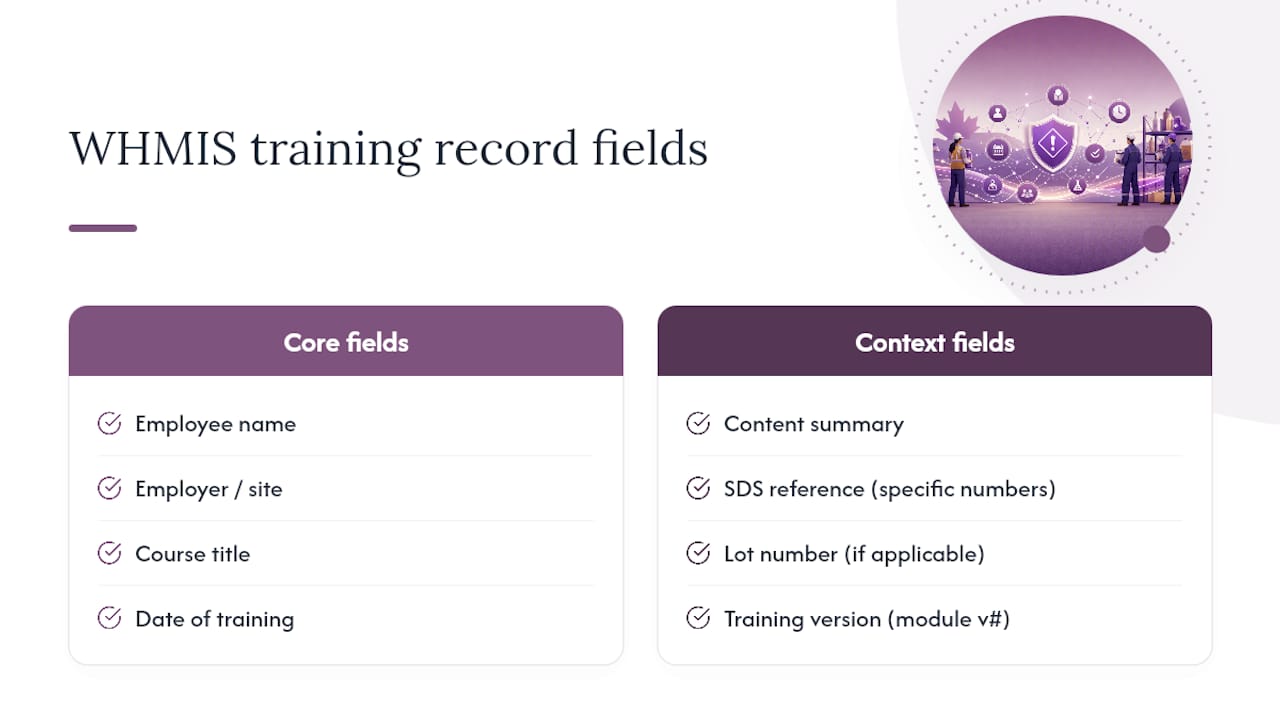
Linking training to your SDS library and inventory is where most organizations fall short. A record that says “WHMIS training completed” tells an inspector almost nothing. A record that says “training completed, covering SDS #4471 and #4502, with a signed practical demonstration on spill containment” is the kind of documentation that closes an inspection quickly instead of opening a follow-up investigation. Export options matter here too: being able to pull a clean, dated report for an auditor in minutes, rather than assembling one from scattered files, saves real time during a site visit.
Options like the job hazard analysis software comparison lay out how digital dashboards handle this kind of cross-referencing at scale.
Pro Tip: Write your retention policy down as a one-page document, even if your jurisdiction doesn’t legally require one. If an inspector asks why you keep records for three years instead of two, “here’s our written policy and the reasoning behind it” is a far stronger answer than a shrug.
Verifiable digital certificates, the kind that carry a QR code linking back to a central record, reduce the back-and-forth of manually cross-checking paper files during an audit. A dashboard that flags expiring certifications before they lapse does more for your compliance posture than any binder ever will.
Preparing for a WHMIS Inspection: What to Have Ready
Inspectors tend to ask for the same handful of things: attendance and assessment records, proof that SDS documents are accessible to workers, evidence that training was workplace-specific rather than generic, and minutes showing the annual review actually happened. According to WSPS guidance, these are the items most commonly requested during a site visit.
A few tactics make presentation faster:
- Keep an indexed binder or digital folder organized by employee, not scattered by date
- Maintain a searchable export you can generate on demand rather than assembling under pressure
- Use QR-verified certificates where a scan pulls up the full record instantly
Small fixes prevent most friction: label your SDS binder clearly, keep JHSC meeting minutes in the same file as training logs, and make sure whoever greets the inspector knows exactly where the records live.
Can Employees Access Their Own WHMIS Training Records?
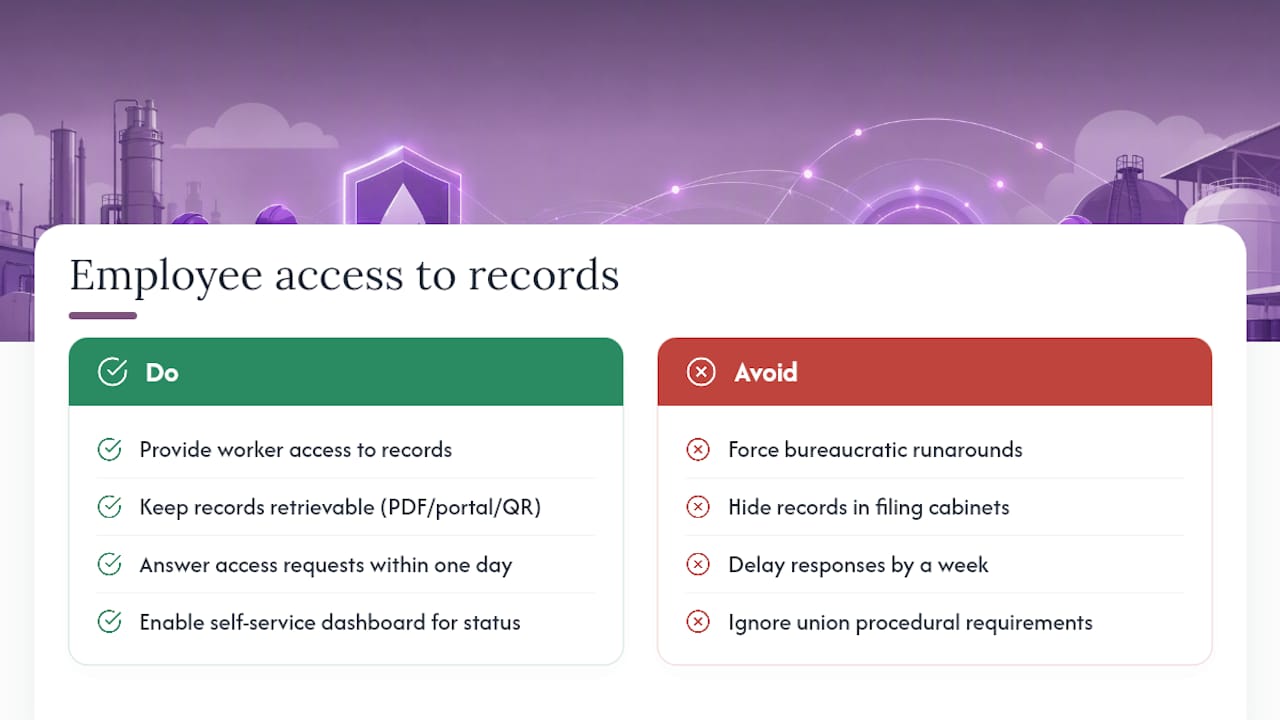
Workers have a reasonable expectation of access to their own training history, and most employers should treat that as standard practice rather than a special request. If a worker changes roles, applies for a new job, or simply wants proof of certification for their own files, they should be able to get a copy without a bureaucratic runaround.
Practically, this means keeping records in a format that’s easy to retrieve and hand over, whether that’s a printed certificate, a PDF, or a digital record accessible through a portal or QR code. A worker asking “when did I last complete WHMIS training?” should get an answer within a day, not a week of searching through filing cabinets.
There’s also a compliance upside to giving workers visibility into their own records. When employees can see their own expiry dates, they’re more likely to flag an upcoming lapse before it becomes a gap, which takes pressure off whoever manages your training calendar. Some organizations build this in through employee self-service access to a training dashboard, letting workers view their own certification status without needing to request it from HR every time.
If your workplace has unionized staff, check whether your collective agreement includes specific language about access to personnel or training records. That can add procedural requirements on top of the general good-practice expectation.
What If Your WHMIS Training Records Are Lost or Incomplete?
Missing records aren’t a dead end, but they do require a clear-eyed response rather than hoping the gap goes unnoticed. The first step is an honest audit: figure out exactly which employees, which time periods, and which training components are missing documentation.
For any worker whose training can’t be verified, the safest move is straightforward retraining. It costs time, but it’s far cheaper than trying to defend a gap during a formal investigation after an incident. Document the retraining thoroughly, including the reason for the retrain, so the new record stands on its own.
Where partial evidence exists, reconstruct what you can from secondary sources: email confirmations of session dates, sign-in sheets from related meetings, calendar invites, or even trainer notes. These won’t replace a proper record, but they can support a good-faith timeline if an inspector asks what happened.
Going forward, treat a records gap as a trigger for a systems review, not just a one-time fix. If paper records got lost in a move or a digital file got corrupted, that’s a signal your storage method needs a backup layer, whether that’s a second physical copy, a cloud backup, or a dedicated records platform. Update your written retention policy to reflect the new safeguard, and note the incident and the fix in your next annual review documentation.
Why Specificity in Records Prevents Compliance Findings
The failures I see aren’t dramatic. They’re generic certificates with no workplace-specific proof attached, no assessment evidence, nothing tying training to the SDS numbers actually in use. The fix is simple: tie every record to a specific product and a specific demonstration. A tool built for that kind of linkage, the way Certicerts approaches certificate and record management, makes the gap harder to leave open.
— James
A Record System Built Around This Exact Checklist
Everything covered above, the field list, the SDS links, the assessment evidence, points to the same conclusion: manual tracking across spreadsheets and paper files eventually breaks down, especially once you’re managing more than a handful of workers or multiple sites.
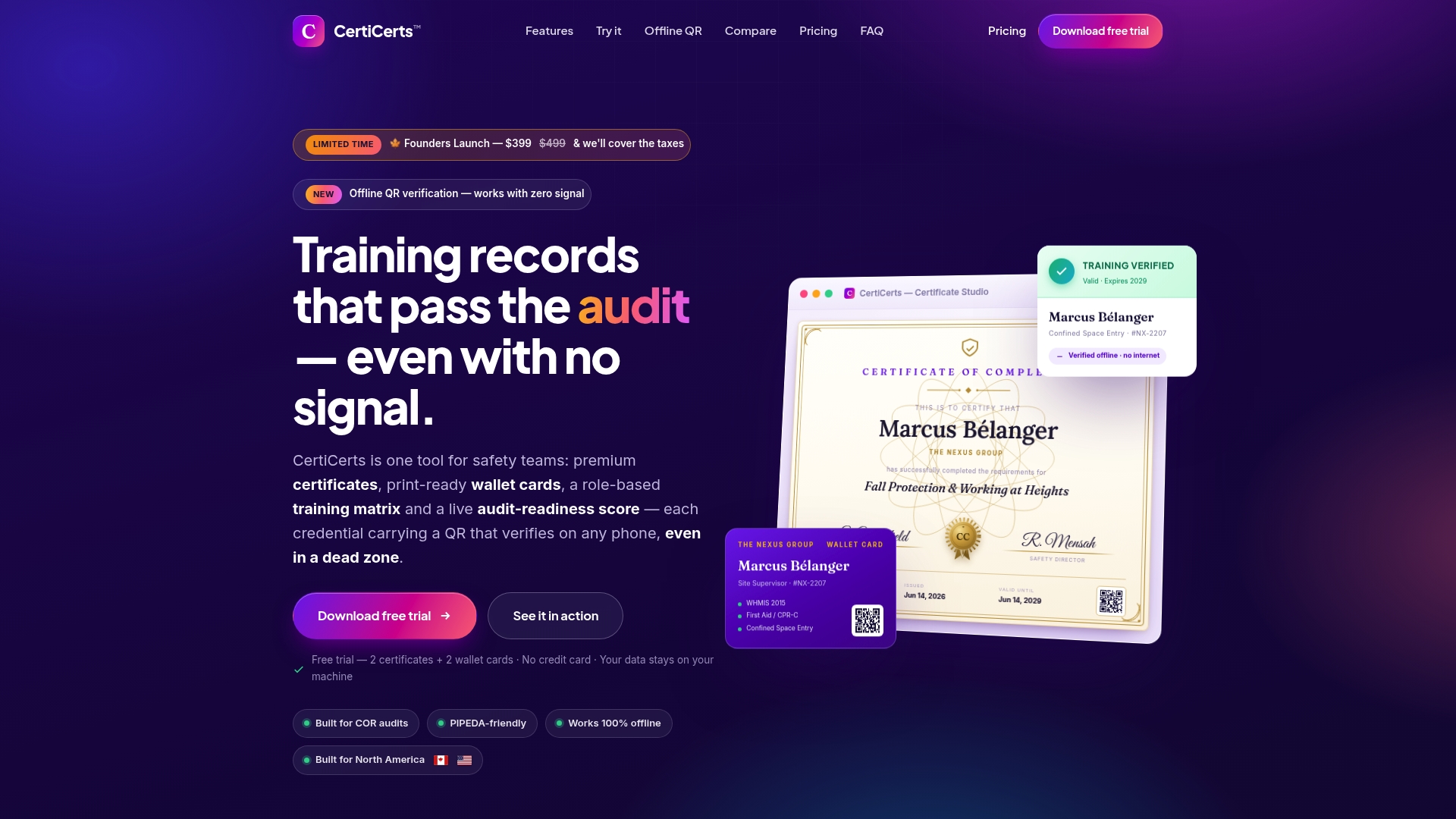
Certicerts was built around that exact checklist. Certificate templates capture the fields inspectors ask for: trainer name, course content, assessment results, expiry dates. Every certificate carries offline QR verification, so a worker or an inspector can confirm authenticity without needing an internet connection on site. The compliance dashboard flags expiring certifications before they lapse instead of after, and bulk issuing handles the logistics when you’re running a large training event and need dozens of certificates and wallet cards generated at once.
Safety teams also use it for audit exports, pulling a clean, dated report in minutes rather than assembling one from scattered files the night before an inspection. If your current system involves a shared folder and a prayer, try Certicerts with a free trial and see how the record structure holds up against your own compliance checklist.
Sources
- Canada Occupational Health and Safety Regulations — Section 10.15
- CCOHS — WHMIS: Education and training