RAMS Abbreviation: Meanings Across Every Industry

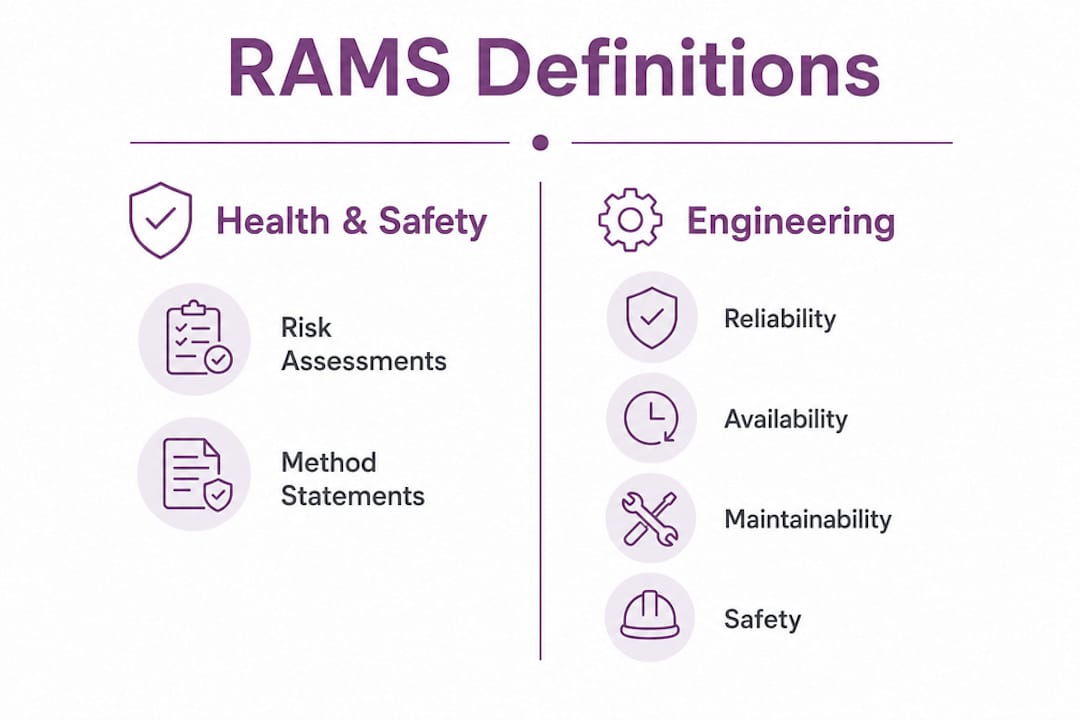
RAMS is defined as either “Risk Assessments and Method Statements” in health and safety contexts, or “Reliability, Availability, Maintainability, and Safety” in engineering and asset management. These two interpretations cover the vast majority of professional uses you will encounter. The rams abbreviation also appears in military, atmospheric science, and business contexts, each with distinct meanings. Knowing which definition applies requires reading the industry context first. This guide breaks down every major meaning, explains how each is applied in practice, and shows you how to avoid the most common mistakes professionals make when working with RAMS documentation.
What does RAMS stand for in health, safety, and construction?
RAMS in health, safety, and construction stands for Risk Assessments and Method Statements. These two documents work together as a combined package submitted before any high-risk work begins. Treating them as one document is the most common mistake professionals make, and it causes real compliance problems.
Risk assessment vs. method statement
A Risk Assessment identifies hazards present at a work site, evaluates the likelihood and severity of harm, and defines control measures to reduce that risk. It answers the question: what could go wrong, and how do we reduce that chance?
A Method Statement describes step-by-step how the work will be carried out safely, including equipment, personnel, and personal protective equipment (PPE). It answers the question: how exactly will we do this work without causing harm?
The two documents are distinct but inseparable. A Risk Assessment alone without a Method Statement leaves execution ambiguous. A Method Statement without risk justification lacks professional accountability. Together, they form what safety professionals call a Safe System of Work.
Why RAMS matter in construction and high-risk industries
Construction, demolition, electrical work, and confined space entry all require RAMS submission before work starts. Site managers and principal contractors use them to verify that subcontractors understand the hazards and have a credible plan to control them.
- Hazard identification: The Risk Assessment lists every foreseeable hazard, from falls and electrical exposure to chemical contact.
- Control hierarchy: Controls are ranked from elimination at the top to PPE at the bottom, following established safety hierarchies.
- Step-by-step procedure: The Method Statement sequences the work in a logical order, naming responsible personnel at each stage.
- Equipment and PPE: Both documents specify what tools, machinery, and protective gear are required.
- Emergency procedures: Method Statements include what to do if something goes wrong, covering evacuation routes and first aid contacts.
Failing to submit RAMS, or submitting generic documents, results in site access denial, project delays, and potential regulatory action. The job hazard analysis software options available in 2026 make it far easier to build site-specific documents rather than recycling templates.
Pro Tip: Never copy a RAMS document from a previous project and change only the date. Auditors and site managers recognize generic content immediately. Every document must reflect the specific site, task, and personnel involved.
How is RAMS used in reliability engineering and asset management?
RAMS in maintenance and engineering stands for Reliability, Availability, Maintainability, and Safety. This framework gives asset managers and maintenance engineers a structured way to measure and improve how physical assets perform over their operational life. It is widely used in manufacturing, rail, aerospace, utilities, and defense.

The four pillars of engineering RAMS
Each element of the framework addresses a different dimension of asset performance.
| RAMS Attribute | Definition | Operational Implication |
|---|---|---|
| Reliability | Probability an asset performs its function without failure over a given period | Drives decisions on component quality and redundancy planning |
| Availability | Percentage of time an asset is operational and ready for use | Directly affects production output and service continuity |
| Maintainability | Ease and speed with which an asset can be restored after a failure | Influences maintenance scheduling, spare parts inventory, and technician training |
| Safety | Freedom from conditions that can cause harm to people, property, or the environment | Integral to every maintenance decision, not an afterthought |
Reliability and Availability get the most attention in maintenance planning because they connect directly to uptime and revenue. Maintainability is often underestimated, yet it determines how quickly a team can recover from a failure. Safety, however, is the element that cannot be treated as optional. Ignoring safety within a RAMS strategy leads to long-term operational failures and significant liability exposure.
Applying RAMS in predictive maintenance
Predictive maintenance uses condition monitoring data, such as vibration analysis, thermal imaging, and oil analysis, to predict when an asset will fail before it does. RAMS provides the framework that tells engineers what level of reliability and availability is acceptable, and what safety thresholds must never be crossed.
High reliability and availability targets must be complemented by explicit safety integration. An asset that runs continuously but creates unsafe conditions for maintenance technicians is not a RAMS success. Construction safety management professionals face the same challenge: optimizing performance while keeping safety non-negotiable.
Pro Tip: When building a RAMS strategy for an asset, define your safety acceptance criteria first. Reliability and availability targets should be set within those safety boundaries, not the other way around.
What are other professional meanings of the RAMS acronym?
The RAMS acronym appears in several specialized fields beyond health and safety or engineering. Context determines meaning in every case, and assuming the wrong definition can cause real confusion in cross-sector communication.
Here are the most recognized niche uses of the acronym:
- Remote Activation Munitions System (RAMS): A military term referring to remotely triggered munitions used in defense and tactical operations. This meaning is specific to defense and armed forces contexts.
- Regional Atmospheric Modeling System (RAMS): A scientific computing model used in atmospheric research and meteorology to simulate weather patterns and climate behavior.
- Risk Analysis and Management System (RAMS): Used in project management and business risk contexts to describe frameworks for identifying, analyzing, and managing organizational risks.
- Rapid Application Management System (RAMS): Appears in some IT and software development environments as a label for project or application management tools.
- Los Angeles Rams: In sports, Rams refers to the NFL franchise. The team underwent a brand refresh ahead of the 2026 season, including logo simplification and uniform updates. This is the most widely recognized non-professional use of the term.
The practical takeaway is straightforward. When you encounter the RAMS acronym in a document, email, or conversation, identify the industry first. A defense contractor and a construction site manager are both using “RAMS” correctly, but they mean entirely different things.
How do you prepare RAMS documents that pass audits?
Effective RAMS documentation requires specificity, coordination between the two documents, and a clear understanding of what auditors and site managers actually check. Generic RAMS packages are the single most common reason for rejection.
- Identify the specific task and site. Every RAMS document must reference the exact location, the specific work activity, and the date range. A document that could apply to any site on any project will be rejected.
- List hazards relevant to this task only. Avoid copying hazard lists from unrelated projects. A roofing RAMS and an electrical installation RAMS share almost no hazards. Specificity signals competence.
- Match control measures to identified hazards. Each hazard in the Risk Assessment must have a corresponding control measure. Auditors check this alignment directly.
- Write the Method Statement in sequence. The step-by-step procedure must follow the actual order of work. If step three requires scaffolding to be in place, step two must confirm scaffolding erection.
- Name responsible personnel. Generic references to “the supervisor” or “the team” are not acceptable. Name the competent person responsible for each stage of the work.
- Cross-reference the two documents. The Method Statement should reference the Risk Assessment explicitly. This confirms they were written as a linked Safe System of Work, not as two separate documents that happen to share a cover page.
- Review and sign off before submission. Both documents require sign-off from a competent person. Unsigned RAMS are automatically non-compliant in most regulatory frameworks.
Misunderstanding RAMS as a single document instead of two distinct but linked documents causes audit failures and site access denials. The fix is simple: treat the Risk Assessment and Method Statement as partners, not as one merged form. Professionals who also manage JHA vs AHA documentation will recognize the same principle: each document type has a defined purpose, and blurring those boundaries creates compliance gaps.
Generic RAMS documents are frequently rejected by auditors and site managers. The consequence is not just a resubmission request. It can mean work stoppages, contract penalties, and in serious cases, regulatory investigation.
Key Takeaways
RAMS has two dominant professional meanings: Risk Assessments and Method Statements in safety, and Reliability, Availability, Maintainability, and Safety in engineering, and confusing the two or misapplying either creates compliance failures.
| Point | Details |
|---|---|
| Two primary RAMS definitions | Health and safety uses Risk Assessments and Method Statements; engineering uses Reliability, Availability, Maintainability, and Safety. |
| RAMS is two documents, not one | Risk Assessment and Method Statement are distinct but must be submitted together as a linked Safe System of Work. |
| Safety is non-negotiable in both | Whether in construction or asset management, the safety component of RAMS cannot be treated as secondary or optional. |
| Site-specific documents are required | Generic RAMS documentation is rejected by auditors; every document must reflect the specific task, site, and personnel. |
| Context determines meaning | In military, science, and business fields, RAMS carries entirely different meanings, so always confirm the industry before interpreting the acronym. |
Why the RAMS confusion problem is worse than most professionals admit
The two dominant RAMS definitions are so different that professionals from separate industries can use the same acronym in the same meeting and mean completely different things. I have seen this happen in cross-functional project teams where a safety manager and a maintenance engineer both referenced “the RAMS framework” and spent twenty minutes talking past each other.
What strikes me most is that both major definitions share a common thread: safety is the element that gets underweighted. In health and safety RAMS, the Method Statement often gets written carefully while the Risk Assessment becomes a checkbox exercise. In engineering RAMS, reliability and availability targets dominate planning while safety acceptance criteria get added at the end. Both approaches are backwards.
The professionals who get the most value from RAMS, in either sense, are the ones who treat safety as the constraint that shapes everything else. Reliability targets, work procedures, and maintenance schedules should all be built within safety boundaries, not adjusted to meet production pressure.
My honest view is that the abbreviation’s ambiguity is actually useful. It forces professionals to be explicit about which framework they mean, which in turn forces a conversation about context, industry, and intent. That conversation is almost always worth having.
— James
Certicerts supports your safety training and certification records
Safety professionals who work with RAMS documentation need more than well-written documents. They need verifiable proof that their teams hold the right qualifications before work begins.

Certicerts is a professional certification platform that lets organizations issue, manage, and verify training certificates and wallet cards with offline QR verification. Auditors and site managers can confirm credentials instantly, without needing internet access. For teams managing RAMS compliance across multiple sites or contractors, Certicerts removes the friction from proving workforce qualifications. Explore Certicerts to see how certificate generation, training records, and compliance tracking work together in one place.
FAQ
What does RAMS stand for in health and safety?
RAMS stands for Risk Assessments and Method Statements. These two documents are submitted together before high-risk work begins to identify hazards and outline safe work procedures.
What does RAMS mean in engineering and maintenance?
In engineering and asset management, RAMS stands for Reliability, Availability, Maintainability, and Safety. The framework is used to measure and improve how physical assets perform over their operational life.
Are RAMS one document or two?
RAMS are two separate but linked documents. The Risk Assessment identifies hazards and controls, while the Method Statement describes the step-by-step safe work procedure. Treating them as one document causes audit failures.
Why do generic RAMS documents get rejected?
Generic RAMS documents are rejected because they do not reflect the specific site, task, or personnel involved. Auditors require site-specific content that demonstrates the preparer understands the actual hazards present.
What are other meanings of the RAMS acronym?
RAMS also stands for Remote Activation Munitions System in military contexts, Regional Atmospheric Modeling System in atmospheric science, and Risk Analysis and Management System in business risk management. The correct meaning always depends on the industry context.