Falling Object Hazard: A Safety Professional’s 2026 Guide

A falling object hazard is any unsecured item at elevation that can fall and strike personnel or equipment below, and it represents one of the most preventable causes of workplace fatalities in industrial and construction settings. The industry term for this category of risk is “dropped object,” and the distinction matters: not every dropped object falls from a crane or scaffold. Most drops originate from routine tasks at modest heights. Falling objects cause over 50,000 struck-by incidents annually on construction sites alone, with 237 fatalities recorded in 2026 data. That number reflects a hazard that safety professionals can directly control with the right systems in place.
What are the common sources of falling object hazards at work?
Dropped objects fall into two categories: static drops and dynamic drops. A static drop occurs when an object at rest loses its support and falls. A dynamic drop happens when an object in motion becomes uncontrolled, such as a tool slipping from a worker’s grip mid-swing. Static drops are the dominant cause of dropped object incidents, not crane failures or dramatic structural collapses.
Common sources include:
- Hand tools left on elevated surfaces or unsecured in tool bags
- Fasteners, bolts, and small components that roll off edges during assembly
- Construction materials such as lumber, pipe sections, and steel fittings stored on scaffolds
- Debris generated by cutting, grinding, or demolition at height
- Equipment parts that detach during maintenance on elevated machinery
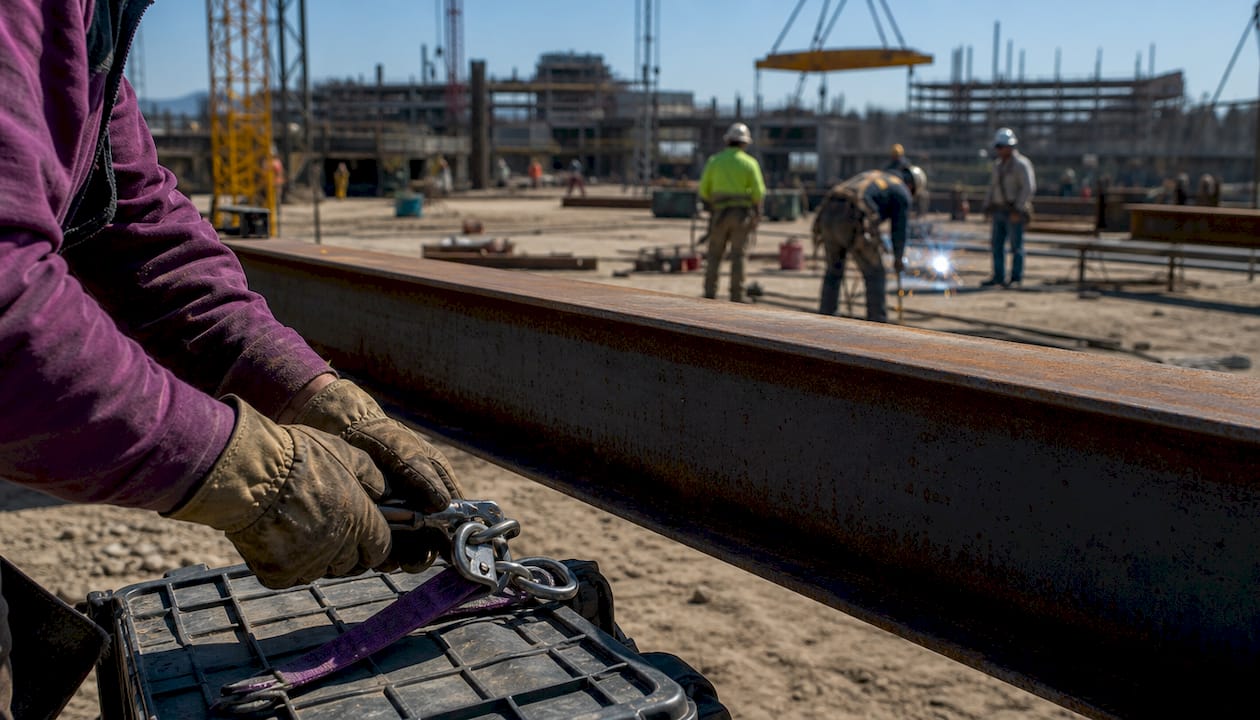
Work environments with the highest exposure include scaffolding, cranes, aerial work platforms, steel erection sites, and offshore platforms. The risk is not limited to construction. Manufacturing facilities with mezzanines, warehouses with racking systems, and facilities undergoing maintenance all generate significant object drop safety concerns.
Pro Tip: Small objects are not small risks. A 1 kg object dropped from 5 meters generates enough kinetic energy to be fatal. A 500g wrench dropped from a scaffold at 10 meters carries more impact energy than most safety managers intuitively expect.
The physics of height and mass combine in ways that consistently surprise teams new to dropped object prevention. A bolt that causes no harm when dropped on a bench can kill when dropped from a rooftop. That gap between intuition and reality is where most programs fail.
How is the risk from falling objects measured and classified?
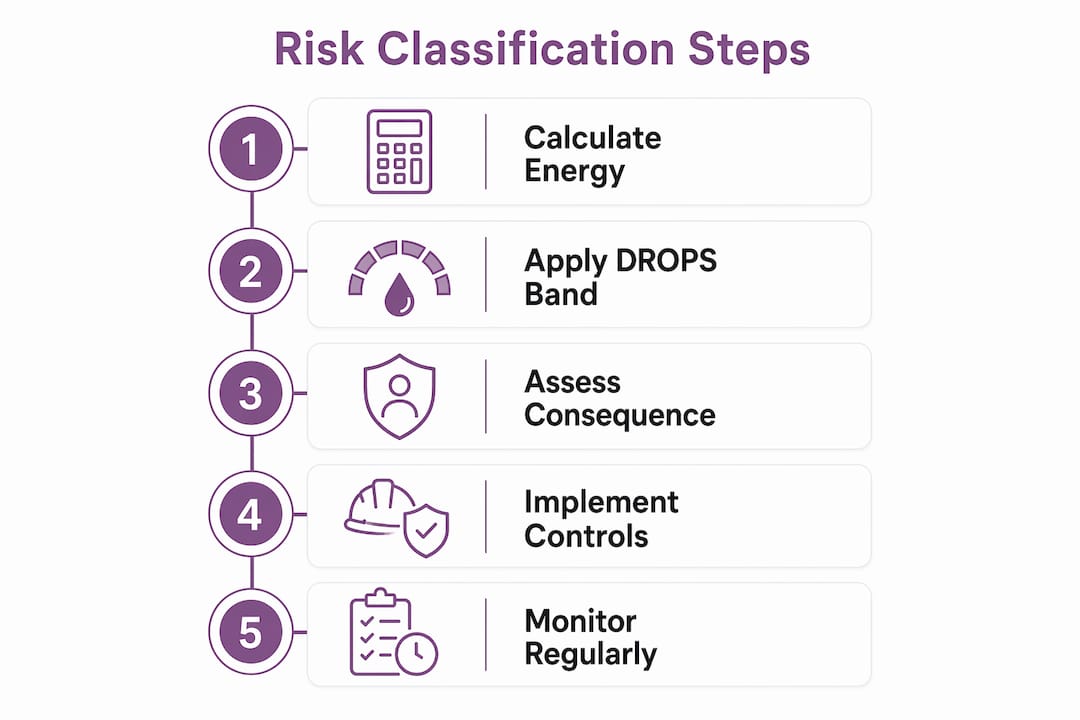
The DROPS Forum provides the most widely used framework for quantifying dropped object risk. It uses kinetic energy, calculated as mass multiplied by height multiplied by gravitational acceleration (9.81 m/s²), to assign consequence bands to any potential drop scenario.
The DROPS consequence bands are:
- Low: below 40 joules. Likely to cause minor injury or no injury.
- Medium: 40–100 joules. Potential for serious injury.
- High: 100–500 joules. High probability of severe or life-altering injury.
- Fatal: above 500 joules. Expected to cause death on impact.
The DROPS Calculator applies this formula to specific objects and drop heights, producing a consequence band that guides the selection of controls. Safety professionals use it during pre-job hazard assessments to classify each potential drop scenario before work begins.
| Object | Mass | Drop height | Approximate energy | DROPS band |
|---|---|---|---|---|
| Small bolt | 0.1 kg | 10 m | ~10 J | Low |
| Hammer | 0.8 kg | 5 m | ~39 J | Low/Medium boundary |
| Wrench | 0.5 kg | 15 m | ~74 J | Medium |
| Pipe section | 2 kg | 10 m | ~196 J | High |
| Steel fitting | 5 kg | 15 m | ~736 J | Fatal |
The 49-joule threshold is widely cited as the energy level at which a head strike becomes potentially fatal, depending on PPE worn. This table makes clear that even mid-weight tools dropped from moderate heights cross into dangerous territory quickly.
What are the current regulatory requirements for falling object protection?
OSHA regulations trigger falling object protection requirements based on exposure to overhead work, not on a fixed height threshold the way fall protection rules do. Falling object protection regulations are site-specific and activate whenever workers below face a credible risk from items above.
Key requirements include:
- OSHA 1910.29(k): Toeboards must be at least 3.5 inches high, maintain no more than 0.25 inches of clearance from the walking surface, and withstand 50 pounds of force without failure.
- Scaffold standards: OSHA requires overhead protection for workers below scaffolding when tools or materials are present at elevation.
- Steel erection provisions: Specific OSHA rules govern falling object controls during structural steel work, including the use of nets and barricades.
- ANSI and DROPS standards: Tool tethering systems must carry rated attachment points and meet documented weight safety factors. Lanyards have weight limits and expiration dates that require tracking.
Pro Tip: Tool tethers are not a substitute for elimination or engineering controls. Secondary retention is mandatory only when primary securing is already in place. Relying on a lanyard as the sole control is a compliance gap and a genuine risk.
Drop zones and exclusion zones are administrative controls that complement physical barriers. A drop zone is a designated area where objects may fall during controlled operations. An exclusion zone prohibits personnel from entering areas below elevated work. Both require physical demarcation, signage, and active enforcement. Auditing these controls at shift start and after any site disturbance is a regulatory expectation, not just a best practice.
What are effective strategies to prevent falling objects on worksites?
A layered approach to object drop safety follows the hierarchy of controls: eliminate the hazard first, then engineer it out, then manage it administratively, and use PPE last.
-
Conduct pre-job hazard assessments. Pre-job hazard assessments systematically identify drop risks, personnel exposure zones, and appropriate controls before any elevated work begins. Use a structured job hazard analysis process to document each potential drop source and assign a DROPS consequence band.
-
Apply engineering controls first. Toeboards, debris nets, tool pouches with retention lanyards, and secondary attachment points on all tools used at height are the first line of defense. Secure all materials before work begins. Never leave tools resting on surfaces without positive retention.
-
Enforce administrative controls. Maintain a tool inventory for every elevated work session. Require workers to account for every item taken to height before descending. Enforce exclusion zones with physical barriers, not just verbal instruction. Conduct drop zone briefings at every shift start.
-
Integrate PPE as the last layer. Hard hats rated to ANSI Z89.1, safety glasses, and steel-toed footwear reduce injury severity when controls above them fail. OSHA prioritizes engineering and administrative controls over PPE as primary defenses. PPE does not prevent a drop. It only limits the consequence.
-
Capture and investigate all no-harm drops. No-harm drops are leading indicators of program weaknesses. A tool that falls and misses everyone today reveals a control failure that will eventually cause harm. Require reporting of every drop, regardless of outcome.
Pro Tip: Procedural drift is the most common failure mode in mature programs. Teams that have worked safely for months begin skipping steps because nothing bad has happened. Build stop-work authority into your program so any worker can halt elevated operations when a control is missing or compromised.
Common pitfalls include false confidence in tethering, non-compliance with exclusion zones, and failure to inspect tool lanyards for wear or expiration. A lanyard that has exceeded its rated load or passed its service date provides no protection. Tracking these details manually across a large workforce is where most programs break down.
How to maintain and audit a falling object prevention program
Sustained prevention requires more than initial setup. Programs degrade without active monitoring, periodic audits, and a culture that treats every drop as a signal worth investigating.
Effective maintenance practices include:
- Color-coded DROPS inspection tags on all tools and tethering equipment, rotated on a defined schedule to confirm recent inspection
- Shift-start audits of toeboards, barricades, and exclusion zone integrity before elevated work resumes
- Tool lanyard condition checks covering load rating, expiration date, and physical wear at every inspection cycle
- Incident reporting systems that capture no-harm drops with the same rigor as injury events
- Leadership walkthroughs where supervisors and managers visibly enforce stop-work authority and reinforce expectations
Routine inspection of barricades, toeboards, and tool lanyards is necessary to prevent procedural drift and maintain control effectiveness. Auditing after any site disturbance, such as a weather event, equipment repositioning, or crew change, catches degraded controls before they contribute to an incident.
Digital tools for construction safety management help safety professionals track inspection records, flag overdue audits, and generate compliance reports for management and regulators. Paper-based systems struggle to keep pace with the volume of data a serious dropped object program generates.
Pro Tip: Reporting and analyzing no-harm drops strengthens safety culture and prevents the normalization of risk. Teams that treat near misses as non-events are the ones that eventually experience fatalities. Make reporting easy, make it expected, and make it visibly valued by leadership.
Leadership behavior is the single strongest predictor of program effectiveness. When managers stop work for a missing toeboard and explain why, workers internalize the standard. When managers walk past a violation, the standard disappears.
Key Takeaways
Effective dropped object prevention requires layered controls, consistent auditing, and a culture that treats every drop as a failure worth investigating.
| Point | Details |
|---|---|
| Define the hazard precisely | A falling object hazard is any unsecured elevated item; static drops cause more incidents than dynamic ones. |
| Quantify risk with DROPS | Use kinetic energy bands to classify each scenario and select controls proportionate to consequence. |
| Meet OSHA requirements | Toeboards, tethering, exclusion zones, and overhead protection are regulatory requirements, not optional additions. |
| Layer your controls | Engineering controls come first; PPE is the last line of defense, not the primary one. |
| Investigate every drop | No-harm drops are leading indicators. Capture, report, and analyze them to prevent future injuries. |
What most programs get wrong about dropped object prevention
The most consistent mistake I see in mature safety programs is treating tool tethering as a complete solution. Teams invest in quality lanyards, train workers on attachment points, and then stop there. The problem is that tethering is a secondary retention system. It only works when primary securing has already failed. If the primary control is a worker’s grip on a hammer, and the secondary control is a lanyard, the program has skipped the engineering step entirely.
The second mistake is underestimating small tools. A 300-gram utility knife dropped from 8 meters sits squarely in the medium DROPS band. Most safety managers would not flag that scenario as high priority. The physics disagree. I have seen programs with excellent large-tool protocols and almost no controls on fasteners, small hand tools, and personal items like phones and glasses. Those gaps produce incidents.
The third mistake is treating no-harm drops as non-events. Every drop that misses a worker is a data point. It tells you exactly where your controls failed and exactly where the next incident will occur if you do not act. Programs that investigate near misses with the same rigor as injuries consistently outperform those that do not. The data on this is unambiguous, and the logic is simple: the hazard was present. The outcome was luck.
Build a culture where workers report drops without fear of blame. Make the investigation process fast and visible. Show workers that reports lead to changes. That feedback loop is what separates programs that improve from programs that stagnate.
— James
Certicerts supports your falling object safety training
Documenting worker training on dropped object prevention is as critical as the training itself. Auditors, clients, and regulators expect verifiable proof that your team has completed the required competency programs.

Certicerts gives safety managers a direct way to issue, track, and verify training certificates for every worker in their program. Certificates include offline QR verification, so credentials can be confirmed on any job site without an internet connection. Wallet cards give workers a portable record of their qualifications. The compliance dashboard flags expiring certifications before they become audit findings. For teams managing training certifications and records across large workforces, Certicerts removes the administrative burden and keeps compliance documentation audit-ready at all times.
FAQ
What is a falling object hazard?
A falling object hazard is any unsecured item at elevation that can fall and strike workers or equipment below. The industry term is “dropped object,” and it covers both static drops and dynamic drops across all work environments with elevated operations.
How do you calculate the risk from a dropped object?
Risk is calculated using kinetic energy: mass multiplied by height multiplied by 9.81 m/s². The DROPS Forum classifies results into four consequence bands, from below 40 joules (low) to above 500 joules (fatal), to guide control selection.
What does OSHA require for falling object protection?
OSHA 1910.29(k) requires toeboards at least 3.5 inches high with no more than 0.25 inches of clearance, capable of withstanding 50 pounds of force. Additional scaffold and steel erection standards require overhead protection, exclusion zones, and tool tethering where workers are exposed to overhead work.
Are tool tethers enough to prevent dropped object incidents?
Tool tethers are a secondary retention system, not a complete solution. Effective prevention requires primary securing through engineering controls, with tethering as a backup. Lanyards also have rated weight limits and expiration dates that require active tracking and inspection.
Why should no-harm drops be reported and investigated?
No-harm drops are leading indicators of control failures. Reporting and analyzing every drop, regardless of outcome, identifies program weaknesses before they result in injuries and prevents the normalization of risk across the workforce.