Job Hazard Analysis in Construction: A Safety Guide
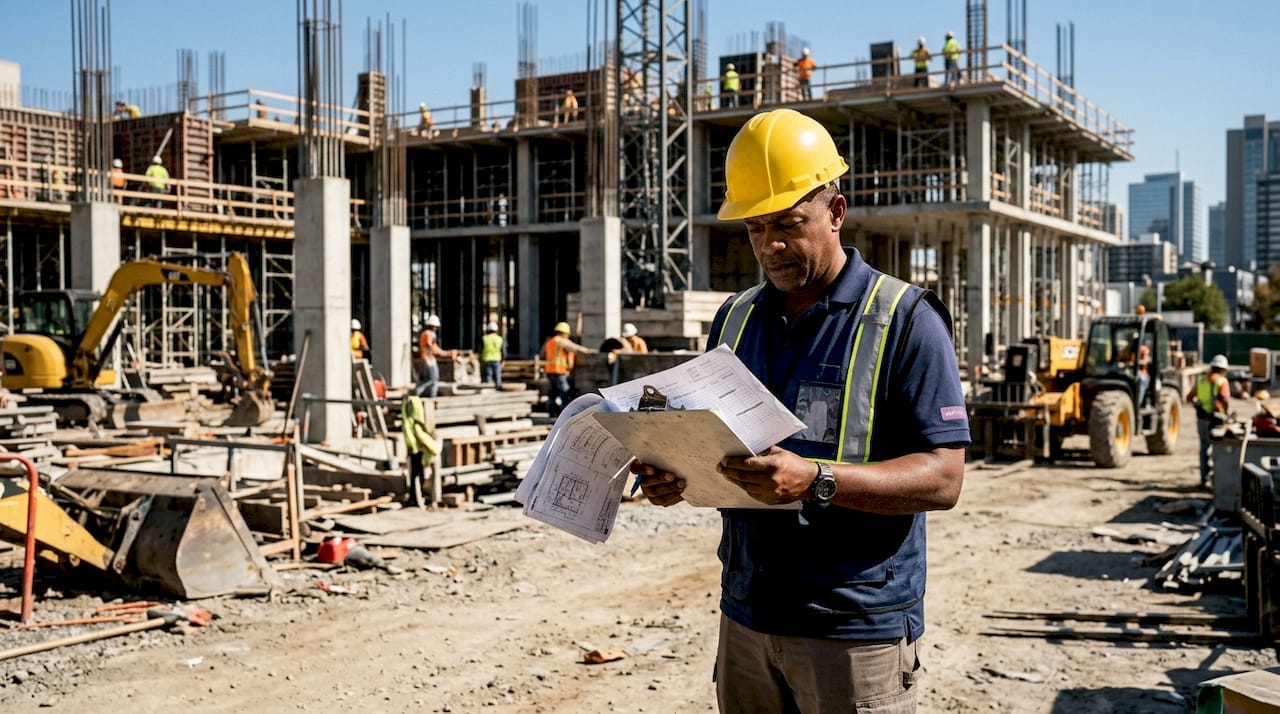
Job hazard analysis in construction is defined as a systematic, task-specific process of breaking work into discrete steps, identifying hazards at each step, and establishing controls to prevent incidents before work begins. Safety managers who apply this method consistently reduce reactive incident response and build proactive safety cultures. The process aligns with OSHA standards under 29 CFR 1926 and supports compliance frameworks like ISO 45001. This guide covers every stage of the process, from regulatory grounding to crew engagement, with practical techniques you can apply on any job site.
What are the essential steps of a job hazard analysis in construction?
A systematic JHA process involves five core stages: selecting the job, breaking it into steps, identifying hazards, determining controls, and documenting the plan. Each stage builds on the last, and skipping any one of them weakens the entire analysis.
Selecting and prioritizing tasks
Start with jobs that carry the highest risk or have a history of incidents and near misses. Tasks involving the OSHA “fatal four” construction hazards, which are falls, struck-by events, electrocutions, and caught-in/between incidents, deserve priority. Energy-source-based identification of hazards, such as gravity, kinetic force, and electrical energy, captures risks that outcome-based approaches miss. This method prevents safety managers from overlooking less obvious dangers buried in routine tasks.
Breaking the job into steps
Each step should reflect how the work actually happens on site, not how it looks on a drawing. A concrete pour, for example, breaks into truck arrival, chute positioning, placement, vibration, and finishing. Steps that are too broad miss hazards. Steps that are too narrow create an unworkable document.
Identifying hazards and applying controls
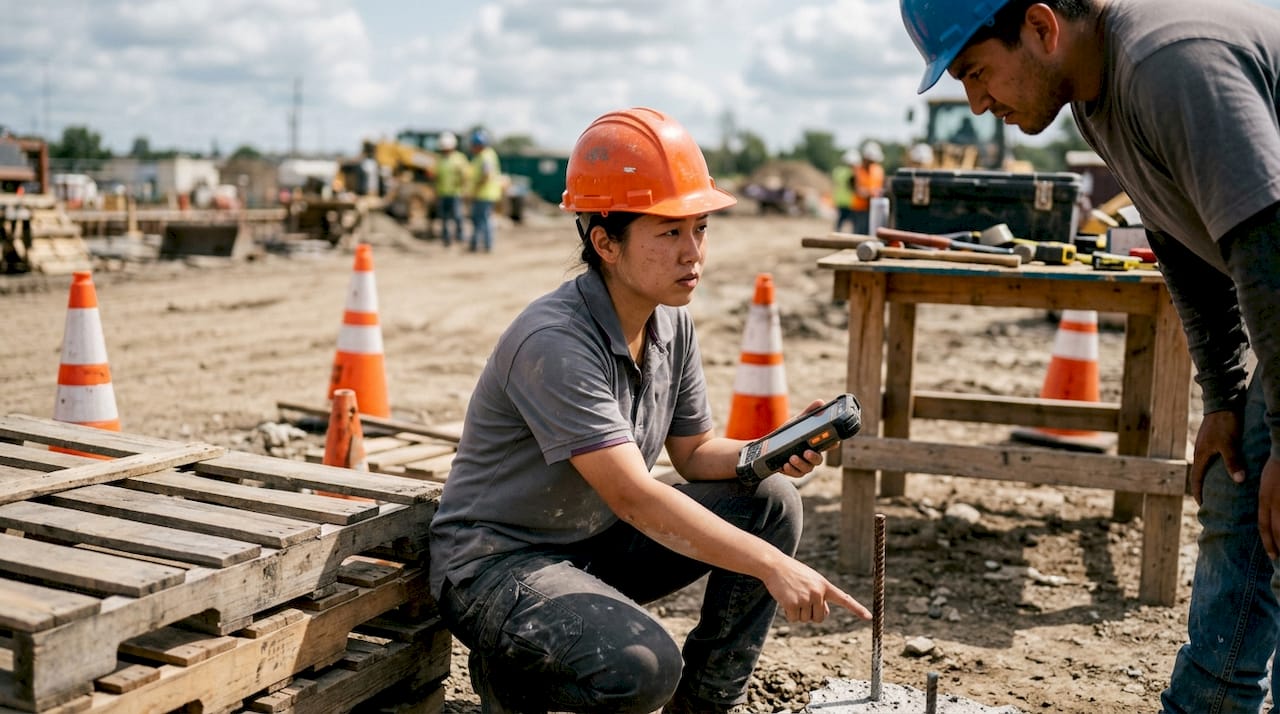
For each step, identify what could go wrong and what energy source drives the harm. Then apply controls using the ERIC-PD hierarchy: Elimination, Reduction, Isolation, Control, PPE, and Discipline. Jumping straight to PPE is the most common failure in JHA programs. Engineering controls and elimination always take priority.
| Task step | Potential hazard | Recommended control |
|---|---|---|
| Scaffold erection | Fall from height | Install guardrails; use fall arrest harness |
| Concrete cutting | Silica dust inhalation | Wet cutting method; respiratory protection |
| Electrical rough-in | Electrocution | LOTO procedures; insulated tools |
| Material hoisting | Struck-by falling load | Exclusion zones; tag lines; hard hats |
| Excavation entry | Cave-in or engulfment | Shoring, sloping, or trench box |
Pro Tip: Walk the job site before writing a single word of the JHA. Desk-only analyses miss site-specific congestion, environmental factors, and actual work sequencing that only show up in person.
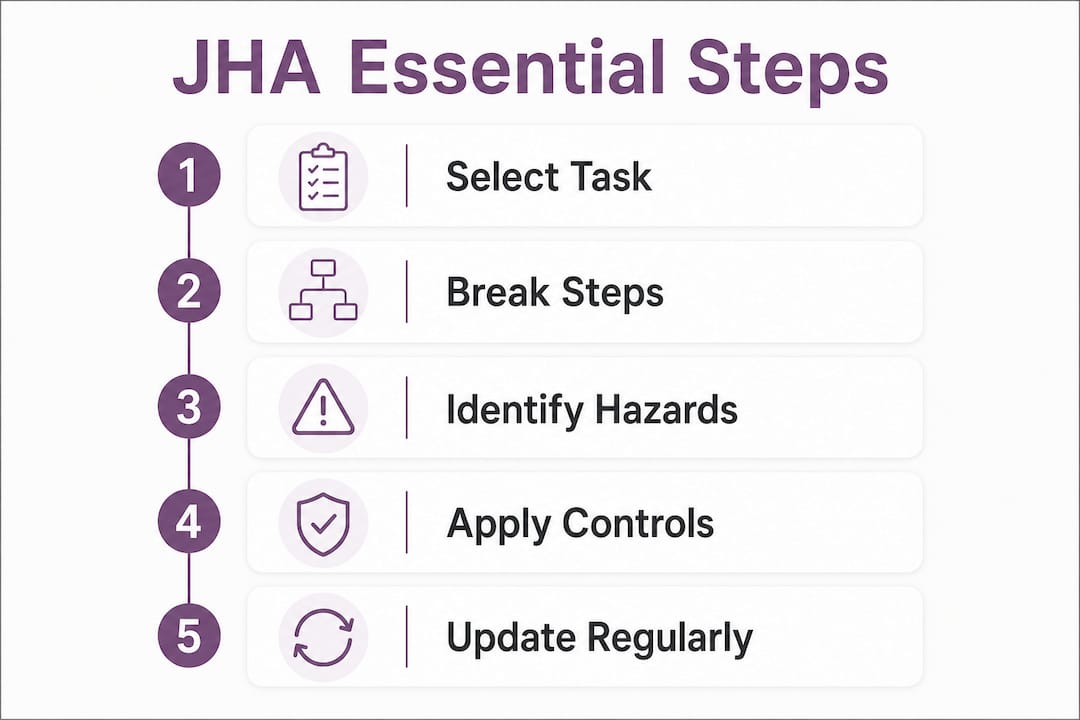
JHA updates are required whenever the sequence, equipment, crew, weather, or method changes, and after every incident or near miss. A JHA written in march for dry conditions does not apply to the same task in wet winter weather.
How does job hazard analysis comply with OSHA and other regulatory requirements?
OSHA does not use the term “job hazard analysis” in its regulations by name. However, OSHA standards like 1926.500 for fall protection and 1926.1153 for silica exposure effectively require task-level hazard analysis to demonstrate compliance. That distinction matters. Safety managers who treat JHA as optional because it is not explicitly named in the code expose their organizations to serious liability.
The regulatory picture includes several key obligations:
- 29 CFR 1926 governs construction safety broadly and requires employers to identify and control hazards before work begins.
- 29 CFR 1910 applies to general industry but overlaps with construction in areas like electrical safety and confined spaces.
- ISO 45001 sets the international standard for occupational health and safety management systems, and its risk assessment requirements align directly with JHA methodology.
- Daily supervisor walk-downs and monthly site audits are the inspection frequencies most commonly expected by OSHA compliance officers.
- JHA documentation creates a legal record. A signed, dated JHA demonstrates due diligence if an incident leads to an OSHA investigation or civil litigation.
The legal weight of a JHA document is often underestimated. A well-maintained JHA file shows that the employer identified the hazard, communicated controls to workers, and obtained crew acknowledgment. That paper trail is the difference between a citation and a defensible record.
ISO 45001 adds another layer for construction firms operating internationally or bidding on projects that require certified safety management systems. Its clause on hazard identification maps directly to the JHA process, making a strong JHA program a foundation for ISO certification.
What distinguishes job hazard analysis from risk assessments and field-level hazard assessments?
JHAs and risk assessments are not substitutes for each other. Each tool serves a different purpose, and using them together produces better safety outcomes than relying on either alone.
A JHA is task-specific and execution-focused. It asks: “What are the steps in this task, and what could go wrong at each one?” A risk assessment is broader and prioritization-based. It asks: “Across this site or project, which hazards are most severe and most likely?” The two tools answer different questions, which is why combining JHA and risk assessments leads to more dynamic hazard management.
A Field-Level Hazard Assessment (FLHA) is the third tool in a complete three-tier hazard analysis system. Workers conduct FLHAs on site immediately before starting work, using a risk matrix to flag changing conditions. An FLHA is the most immediate and worker-led of the three tools.
| Tool | Scope | Timing | Ownership | Primary output |
|---|---|---|---|---|
| Risk assessment | Site or project-wide | Pre-project planning | Safety manager | Hazard register with priority rankings |
| Job hazard analysis | Single task or job type | Pre-task, updated as needed | Safety manager with crew input | Step-by-step control plan |
| FLHA | Immediate work area | Just before work starts | Worker or crew | Go/no-go decision with documented checks |
Pro Tip: Treat these three tools as a system, not a menu. The risk assessment sets priorities, the JHA builds the control plan, and the FLHA confirms conditions are safe right now. Missing any tier leaves a gap.
Safety managers who understand when to use each tool avoid the common mistake of writing one document and calling it everything. Each tool has a distinct role in construction safety management.
What are common challenges and best practices for implementing JHA effectively?
The most frequent failure in JHA programs is generic hazard language. Writing “worker may be injured” tells a crew nothing. Writing “worker may fall 12 feet from scaffold platform if guardrail is not installed” gives them something to act on. Specificity is the difference between a useful document and a compliance checkbox.
Common mistakes safety managers make include:
- Writing JHAs at a desk without visiting the site first
- Listing PPE as the primary or only control measure
- Failing to involve the crew who will actually perform the work
- Using the same JHA for different site conditions or locations
- Never updating the document after changes occur
Displaying the JHA at the work face and requiring crew sign-off transforms the document from a filing exercise into a live safety tool. Workers who sign a JHA are more likely to follow its controls and more likely to raise concerns when conditions change. That crew engagement is the single most underused element in most JHA programs.
Monitoring JHA effectiveness requires measurable indicators. Near-miss reporting ratios, with a target of 10:1 near misses to recordable incidents, reveal whether workers are identifying hazards before they escalate. Safety observation close-out cycle times show whether identified hazards are being corrected promptly. These KPIs connect JHA activity to actual safety behavior on site.
Stop-work authority is a direct extension of the JHA process. When conditions change and the current JHA no longer reflects reality, any worker should have the authority to stop work and trigger a reassessment. Building that expectation into your safety culture requires clear communication, visible leadership support, and a JHA process that workers trust.
Pro Tip: Involve the most experienced worker on the crew when writing or reviewing a JHA. They know the shortcuts, the workarounds, and the near misses that never got reported. That knowledge belongs in the document.
For safety managers looking to build stronger documentation habits, reviewing JHA best practices alongside your existing program reveals gaps that internal review alone often misses.
Key Takeaways
A job hazard analysis in construction is only as effective as the specificity of its hazard descriptions, the rigor of its controls, and the consistency of its crew engagement.
| Point | Details |
|---|---|
| Walk the site first | Desk-only JHAs miss real conditions; physical site observation captures actual hazards. |
| Apply ERIC-PD controls | Start with elimination and engineering controls before defaulting to PPE. |
| Use all three safety tools | Combine risk assessments, JHAs, and FLHAs for complete hazard coverage. |
| Update after every change | Revise the JHA whenever crew, method, equipment, or conditions change. |
| Measure with KPIs | Track near-miss ratios and observation close-out times to confirm JHA impact. |
Why most JHA programs fail before they start
The construction industry has a documentation problem disguised as a safety problem. Safety managers produce JHAs, file them, and move on. Workers never see them. Conditions change and the document stays the same. When an incident happens, the JHA exists but the hazard it should have controlled was never actually managed.
The fix is not more paperwork. The fix is treating the JHA as a conversation, not a form. The most effective JHAs I have seen were written with the crew, reviewed at the tailgate meeting, posted at the work face, and updated when the foreman noticed something had changed. That process takes maybe 20 minutes longer than the desk version. The difference in crew buy-in is enormous.
The other pattern I see consistently is over-reliance on PPE as the primary control. PPE is the last line of defense, not the first. When a JHA lists “wear hard hat and safety glasses” as the control for a struck-by hazard on a hoisting operation, it has failed. The control is an exclusion zone, a tag line, and a designated signal person. The hard hat is what protects the worker if all of that fails.
Safety managers who integrate JHA into daily operations rather than treating it as a pre-project document see measurable differences in incident rates and near-miss reporting. The JHA is not a compliance artifact. It is the clearest signal your crew receives about how seriously you take their safety.
— James
Certicerts supports your construction safety training program
Construction safety managers who conduct thorough job site risk evaluations also need a reliable way to document and verify the training behind those assessments.

Certicerts gives safety professionals a complete system for issuing, managing, and verifying training certificates and wallet cards with offline QR verification that works on any job site. Every certificate includes a secure, scannable code that auditors, clients, and supervisors can verify instantly, with no internet connection required. Certicerts runs as a local-first Windows application, so your data stays under your control. Whether you are certifying a crew of five or managing compliance across a large contractor workforce, Certicerts keeps your training records accurate, current, and audit-ready.
FAQ
What is a job hazard analysis in construction?
A job hazard analysis in construction is a structured process that breaks a task into steps, identifies hazards at each step, and assigns controls to prevent incidents. It is the primary task-level safety planning tool used by construction safety managers.
Is a JHA legally required by OSHA?
OSHA does not mandate a JHA by name, but standards like 29 CFR 1926.500 and 1926.1153 require task-level hazard identification that effectively necessitates JHA documentation. A signed JHA also serves as legal evidence of due diligence during inspections or incident investigations.
How often should a JHA be updated?
A JHA requires updating whenever the task sequence, crew, equipment, weather, or site conditions change, and after any incident or near miss. Static JHAs that are never revised become safety liabilities rather than safety tools.
What is the difference between a JHA and a field-level hazard assessment?
A JHA is a pre-task document developed by a safety manager that outlines step-by-step controls. A field-level hazard assessment is a real-time, worker-led check conducted immediately before work starts to confirm current conditions match the plan.
What controls should a JHA prioritize?
A JHA should apply the ERIC-PD hierarchy: Elimination, Reduction, Isolation, Control, PPE, and Discipline. Engineering controls and elimination always rank above PPE, which functions as a last-resort measure rather than a primary safeguard.