WHMIS Certificates Don’t Expire in Canada: How to Stay Audit Ready

WHMIS certificates do not carry a legislated expiry date anywhere in Canada. No federal or provincial regulation says a WHMIS certificate becomes invalid after one year, three years, or any fixed period. What employers must do instead is keep training current: retrain workers when hazards, products, or job conditions change, and review the training program at least annually. Most workplaces settle on periodic refreshers at intervals of typically one to three years as a practical middle ground.
TL;DR:
- WHMIS certificates have no legislated expiration date, but employers must review and update training programs at least annually or after any hazard or process change.
- Retraining is triggered by specific events such as new hazardous products, SDS updates, process changes, incidents, or role shifts, rather than by time elapsed.
- Most workplaces adopt a one- to three-year refresher schedule based on risk level, with higher-risk sectors requiring more frequent updates.
- Keeping comprehensive training records, including dates, course details, and supporting documents, is essential for passing inspections, especially across multiple sites.
- Digitized certificate management systems that track expiry, facilitate bulk issuing, and enable offline verification improve compliance and reduce audit stress.
Table of Contents
- What Canadian Law Actually Requires for WHMIS Training
- When Does a Worker Actually Need to Be Retrained?
- Setting a Refresher Cadence That Actually Holds Up
- Keeping Records That Survive an Inspection
- Practical Tools for Managing WHMIS Records Without the Paper Chase
- A Practical WHMIS Policy Worth Adopting
- Track WHMIS Training and Prove It Instantly with Certicerts
- Sources
What Canadian Law Actually Requires for WHMIS Training
Nothing in the WHMIS regulations under SOR/2015-17 sets a validity window for a training certificate. The regulations establish supplier and employer duties around hazard classification, labeling, and safety data sheets, but they stop short of dictating how often a worker needs to sit through training again. Health Canada’s WHMIS guidance confirms this: the federal role is to define the hazard communication system, not to police individual certificate lifespans.
The obligation actually sits with the employer, not the government. Every Canadian jurisdiction requires employers to build and maintain a WHMIS education and training program, and CCOHS guidance recommends reviewing that program at least once a year to confirm it still reflects the hazards on site.
Quick fact: No province or territory has ever legislated a fixed WHMIS certificate expiry date. The annual review requirement is about the program, not the certificate itself.
Enforcement still varies by location. A few things to keep in mind:
- Provincial and territorial OHS inspectors, not Health Canada, check training records during workplace visits.
- Alberta, Ontario, and British Columbia each run their own occupational health and safety inspection priorities.
- Confirm specifics with your provincial regulator before assuming a national standard applies everywhere the same way.
When Does a Worker Actually Need to Be Retrained?
Retraining isn’t about the calendar. It’s about what changed since the last session. Here are the situations that should trigger it:
- A new hazardous product arrives on site. If a facility starts using a solvent, adhesive, or cleaning agent it didn’t stock before, workers handling it need product-specific instruction, not just the generic WHMIS overview.
- A safety data sheet or classification changes. Suppliers update SDS documents periodically, and a reclassified hazard can change handling procedures entirely.
- Processes or equipment change. New ventilation systems, storage methods, or transfer procedures can shift exposure risk enough to warrant a refresher.
- An incident or near-miss occurs. A spill, exposure, or close call is a clear signal that the current training didn’t stick or didn’t cover the scenario.
- A worker changes role or site. Moving from an office to a shop floor, or between job sites with different chemical inventories, resets the training need.
- A supervisor flags a knowledge gap. Sometimes retraining isn’t triggered by an event at all. It’s triggered by a supervisor noticing a worker can’t explain a pictogram or read a label correctly.
Industry guidance from safety training providers treats items 1, 2, and 4 as immediate retraining triggers, while items 5 and 6 often get folded into scheduled refreshers.
Pro Tip: Keep a short log every time a new chemical product enters your workplace. That log becomes your evidence trail for exactly when product-specific retraining should have happened, and it’s the first thing a diligent inspector will ask to see.

Setting a Refresher Cadence That Actually Holds Up
Most Canadian employers land on one of two patterns: an annual training review paired with periodic refreshers, or a straight annual refresher for higher-risk sectors. Neither is legally mandatory on its own, but both satisfy the underlying requirement to keep training effective, a point WSPS guidance makes explicit when it notes there’s no expiry date but strongly recommends annual review.
Risk level should drive the choice. A construction firm juggling multiple hazardous products and rotating crews has a different exposure profile than an office with a handful of cleaning supplies in a closet.
A workable WHMIS policy should spell out:
- Who is covered (all workers, or only those handling controlled products directly)
- What training format applies (generic orientation versus product-specific instruction)
- When refreshers happen (fixed calendar date, or tied to program review)
- What evidence gets collected to prove it happened
- Whether the joint health and safety committee reviewed and signed off on the schedule
Lower-risk workplaces can often stretch refreshers toward longer intervals, while manufacturing, construction, and lab environments tend to use annual refreshers.
Keeping Records That Survive an Inspection
An inspector doesn’t ask whether your certificate expired. They ask whether you can prove training happened, when, and for what. CCOHS guidance on WHMIS education points to a specific set of record elements that should back up every worker’s file.
At minimum, keep:
- Employee name and job role
- Course or training title completed
- Completion date
- Trainer or provider name
- Whether the session was generic WHMIS or product-specific
- Supporting documents (sign-in sheets, quiz results, certificates)
Quick fact: Provincial inspectors commonly ask for records covering recent years of activity, which is why a static filing cabinet full of paper certificates becomes a liability the moment a multi-site audit starts.
Printable PDFs, sign-in sheets, and a centralized training matrix work fine for a single site. The friction shows up with remote crews or multiple job sites, where paper certificates get lost, water damaged, or left in a truck. A dedicated training record system solves that by centralizing the same data points inspectors ask for, exportable as a single report instead of a stack of folders. For construction crews specifically, offline-friendly record templates matter because job sites rarely have reliable internet the day an inspector shows up.
Practical Tools for Managing WHMIS Records Without the Paper Chase
Spreadsheets and paper folders work until a company has more than a handful of employees or more than one location. At that point, tracking who took what training, when it happened, and whether it’s still relevant becomes a manual chore that’s easy to get wrong.
Purpose-built certificate management systems solve three specific problems paper can’t:
- Expiry and review alerts. A training matrix flags which workers are due for a refresher before an inspector does.
- Bulk issuing for group training. Onboarding twelve new hires or running a site-wide refresher shouldn’t mean generating certificates one at a time.
- Offline verification. QR-coded certificates let a supervisor or auditor confirm authenticity on a job site with no cell signal, since the verification process works from a self-contained record rather than a live database lookup.
Certificate management software can be built around exactly this workflow, generating certificate templates and matching wallet cards, tracking training records and expiry dates in a compliance dashboard, and issuing certificates in bulk for group sessions or safety events. Software that runs locally can keep records accessible even without a stable connection. Employers managing SDS-triggered retraining can pair this with structured SDS management practices to keep chemical inventory changes and training updates aligned.
Pro Tip: Whatever system you use, print a sample report before an inspection ever happens. If you can’t generate a clean training matrix in under two minutes, your recordkeeping isn’t audit-ready yet.
A Practical WHMIS Policy Worth Adopting
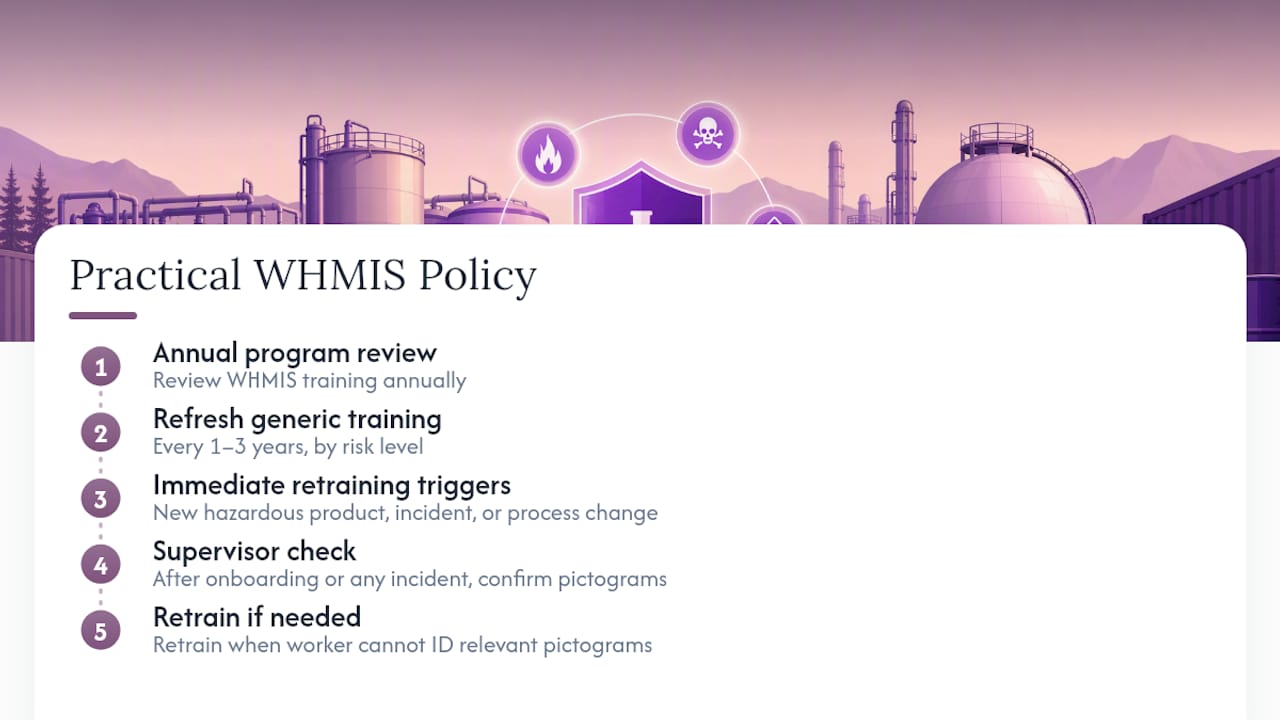
Here’s the policy I’d tell any employer to write down today: review your WHMIS training program annually, refresh generic training every one to three years depending on risk level, and retrain immediately whenever a new hazardous product, incident, or process change occurs. That’s it. No certificate needs an expiry stamp to make this work.
For supervisors, the checklist is even shorter: after onboarding or any incident, confirm the worker can identify the pictograms on the products they’ll actually touch that shift. If they can’t, that’s your retraining trigger, not a date on a wall calendar. Pair that habit with the recordkeeping practices covered earlier, and audits stop being stressful.
— James
Track WHMIS Training and Prove It Instantly with Certicerts
Some platforms offer employers a way to solve the exact problems this article covers: certificates that go missing, records inspectors can’t easily verify, and no clean way to prove a refresher happened on schedule. These platforms generate professional WHMIS certificates and wallet cards from customizable templates, track completion and review dates on a compliance dashboard, and support bulk issuing for onboarding groups or site-wide refresher sessions.

Offline QR verification enables supervisors to confirm a certificate’s authenticity on a job site with no signal, which matters most when an inspector shows up unannounced. Instead of chasing paper certificates across multiple sites, employers can use a training matrix that flags who’s due for a refresher before it becomes a compliance gap.
If your current system is a filing cabinet or a spreadsheet nobody updates consistently, start with the Certicerts free trial and generate your first certificates today.
Sources
- Workplace Hazardous Materials Information System (WHMIS) — Health Canada
- WHMIS - Education and training — CCOHS
- Workplace Hazardous Materials Information System Regulations (SOR/2015-17) — Justice Laws
- WHMIS Frequently Asked Questions — WSPS