Job Hazard Analysis Form PDF: Download and Use It Right

What is a job hazard analysis form PDF and where can you download one?
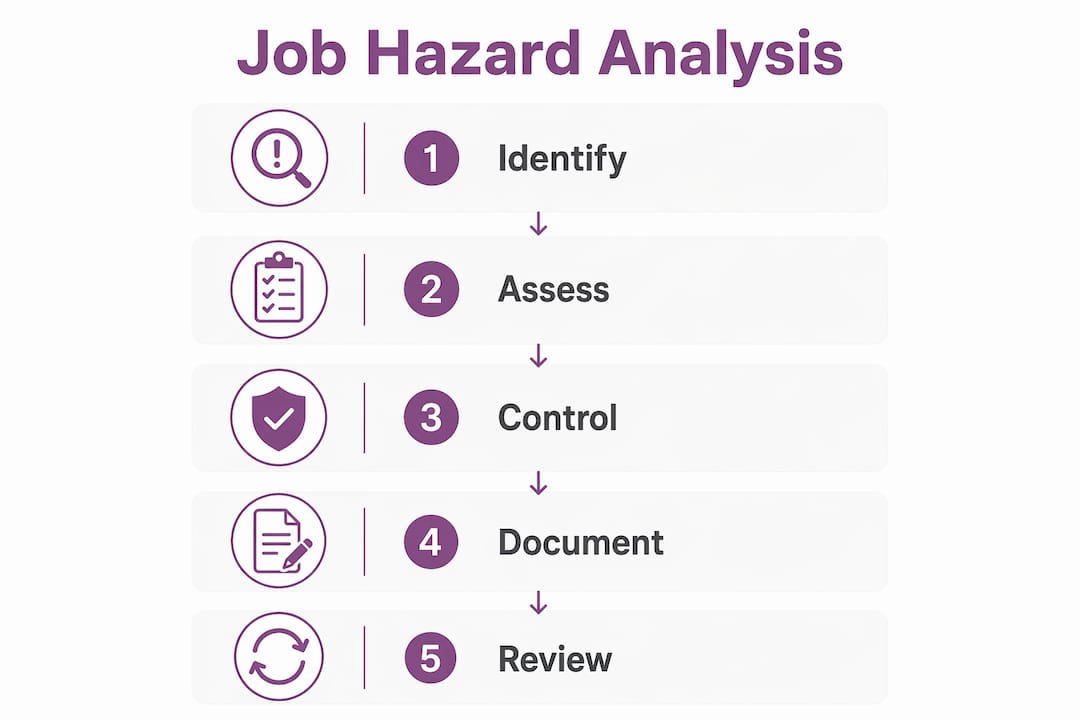
A Job Hazard Analysis (JHA) form PDF gives safety professionals a structured way to break any job into sequential steps, identify the hazards in each step, and document the controls that eliminate or reduce those risks. OSHA’s publication 3071 defines it as a proactive technique focused on the relationship between the worker, the task, the tools, and the work environment. The goal is to catch hazards before they cause injuries, not after.
OSHA provides free, ready-to-use forms you can download right now:
- OSHA Job Hazard Analysis Worksheet (PDF) — the standard fillable form with sections for job steps, hazards, and controls, available in English and Spanish
- OSHA 3071 Publication with Sample JHA Form (PDF) — the full guidance document including a completed example and a blank template in Appendix 3
- OSHA JHA Activity Worksheets (PDF) — a team-based workbook format useful for group hazard identification sessions
Every standard JHA form contains the same core sections:
- Job title and location — identifies the specific role and worksite
- Task description — a plain-language description of what the worker does
- Job steps — the sequential actions that make up the task, listed in order
- Hazard type and description — the specific risk at each step, including consequence
- Control measures — the actions or equipment used to eliminate or reduce each hazard
- Analyst name and date — establishes accountability and creates a dated record
- Signatures — employee and supervisor sign-off confirms training has occurred
The JHA form is both a planning tool and a compliance document. Completed forms serve as evidence during OSHA inspections that your organization has assessed hazards and taken corrective action.
How to complete a job hazard analysis form accurately
Filling out a JHA form correctly takes more than writing something in each box. Vague entries like “worker could get hurt” or “use PPE” are the most common mistakes, and they make the form nearly useless for training or audits.
Step-by-step completion process:
- Select the job to analyze. Prioritize tasks with a history of incidents, near-misses, new equipment, or newer workers assigned. Jobs with the potential for severe worst-case outcomes go first.
- Observe the job in real conditions. Watch multiple workers complete the same task. Note differences in how the job gets done, since those variations often reveal hidden hazards.
- List job steps in sequence. Write each step as a discrete action, not a broad category. “Lifts 50-pound bag from pallet” is a step. “Handles materials” is not.
- Identify hazards at each step. For every step, ask what could go wrong, what the consequence would be, and what conditions trigger the hazard. Be specific: “repetitive twisting while lifting causes lower back strain” beats “ergonomic hazard.”
- Determine and document controls. Apply controls in priority order (covered in the next section). Write controls specifically enough that a new worker could follow them without asking questions.
- Have both the worker and supervisor review and sign. This confirms the analysis reflects real conditions and that training has been communicated.
Common mistakes to avoid:
- Writing hazard descriptions so vague they could apply to any job
- Skipping steps that seem routine or low-risk
- Listing only PPE as the control when engineering solutions are available
- Failing to update the form when equipment, processes, or personnel change
- Leaving the “consequence” field blank, which removes the urgency from the hazard description
Pro Tip: Think like a new hire. Ask yourself what a worker on their first day would encounter at each step, even with existing controls in place. That perspective surfaces hazards that experienced workers have stopped noticing.
For a deeper look at maintaining completed forms as training records, the JHA form guide from Certicerts covers documentation practices that hold up during compliance audits.

How do you identify hazards and choose the right controls?
Hazard identification is the analytical core of the JHA process. The most effective approach combines direct observation with worst-case scenario thinking — deliberately asking what would happen if something went wrong, rather than assuming familiar tasks are safe. Familiarity breeds oversight. Workers who have done a job for years often stop seeing the risks that a new employee would notice immediately.
Common workplace hazard categories to examine at each step:
- Slips, trips, and falls (same level and elevated)
- Struck-by or caught-in mechanical hazards
- Chemical exposure through inhalation, skin contact, or eye splash
- Ergonomic stressors: lifting, twisting, repetitive motion
- Electrical contact and pressurized systems
- Noise, vibration, heat, and extreme temperature
- Combustible dust and flammable materials
Once hazards are identified, controls must be selected using the hierarchy of controls, which ranks methods from most to least effective:
| Level | Control Type | Example |
|---|---|---|
| 1 | Elimination | Remove the hazardous process entirely |
| 2 | Substitution | Replace a toxic chemical with a safer alternative |
| 3 | Engineering controls | Install machine guarding or local exhaust ventilation |
| 4 | Administrative controls | Rotate workers to limit exposure duration |
| 5 | PPE | Require gloves, respirators, or safety glasses |
Engineering controls physically alter the work environment and provide stronger protection because they do not depend on worker behavior. PPE, by contrast, only creates a barrier between the worker and the hazard. It fails if it fits poorly, gets damaged, or is not worn consistently. That is why PPE belongs at the bottom of the hierarchy, not the top.
Visual aids such as photos or diagrams significantly increase worker understanding of hazards and control methods compared to text-only forms. If your JHA covers a task with a non-obvious hazard, add a photo showing both the uncontrolled condition and the correct control in place.
Pro Tip: Controlling a hazard well often requires more than one level of the hierarchy. A grinding operation might need machine guarding (engineering), a rotation schedule (administrative), and cut-resistant gloves (PPE) working together.
OSHA compliance, documentation, and best practices
OSHA does not mandate JHAs for every industry, but several standards explicitly require them, including the Bloodborne Pathogens standard and the PPE standard at 29 CFR 1910.132. Beyond those specific requirements, OSHA’s general duty clause holds employers responsible for providing a workplace free from recognized hazards. A documented JHA process is one of the clearest ways to demonstrate that obligation is being met.
Completed JHA forms serve as training records and audit evidence, confirming that employees understood the hazards and controls for their specific tasks. During an OSHA inspection, a well-maintained set of JHA forms shows that hazard assessment was systematic, not reactive.
Best practices for maintaining compliance:
- Involve workers directly. Supervisors and workers completing the JHA together produce more accurate and practical controls. Workers know the real-world difficulties; supervisors know which solutions are feasible.
- Review JHAs after every incident. An injury or near-miss on a task that already has a JHA means the analysis missed something. Revise it before the next shift.
- Update when conditions change. New equipment, processes, or chemical exposures require a fresh analysis, not a note in the margin of the old one.
- Use JHAs as training documents. Walk new employees through the completed form for their specific tasks before they start work. The form becomes a lesson plan.
- Store forms where they are accessible. Workers should be able to reference the JHA for their task at any time, not just during onboarding.
For advanced strategies on worker engagement and keeping JHA programs current, the JHA best practices guide from Certicerts covers practical approaches safety professionals are using in 2026.
Where to find and customize additional JHA form PDFs
The OSHA forms linked in the first section cover most general industry needs, but specific industries and job roles often benefit from templates designed around their particular hazard profiles.
Reputable sources for free JHA templates:
- Oregon OSHA JHA Workshop Materials — includes a full workbook with team-based JHA exercises and a risk-scoring matrix
- Oregon State University EHS JHA Form (2025) — a fillable PDF with detailed hazard category checklists covering physical, chemical, biological, and human factors
- University of Hawaii EHSO JHA Template — includes a photograph column for visual documentation alongside each step
- University of Maryland JHA Template — a clean electronic form with a submit function for digital record-keeping
Customizing templates for your industry or job role:
Start with an official OSHA template and add columns or fields specific to your work. A construction site JHA might add a column for fall protection requirements at each step. A laboratory form might include a chemical-specific exposure limit field. For construction-specific guidance, a construction safety checklist can help you identify which task categories need dedicated JHA coverage.
If your team manages JHA documentation digitally, digital checklist tools that support photo proof and completed job records can integrate with your existing JHA workflow, making it easier to attach visual evidence directly to each step.
The most important customization principle: never add fields you will not actually fill out. A form with 20 blank columns looks thorough and gets ignored. A form with six well-defined columns that workers complete accurately is far more useful.
JHAs are living documents. Review them on a set schedule, after any incident, and whenever a job changes. A form dated three years ago for a process that has since been modified is not a compliance document. It is a liability.
Key Takeaways
A completed, well-documented JHA form is the foundation of both effective hazard prevention and OSHA compliance, combining worker knowledge with supervisor oversight to produce controls that actually get used.
| Point | Details |
|---|---|
| Download official OSHA forms | OSHA provides free JHA PDFs in English and Spanish, ready to fill out and use immediately. |
| Complete each step with specifics | Vague hazard descriptions and generic controls make JHA forms useless for training and audits. |
| Apply the hierarchy of controls | Engineering controls outperform PPE because they do not rely on consistent worker behavior. |
| Involve workers and supervisors jointly | Workers reveal hidden risks; supervisors identify feasible solutions — both perspectives are required. |
| Treat JHAs as living documents | Update forms after incidents, equipment changes, or process modifications to maintain compliance. |
Certicerts helps you close the loop on training documentation

Completing a JHA is only half the job. The other half is proving that workers were trained on the hazards and controls you identified. Certicerts is a Windows desktop application built for safety professionals, HR teams, and compliance managers who need to issue, manage, and verify employee training records without the chaos of paper certificates and spreadsheets.
With Certicerts, you can generate professional training certificates with QR verification codes, track expiry dates and recertification schedules on a compliance dashboard, and produce audit-ready reports in seconds. Every certificate includes an offline-verifiable authenticity code, so employers, clients, and auditors can confirm credentials without needing an internet connection.
Whether you run a construction company, a manufacturing facility, or a training organization, Certicerts connects your completed JHA documentation to the training records that prove your workforce is qualified and compliant. Start with Certicerts and take control of your certification program today.