Pre-Task Safety Plan: A Field Guide for Site Supervisors
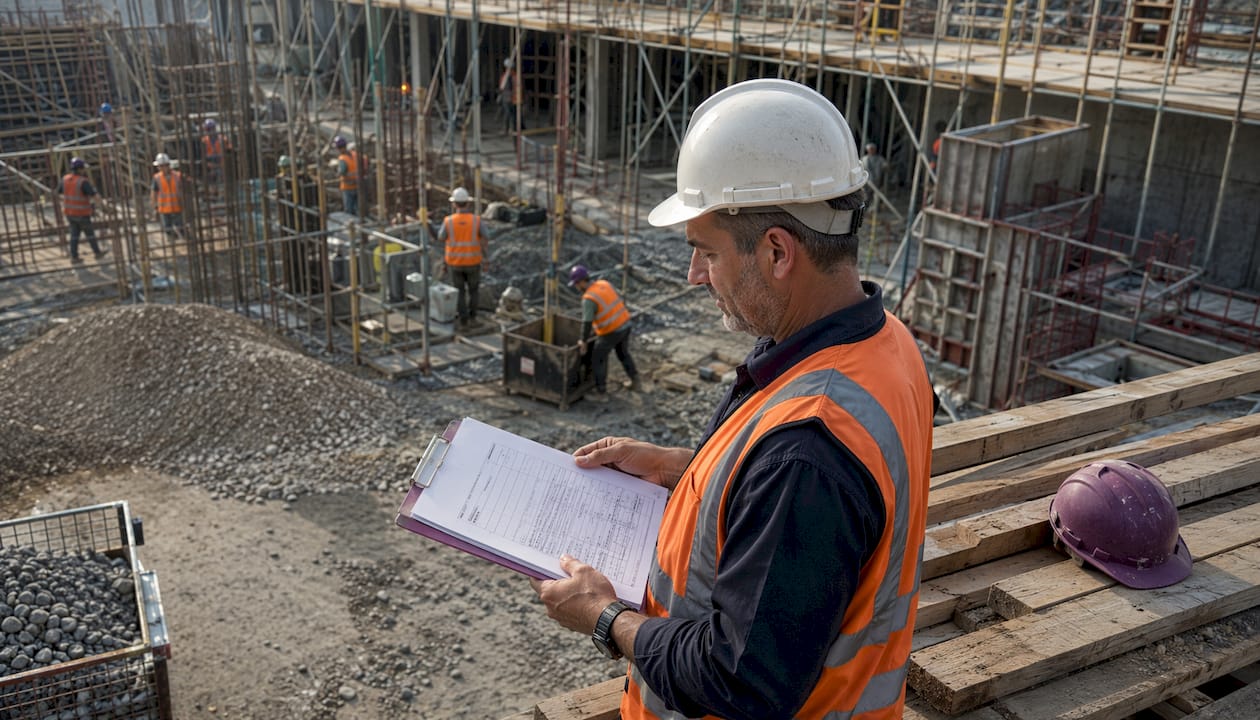
A pre-task safety plan (PTP) is a structured, preventive process completed before any work begins. Its purpose is to walk the crew through each task step, name the hazards attached to each one, and lock in controls before anyone picks up a tool. CPWR guidelines describe PTPs as critical for daily field-level safety, with worker engagement and cross-trade coordination as the two factors that determine whether a plan actually works or just fills a binder.
Construction workers face a disproportionately high rate of occupational injuries and fatalities compared to other industries, and research shows that most incidents could be prevented if hazards were proactively recognized and addressed before work started. OSHA and CPWR both point to pre-task planning as one of the most direct tools for closing that gap. A well-run PTP delivers four concrete benefits:
- Hazard identification before exposure, not after an incident
- Clear assignment of roles, stop-work authority, and equipment requirements
- Documented accountability through crew signatures
- Regulatory compliance with OSHA standards and site-specific safety programs
The industry term you will see in formal safety management is “pre-task plan” or PTP, sometimes called a pre-work safety assessment or daily task safety checklist depending on the trade. All refer to the same field-level process.
What goes into an effective pre-task safety plan?
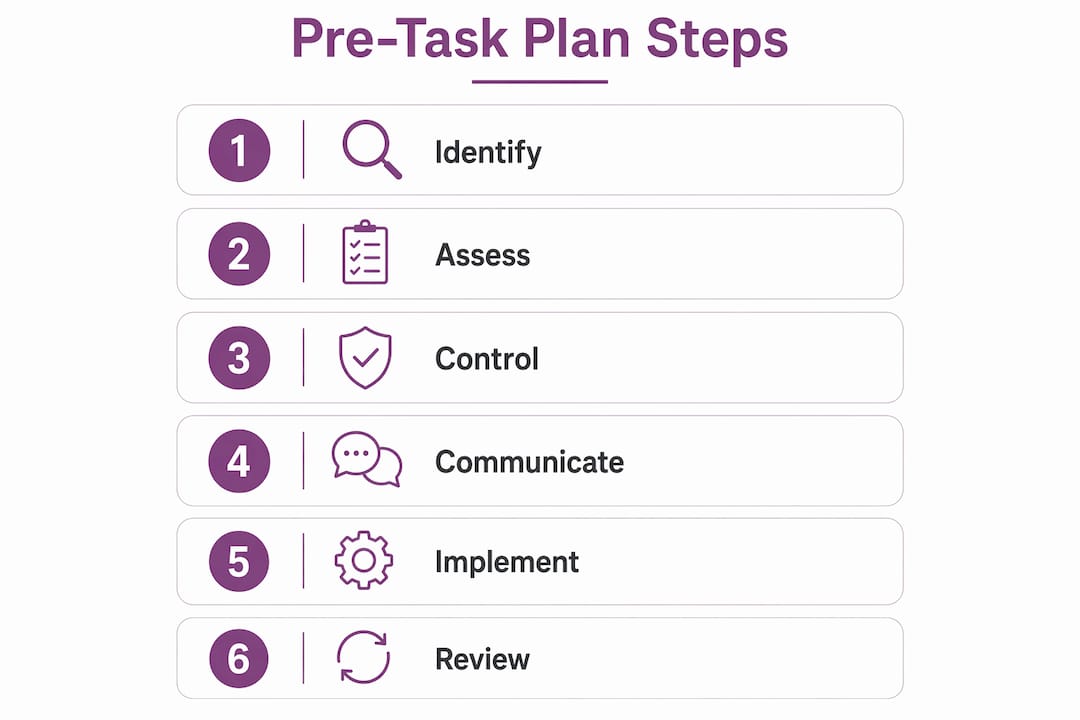
A PTP that actually protects workers covers six core areas. Miss one and you have a document, not a plan.
| Component | What it covers |
|---|---|
| Task description | Scope of work broken into discrete, sequential steps |
| Hazard identification | Specific hazard tied to each task step |
| Hierarchy of Controls | Elimination, substitution, engineering controls, administrative controls, PPE — in that order |
| Roles and responsibilities | Named crew members, supervisor, stop-work authority holder |
| Training and equipment | Required certifications, tools, and personal protective equipment |
| Signatures | Plan author, supervisor, safety manager, and every crew member |

CPWR’s implementation guidelines specify that a separate PTP is required for each unique activity. One plan does not cover two different scopes of work, even on the same shift.
The Hierarchy of Controls deserves particular attention. Most crews default to PPE because it is visible and familiar. But PPE sits at the bottom of the hierarchy for a reason: it reduces exposure without eliminating the hazard. A PTP built around elimination, engineering controls, and administrative controls first is far more protective than one that lists hard hats and safety glasses and calls it done.
How and when should you complete a pre-task safety plan?
Complete the PTP before the task starts, not during it. That sounds obvious, but rushed morning starts push this step to the last minute or skip it entirely. The CPWR guidelines are direct: complete the plan before each task or shift, involve the entire crew, and update it whenever site conditions or personnel change.
A practical step-by-step sequence:
- Define the task. State exactly what work will be performed, where, and by whom.
- Break it into steps. List each discrete action in sequence. Vague steps produce vague hazard identification.
- Identify hazards per step. Ask “what could go wrong here?” for each line. Review any prior incidents or near-misses on similar tasks.
- Select controls. Work down the Hierarchy of Controls. Document the chosen control for each hazard.
- Assign roles. Name the supervisor, designate stop-work authority, and confirm each crew member’s responsibilities.
- Review and sign. Walk through the plan with the full crew. Every person present signs before work begins.
- Update as conditions change. New crew member, changed weather, adjacent trade activity — any of these triggers a plan update.
Visual briefing aids and physical walkthroughs of the work area improve comprehension, especially on complex or multi-trade sites.
Common pitfalls and how to avoid them
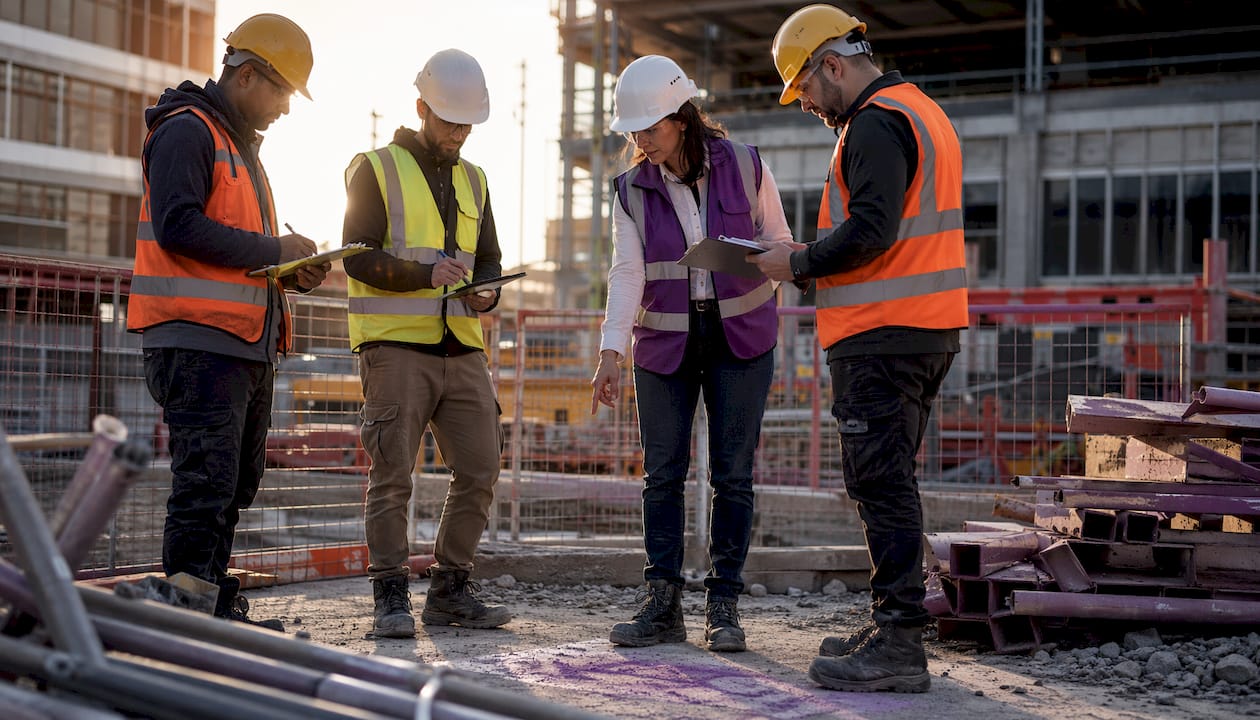
The most common failure mode is treating the PTP as paperwork rather than a working tool. Research from NIOSH found that static checklists lead to “paper drift,” where the document no longer reflects real-time conditions and workers stop trusting it. When workers stop trusting it, they stop engaging with it.
Other frequent problems:
- Poor worker buy-in. Workers who feel the PTP is a supervisor’s form to fill out, not their own safety tool, disengage fast.
- Language and literacy barriers. Multilingual crews need multilingual plans. NIOSH analysis confirms that visual aids, multilingual briefings, and live demonstrations measurably improve adherence across diverse workforces.
- PPE-first thinking. Jumping straight to PPE without working through higher-level controls leaves preventable hazards in place.
- No post-task review. End-of-shift huddles that gather feedback on hazards encountered and plan gaps drive continuous improvement. Skip them and you repeat the same mistakes.
Pro Tip: Start your safety huddle by asking the crew what they are worried about today, not by reading the form to them. Workers who identify their own hazards are far more likely to control them.
Supervisors who connect task-level plans to the broader project context, including what adjacent trades are doing nearby, produce better hazard identification and stronger crew engagement than those who treat each PTP in isolation.
How does a PTP differ from a JHA or AHA?
These three tools share a goal but operate at different levels. Confusing them leads to using the wrong tool for the situation, or duplicating effort without adding safety value.
| Tool | Scope | Timing | Who drives it |
|---|---|---|---|
| Job Hazard Analysis (JHA) | Broader, standardized risk analysis for repetitive jobs | Developed once, reviewed periodically | Safety manager or supervisor |
| Activity Hazard Analysis (AHA) | Formal, checklist-based review for high-hazard or permitted work | Before high-risk project phases | Safety team, often required by contract |
| Pre-Task Plan (PTP) | Daily, site-specific hazard control for current conditions | Before each task or shift | Supervisor and crew together |
A comparison of these tools shows that all three communicate risk, but they differ by depth, application context, and regulatory requirements. The JHA informs the PTP. The AHA governs specific high-hazard permits. The PTP is what the crew actually uses on the ground that morning. For a deeper look at how JHA and AHA differ in practice, the JHA vs AHA guide on the Certicerts blog covers the distinctions in detail.
Templates and resources for creating PTPs
A good template does the cognitive scaffolding for you. It prompts the crew to think through each step rather than leaving hazard identification to memory or habit. Harvard EHS publishes a construction pre-task plan form that covers task steps, hazard descriptions, controls, required training, equipment, and multi-party signatures. It is a practical starting point for any site.
CPWR offers implementation and assessment guidelines specifically for construction, including template structures that emphasize the Hierarchy of Controls rather than defaulting to PPE. The Stanford University EHS task safety analysis form takes a similar approach, pairing task steps with hazard descriptions and preventive measures in a three-column format that is easy to complete in the field.
When building your own template, include fields for: task location, date, crew names, task steps, hazard per step, control per hazard, required training, required equipment, and signatures. Keep it to one page if possible. A two-page form that gets skimmed beats a five-page form that gets ignored.
Hazard identification techniques specific to pre-task planning
The quality of a PTP depends almost entirely on how well the crew identifies hazards before work starts. Generic hazard lists produce generic controls. Specific hazard identification produces controls that actually fit the task.
Effective techniques include:
- Task step decomposition. Break the job into the smallest logical steps, then ask “what could injure someone here?” for each one. Smaller steps surface more hazards.
- What-if analysis. For each step, ask “what if the equipment fails, the surface is wet, or a nearby crew moves into the area?” Conditional thinking catches hazards that normal observation misses.
- Near-miss and incident review. Pull records from similar past tasks. Hazards that caused problems before are likely to recur.
- Physical walkthrough. Walk the actual work area before the briefing. Conditions on paper rarely match conditions on the ground.
- Cross-trade input. Ask adjacent crews what they are doing during your task window. Indirect hazards from other trades are a leading cause of incidents on multi-contractor sites.
Risk assessment and control selection within a PTP
Once hazards are identified, the PTP needs a control for each one. The Hierarchy of Controls provides the decision framework: start at the top and work down only when a higher-level control is not feasible.
- Elimination: Remove the hazard entirely. Reschedule work to avoid a weather hazard. Redesign the task to remove the fall exposure.
- Substitution: Replace the hazardous material or method with a safer one.
- Engineering controls: Physical barriers, guardrails, ventilation systems, or tool guards that reduce exposure without relying on worker behavior.
- Administrative controls: Safe work procedures, job rotation, permit systems, and training requirements.
- PPE: The last line of defense. Required when higher-level controls cannot fully eliminate the risk, but never the only control listed.
Risk rating helps prioritize which hazards get the most attention. A simple likelihood-times-severity matrix (high, medium, low) applied to each identified hazard focuses the crew’s energy where the actual risk is greatest. For a step-by-step guide to building this process into your team’s daily routine, the Certicerts blog covers the full workflow.
What do effective PTPs look like across different industries?
The structure stays consistent. The content changes dramatically by trade and task type.
Construction (steel erection): A PTP for overhead steel work lists each lift sequence as a task step, identifies struck-by and fall hazards at each step, specifies engineered anchor points and exclusion zones as controls, names the signal person and rigger, and requires all crew to sign before the crane moves.
Electrical work: A pre-work safety assessment for energized systems follows OSHA 29 CFR 1926.952 lockout/tagout requirements. The PTP documents the energy isolation steps, names the qualified electrician responsible for verification, and lists required PPE including arc flash protection rated to the calculated incident energy.
Oil and gas field operations: PTPs for hot work in hazardous atmospheres integrate with the hot work permit system. The plan references the permit number, documents gas monitoring requirements, names the fire watch, and specifies the atmospheric conditions that trigger work stoppage. For a detailed look at how hot work permits connect to pre-task planning, the hot work permit guide on the Certicerts blog is worth reviewing.
Manufacturing: Assembly line task plans focus on lockout/tagout, ergonomic controls for repetitive motion, and machine guarding verification before each shift.
How do you make sure the whole crew actually understands the PTP?
A signed form is not the same as a crew that understands the plan. The gap between the two is where incidents happen.
Practical communication strategies:
- Read-back confirmation. After explaining a control, ask a crew member to repeat it back in their own words. This surfaces misunderstanding before work starts, not after.
- Visual aids. Diagrams, photos of the work area, and illustrated hazard cards work across language barriers and literacy levels.
- Multilingual briefings. On crews with mixed language backgrounds, translate the key hazards and controls verbally, not just on paper.
- Two-way dialogue. The briefing is a conversation, not a presentation. Workers who ask questions and raise concerns during the huddle are more engaged with the controls once work begins.
- Toolbox talks tied to the PTP. Short, task-specific toolbox talks that reference the day’s actual PTP reinforce the connection between the document and the real work.
Legal and regulatory requirements you need to know
OSHA does not mandate a specific PTP format for most construction work, but several OSHA standards require the underlying activities that a PTP documents. OSHA 29 CFR 1926 (construction standards) covers fall protection, scaffolding, excavation, and electrical work, each with requirements for hazard assessment, employee training, and documented procedures. A PTP that addresses these requirements by task step provides direct evidence of compliance.
For federal contractors and certain high-hazard projects, the Activity Hazard Analysis is a contract requirement, not just a best practice. The AHA must be submitted and approved before work begins. The PTP then operates as the daily execution layer on top of the approved AHA.
State-level OSHA plans (Cal/OSHA, Washington DOSH, and others) may impose additional requirements. Cal/OSHA’s Injury and Illness Prevention Program (IIPP) standard requires employers to have a written program that includes hazard identification and correction procedures. A well-documented PTP process satisfies a significant portion of that requirement.
Documentation matters in enforcement actions and litigation. A signed PTP showing that hazards were identified, controls were assigned, and workers were briefed before the incident is a materially different legal position than no documentation at all.
How Certicerts helps you manage training records behind every PTP

A PTP is only as strong as the training behind it, and using a reliable secure offline PDF comparison tool can help maintain precise documentation of your safety plans before work begins. If the worker assigned to operate the crane has an expired certification, the plan’s control is already compromised before work starts. Certicerts is a Windows desktop application built to close that gap. It lets safety managers issue, track, and verify training certificates with QR-coded credentials, expiry alerts, and a compliance dashboard that shows exactly who is qualified for what before the morning huddle begins. Every certificate carries an offline-verifiable authenticity code, so supervisors can confirm credentials on-site without an internet connection.
Explore Certicerts to see how it fits into your pre-task planning workflow.
Key Takeaways
An effective pre-task safety plan requires task-step decomposition, Hierarchy of Controls-based risk selection, full crew participation, and documented signatures before work begins.
| Point | Details |
|---|---|
| Complete before every task | PTPs must be finished before each task or shift, updated when conditions or personnel change. |
| Hierarchy of Controls first | Start with elimination and engineering controls; list PPE only after higher-level controls are applied. |
| Crew participation drives quality | Workers who identify their own hazards are more likely to follow the controls assigned to them. |
| Separate plan per activity | Each unique scope of work requires its own PTP, not a single form covering multiple tasks. |
| Documentation creates legal protection | Signed PTPs showing hazard identification and crew briefing provide direct evidence of OSHA compliance. |