Pre-Task Plan Template for Construction Safety Pros

What’s in a compliant pre-task plan template?
A solid pre-task plan template gives safety professionals and construction supervisors everything they need to document hazards, assign controls, and get the right signatures before a single tool hits the ground. The best formats cover six core elements: a step-by-step task breakdown, a hazard identification checklist, PPE documentation, permits, hazard controls with responsible persons named, and crew signatures. Templates are available in PDF, Excel, and mobile-friendly formats to fit how your site actually operates.
Here is what a fully compliant pre-task plan template should include:
- Task description and work steps: A numbered breakdown of every step required to complete the activity, written specifically enough that any crew member can follow it
- Hazard identification checklist: A field-by-field list of potential hazards tied to each task step, from fall exposure to struck-by risks and electrical hazards
- PPE documentation: Checkboxes or written fields for all required PPE per task, including hard hats, harnesses, gloves, eye protection, and any task-specific gear
- Permits and controls documentation: Fields to attach or reference required permits (hot work, confined space, excavation) and document the specific control measures assigned to each hazard
- Responsible persons: A column or field naming who implements and verifies each control, not just who wrote the plan
- Emergency information: Exact evacuation routes, the nearest medical facility address, and the site safety lead’s direct contact number
- Signature block: Lines for the plan author, area superintendent, project safety manager, supervisor, and every crew member present
For a downloadable example, the Harvard EHS worksheet is one of the most referenced public templates in U.S. construction safety. The CPWR also publishes a blank PTP form widely used across commercial and industrial sites. Both are free, print-ready, and structured around OSHA-aligned field categories.
Pro Tip: If your site uses Microsoft Planner or a similar task management platform, you can replicate the core template fields digitally and assign hazard controls to named team members, keeping your records searchable and audit-ready without extra paperwork.
Digital formats improve field usability and record accuracy, particularly on large sites where paper plans get damaged or misplaced. A mobile-friendly version of your task planning template lets crew members review and sign before the morning briefing ends.
How to use a pre-task plan template effectively on site
Filling out a template is not the same as using it well. The difference between a plan that prevents incidents and one that just satisfies a checkbox comes down to how thoroughly your team works through each field before work starts.
Step-by-step: completing the template
- Identify the specific task. Write the task name and location at the top. “Concrete pour” is not specific enough; “concrete pour at column line D, Level 3 deck” is.
- Break the work into steps. List every discrete action in sequence. Breaking work into smaller activities makes it far easier to spot where hazards actually live.
- Identify hazards per step. For each step, ask what could go wrong. Think about energy sources, proximity to other trades, overhead work, and ground conditions.
- Assign controls. For every hazard, document the specific control measure and name the person responsible for implementing and verifying it.
- Document PPE. Check off or write in every piece of protective equipment required for the task, not just the site standard minimum.
- Attach permits. If the work requires a hot work permit, confined space entry permit, or excavation permit, attach or reference it directly in the plan. For a practical example of what a hot work permit requires, review the field-level documentation expectations before you start.
- Complete the emergency section. Write the actual evacuation route, not “see site plan.” Include the address of the nearest emergency room and the safety lead’s cell number.
- Collect all signatures. Every crew member present must sign, not just the foreman.
Involving the whole crew
The planning conversation matters as much as the document itself. Walk through the task steps with your crew before anyone signs. Ask questions: Has anyone done this specific task in these conditions before? What went wrong last time? That conversation surfaces hazards the template fields might not prompt. A step-by-step guide for team leaders covers how to run that pre-work discussion effectively.
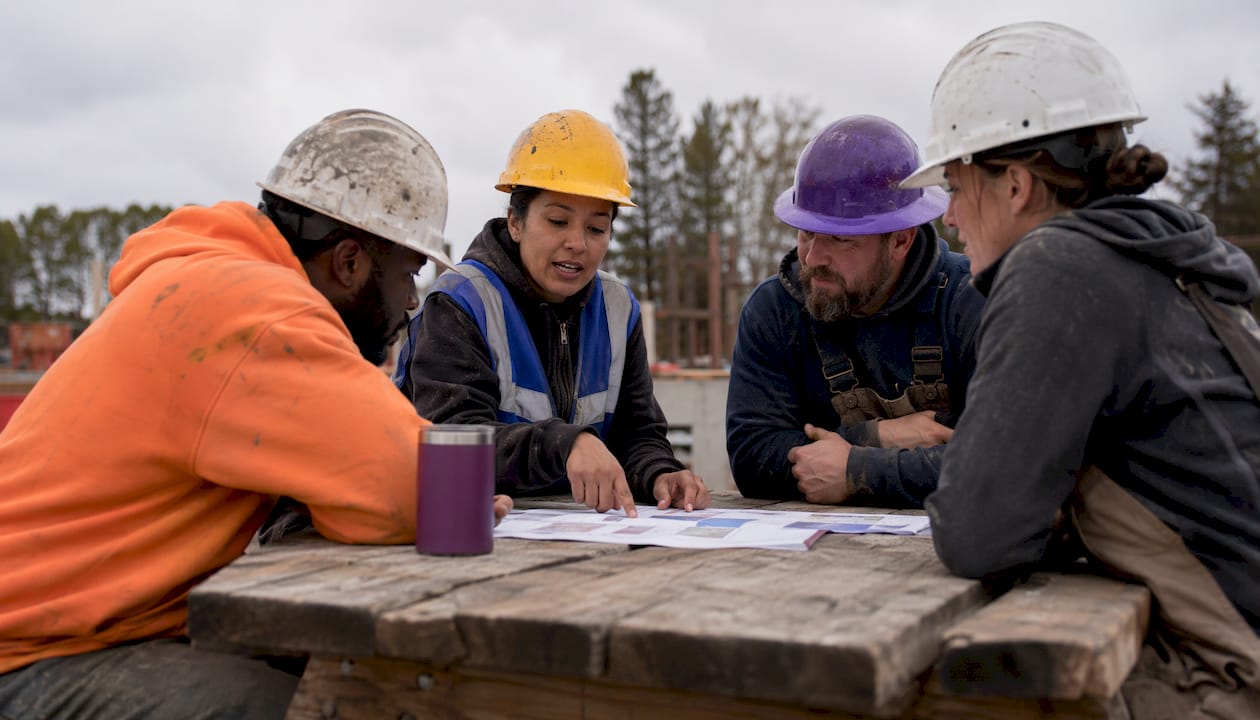
When site conditions change mid-task, stop and update the plan. A pre-task plan written at 7:00 AM does not account for the excavation that opened up next to your work area by 10:00 AM. Treat the document as a live record, not a one-time form.
Pro Tip: Keep a blank template on-site at all times, in both paper and digital form. When scope changes or a new crew rotates in, you can issue a revised plan without waiting for someone to email a file.
What compliance requires for pre-task plans in U.S. construction
Pre-task plans carry legal weight on U.S. construction sites, and the documentation requirements go beyond what many supervisors assume. Meeting OSHA standards and institutional requirements means getting specific about who signs, what gets documented, and how long you keep records.
Signature requirements
Every construction activity must have a dedicated pre-task plan signed by the plan author, area superintendent, safety manager, supervisor, and all crew members. That last part is where compliance breaks down most often. Supervisors routinely assume a foreman’s signature covers the crew. It does not. Full crew acknowledgment is required for authentic hazard mitigation and documentation authenticity.
What the plan must document
- Required PPE for each task step
- Specific hazard controls, not generic categories like “use caution”
- The responsible person for implementing and verifying each control measure
- All required permits, attached or referenced by number
- Emergency response information with specific locations and contacts
Submission timelines and record retention
Pre-task plans in many jurisdictions must be submitted to the contractor safety officer before work begins, and institutional standards like those at Harvard EHS specify submission in advance of task commencement. Keep completed plans on file for the duration of the project at minimum; many safety programs and contract requirements extend that retention period further. Check your specific contract and local jurisdiction requirements, since retention rules vary by state and project type.
Applicable standards
The primary compliance framework for pre-task planning in U.S. construction runs through OSHA 29 CFR 1926 (Construction Industry Standards), which covers fall protection, excavation, scaffolding, electrical, and other hazard categories your plan must address. The CPWR’s guidelines for PTP implementation provide a practical overlay that aligns with OSHA requirements and gives supervisors a field-tested structure for documentation. For a broader look at how JHA documentation connects to pre-task planning compliance, the principles overlap significantly.
Best practices that actually improve pre-task planning
Getting the template filled out correctly is the floor, not the ceiling. The plans that genuinely reduce incidents share a few habits that go beyond checking boxes.
Break tasks down further than you think you need to
Most supervisors write task steps at too high a level. “Install formwork” covers a dozen distinct actions, each with its own hazard profile. Effective pre-task planning breaks work into the smallest meaningful units so hazard identification stays specific. If a step description could apply to three different trades, it is too broad.
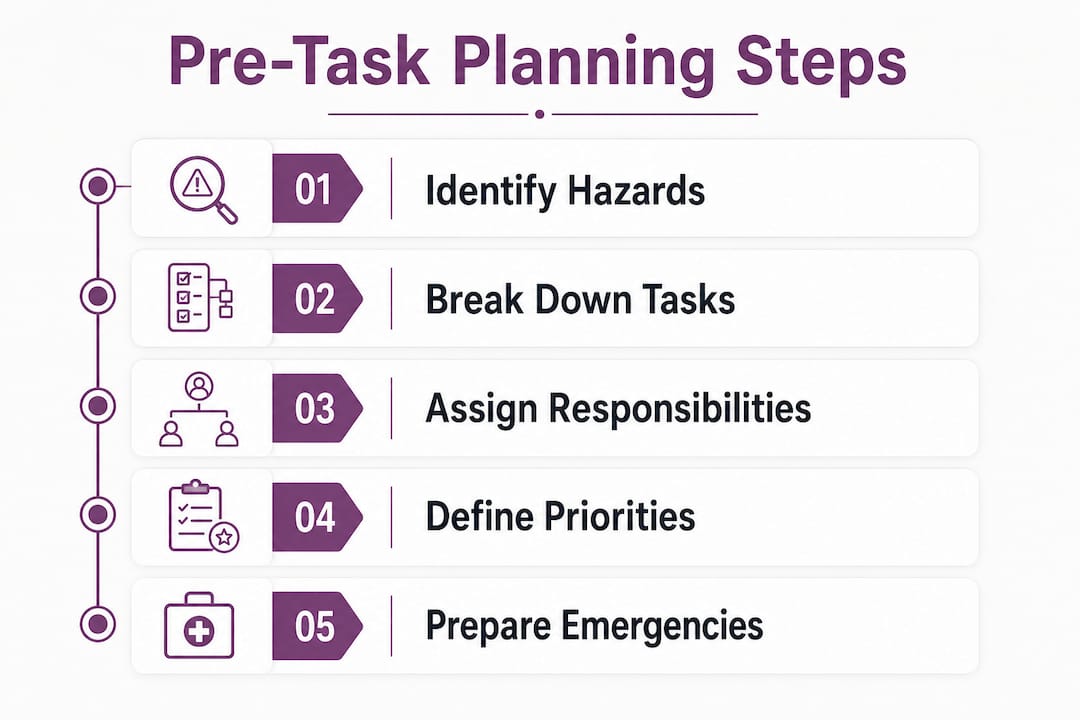
Define priority consistently
The “priority” field in many templates gets filled in based on gut feel, which makes it useless for scheduling decisions.
objective impact on the project schedule, not how stressed the supervisor feels about a task. When every team uses the same definition, the field actually helps decision-makers triage work under time pressure. Pairing this with a project workflow template that maps task dependencies can sharpen those priority calls further.
Build out the emergency section completely
Generic emergency references fail when they are needed most. The emergency section of a pre-task plan should name the exact evacuation assembly point for that specific work area, the street address of the nearest emergency room, and the direct cell number of the site safety lead. “See posted site plan” is not an answer a crew member can act on in a crisis.
Think in scenarios, not just checklists
A preliminary task checklist captures known hazards. What it often misses are the conditional ones. Pre-task planning works best when it includes “what if” thinking: what if the adjacent crew starts grinding while we are doing this pour? What if the weather changes and the scaffold deck gets wet? That scenario-based approach catches the hazards that a static list never surfaces.
Pro Tip: Run a quick “what if” round at the end of every pre-task briefing. Ask the crew to name one thing that could go wrong that is not already on the plan. You will catch at least one real hazard per week that the template fields did not prompt.
Key Takeaways
A compliant, well-used pre-task plan template requires specific hazard controls, named responsible persons, full crew signatures, and detailed emergency information, not just a completed checklist.
| Point | Details |
|---|---|
| Full crew signatures required | Every crew member must sign, not just the foreman, for the plan to meet compliance standards. |
| Name responsible persons | Each control measure needs a named person who implements and verifies it, per CPWR guidelines. |
| Emergency section must be specific | List the exact evacuation route, nearest ER address, and safety lead’s direct number, not generic references. |
| Break tasks into small steps | Granular task breakdowns surface hazards that high-level descriptions miss entirely. |
| Use scenario thinking | Ask “what if” questions at the briefing to catch conditional hazards the template fields do not prompt. |
Keep your training records as tight as your safety plans

A pre-task plan documents the work. Certicerts documents the people doing it. Safety professionals and construction supervisors use Certicerts to issue training certificates, generate wallet cards with offline QR verification, and maintain audit-ready records of every crew member’s qualifications, all from a local-first Windows desktop application that works without an internet connection on site. When an auditor asks who was qualified to do the work, you have the answer in seconds.
Explore Certicerts and see how it fits into your compliance workflow.