Training Gap Analysis: A 5-Step Audit for HR Teams

A training gap analysis is a structured process for measuring the difference between the skills your workforce has and the skills it needs to hit specific business goals. It works at three levels: organization, job, and individual. If you need to start one this week, follow this sequence:
- Scope it — pick the business goal and the team or role it depends on.
- List the skills — define what “good” looks like on a proficiency scale.
- Measure current state — pull assessments, manager ratings, and performance data.
- Calculate the gaps — compare current versus target, then rank by severity.
- Act — prioritize by business impact and choose to train, hire, or contract.
Success looks like a documented baseline, a prioritized gap list with owners attached, and checkpoints already scheduled at intervals covering short, medium, and longer terms. Skip the baseline and you have no way to prove the training worked.
Key Takeaways
A defensible training gap analysis requires a persistent pre-training baseline, evidence from at least three data sources, and a fixed 30/90/180-day evaluation cadence tied to business KPIs.
| Point | Details |
|---|---|
| Start with the KPI | Name the business metric before you list a single skill, or the analysis has no anchor. |
| Use three assessment levels | Check organization, job, and individual competencies separately to avoid strategically pointless training. |
| Combine evidence sources | Pair objective tests with manager ratings and performance data before calculating any gap. |
| Prioritize by impact, not size | A small gap in a critical skill usually outranks a larger gap in a peripheral one. |
| Track baselines with Certicerts | Log training completions and expiry dates in one persistent record with offline QR verification for audits. |
Table of Contents
- What Is a Training Gap Analysis and Why Does It Matter?
- When Should You Run a Skills Gap Assessment?
- The Five-Step Methodology for Running a Gap Analysis
- What Should a Skills Matrix and TNA Worksheet Include?
- How Do You Prioritize Gaps and Decide Build, Buy, or Borrow?
- How Do You Measure Whether Training Actually Closed the Gap?
- What Mistakes Waste Training Budget Most Often?
- How Do You Keep Gap Analysis a Living Process?
- A Practitioner’s View on Getting Buy-In With Thin Data
- Turn Your Gap Analysis Into a Live Compliance Record
- Sources
What Is a Training Gap Analysis and Why Does It Matter?
Most people think of a skills gap assessment as a single event: a survey, a skills test, maybe a manager checklist. It’s actually three separate diagnostic layers stacked on top of each other. The organizational level asks whether the company has the collective capability to hit its strategic goals. The task level asks what a specific job actually requires to perform well. The individual level asks where a specific person’s competencies fall short of that job requirement. Skip the organizational layer and you get a well run training program that solves nothing strategic, because nobody checked whether the skill you’re building actually moves a business metric.
This is where most competency gap analysis efforts go sideways. A department decides everyone needs a communication workshop because morale is low, then discovers six months later that the real problem was a broken handoff process between shifts, not a communication skill gap at all. Anchoring the process to business KPIs first and working backward to required skills, as recommended by Sopact’s training needs assessment framework, forces you to justify every training dollar against something leadership actually cares about.
Done well, closing targeted gaps shows up in concrete outcomes, as explained in why CRM training matters for SME growth:
- Fewer safety incidents tied to procedural skill gaps.
- Faster onboarding-to-productivity time for new hires.
- Reduced software rework once employees clear a competency threshold.
- Lower turnover in roles where skill mismatch was driving frustration.
When Should You Run a Skills Gap Assessment?
You don’t need to wait for an annual cycle to justify one. Certain events should trigger an immediate review:
- New technology or systems rollout — if you’re deploying a new platform, the gap between old and new workflows needs mapping before go-live, not after.
- Regulatory or compliance changes — a new certification requirement or safety standard creates an instant, measurable gap.
- Performance decline — a drop in a specific KPI (defect rate, sales conversion, incident frequency) is a signal to check whether skill, not effort, is the bottleneck.
- Team growth or restructuring — new roles or merged teams almost always reveal capability holes nobody planned for.
For cadence, run one full organizational assessment annually and layer in quarterly, event-driven checks for the teams affected by whatever just changed. For scope, start narrow. A single high-impact team with a clear KPI gets you a usable result in weeks; a company-wide sweep can take months and often stalls before anyone acts on it.
The Five-Step Methodology for Running a Gap Analysis
This is the process itself, and it borrows heavily from the stepwise model Litmos outlines for skills gap analysis, adapted for a more rigorous measurement approach.
1. Define scope and success metrics. Name the business KPI you’re trying to move. Sales conversion rate, incident frequency, customer satisfaction score, whatever it is. Then name the team or role whose skills most directly influence that number. Write the KPI down before you write a single skill. If you can’t connect the analysis to a metric leadership tracks, you’re about to waste a lot of people’s time.
2. Build a skills bank with target proficiency levels. For each role in scope, list the 8 to 12 skills that actually matter. More than that and the output becomes unmanageable, per guidance on limiting tracked competencies per role. For every skill, assign a target proficiency using a simple 0 to 5 scale:
- 0 — No exposure.
- 1 — Aware, cannot perform unsupervised.
- 2 — Performs with regular support.
- 3 — Performs independently in routine situations.
- 4 — Handles complex or unusual scenarios independently.
- 5 — Trains and mentors others.
3. Collect evidence on current state. This is where accuracy lives or dies. Use at least two independent sources per skill: an objective assessment or scenario test, a manager rating, and where possible, a self-assessment. Employees who rate their own skills as part of the process tend to engage more honestly with the results, a pattern Litmos has observed when the assessment is framed as development rather than evaluation. Frame it that way from the first email you send.
4. Calculate gaps and build the matrix. Subtract current proficiency from target proficiency for every skill, for every person. Roll that up into a skills matrix, then color code it into a heatmap: green for on-target, yellow for a one-point gap, red for two or more. The heatmap does more work than any narrative report because a director can scan it in ten seconds and see exactly where the risk sits.
5. Prioritize and assign action. Not every red cell deserves the same urgency. Score each gap on business impact and severity, then assign an owner, a closing method (train, hire, or contract), and a deadline. A gap with no owner attached rarely closes.

Pro Tip: Run the proficiency scale past two or three managers before you finalize it. If they can’t agree on what a “3” looks like for a given skill, your data will be noise no matter how good your collection method is.
What Should a Skills Matrix and TNA Worksheet Include?
A skills matrix is only useful if every cell has a clear definition. At minimum, structure it with role, skill, target proficiency, current proficiency, calculated gap, assigned owner, and planned action. A training matrix built this way turns into a live compliance and planning tool instead of a one-time snapshot.
| Column | What it captures |
|---|---|
| Role | The specific job title or function being assessed |
| Skill | One discrete competency, not a bundle |
| Target level | Required proficiency on the 0 to 5 scale |
| Current level | Measured proficiency from your evidence sources |
| Gap | Target minus current |
| Owner | Person accountable for closing the gap |
| Action | Train, hire, contract, or reassign |
Pair the matrix with a training needs analysis worksheet that asks a few root-cause questions for every flagged gap: Is this a knowledge gap, a skill gap, or a process gap? Has the person had a real opportunity to practice this? Would fixing a tool or a procedure close this faster than training would? Those questions, drawn from the CDC’s approach to needs assessment, keep you from prescribing a course when the actual problem sits somewhere else entirely.
How Do You Prioritize Gaps and Decide Build, Buy, or Borrow?
Rank every identified gap using a matrix that weighs business impact, severity, and how many people share the gap. A small gap in a mission-critical skill generally outranks a large gap in a peripheral one, which is counterintuitive if you’re used to sorting by gap size alone.
Once you know what’s urgent, decide how to close it:
- Build (train) — the most cost-effective route when the gap is widespread across a team and the skill is teachable in a reasonable window.
- Buy (hire) — better for rare, urgent, or highly specialized gaps where training would take too long to catch up.
- Borrow (contract) — the right call for a short-term or one-off need that doesn’t justify a permanent skill investment.
If it’s isolated to one or two people, check for a hiring or fit issue before you build a course around it.*
How Do You Measure Whether Training Actually Closed the Gap?
None of this matters if you can’t prove the gap closed. That starts with a pre-training baseline recorded against the same learners you’ll re-measure later, an approach Sopact calls the “learner thread”, where each person’s pre-training answers stay tied to their record so the post-training comparison is apples to apples.
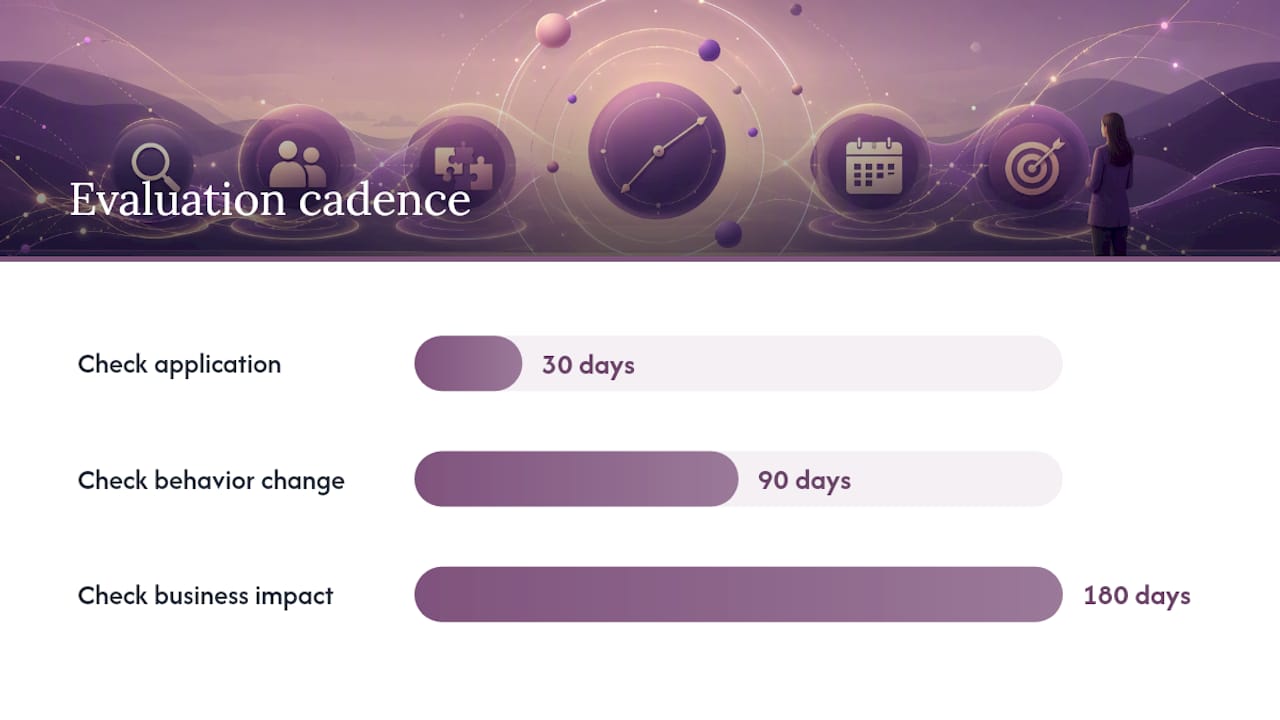
From there, follow a fixed evaluation cadence. Industry guidance on high-impact program evaluation points to three checkpoints:
- 30 days — check application: is the person actually using the skill on the job?
- 90 days — check behavior change: has the new skill become the default way they work, not a one-time demonstration?
- 180 days — check business impact: has the KPI you named in step one actually moved?
That last checkpoint is where you build your ROI case. Report it in the same terms leadership already tracks (incident rate, cycle time, conversion rate) rather than training-specific metrics like completion rate, which executives tend to tune out.
What Mistakes Waste Training Budget Most Often?
The single most common pitfall is treating a symptom as a skill gap. Before committing budget, ask a short set of diagnostic questions: Would this person perform correctly if given a checklist right now? Has the process changed recently without anyone updating the training? Is there an incentive actually rewarding the wrong behavior? Capture the qualitative “why” alongside the numeric rating, not just the number itself. A red cell with no explanation attached tells you almost nothing about what to fix.
- Training a process gap instead of fixing the process.
- Building a course for a tool that’s about to be replaced.
- Ignoring incentive structures that reward the opposite of the trained behavior.
Pro Tip: If three different people give the same numeric rating but three completely different explanations for it, that’s a signal the gap isn’t really a skill gap. Dig into the “why” before you build anything.
How Do You Keep Gap Analysis a Living Process?
A gap analysis that lives in a spreadsheet from last year is worthless. Build the checks into onboarding and into every performance review cycle, so proficiency ratings update continuously instead of resetting from scratch each time. Keep persistent learner records so a re-measurement six months later is comparing the same person against the same baseline, not starting over.
- Assign a single owner for governance, not a committee.
- Set a fixed review cadence and stick to it.
- Report progress to leadership on the same KPI cycle used elsewhere in the business.
A Practitioner’s View on Getting Buy-In With Thin Data
Executives don’t fund a gap analysis because it’s rigorous. They fund it because it’s tied to a number they already worry about. Frame the pitch around the KPI, not the methodology.
If your data is thin, don’t wait for a perfect assessment. Run a targeted pilot on the single highest-impact skill in one team, measure it properly, and use that result to justify the bigger rollout. Manager accountability comes down to one thing: put their name on the gap as the owner, and check in on it at the next one-on-one, not just at review time.
— James
Turn Your Gap Analysis Into a Live Compliance Record
Certicerts is built for the part of this process that most spreadsheets fail at: keeping the baseline alive after you’ve done the work. Once you’ve identified a gap and closed it through training, Certicerts lets you issue the certificate, generate a matching wallet card, and log the completion date directly into a training record that persists for as long as that employee is with you.
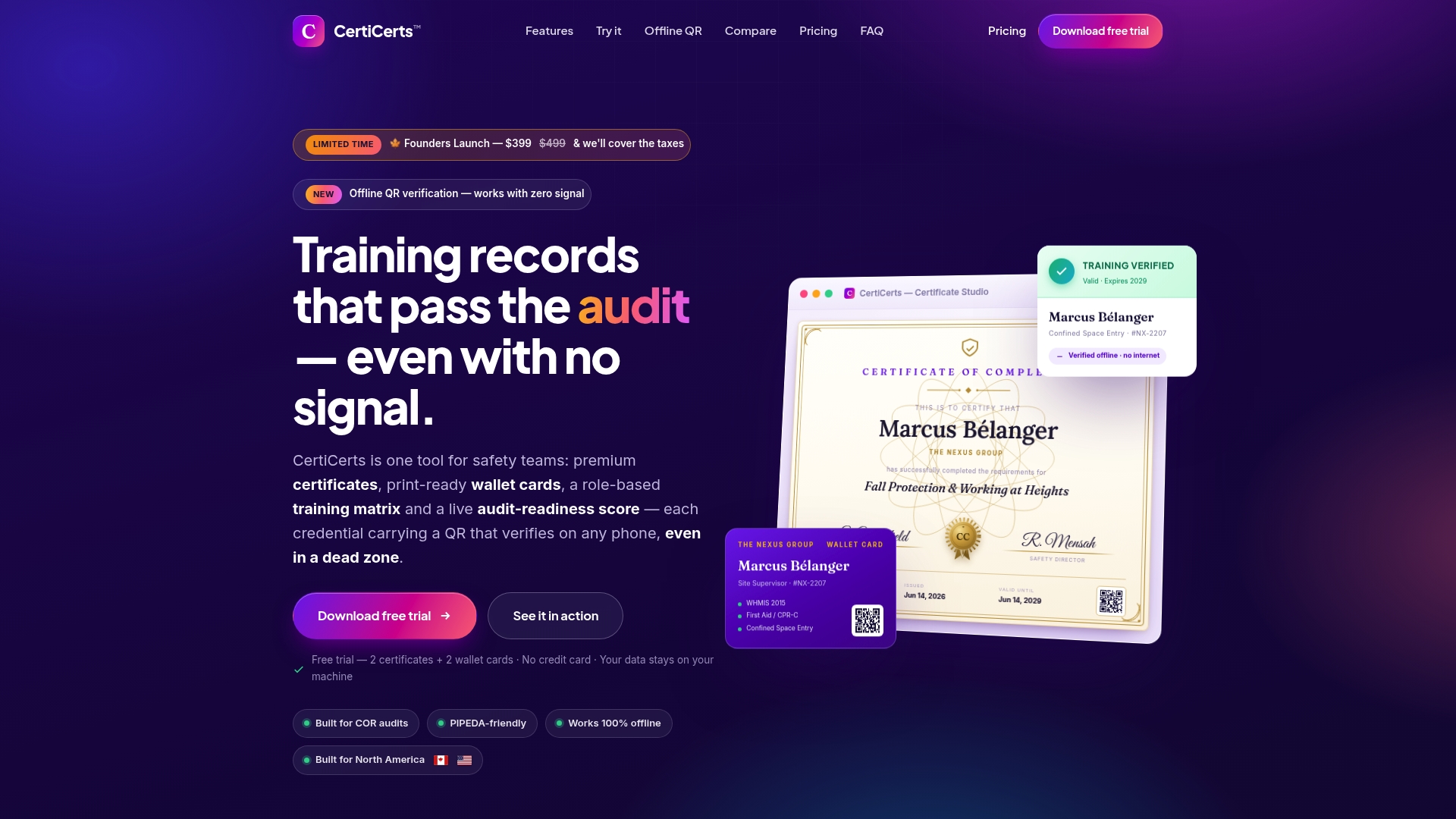
The compliance dashboard shows expiring certifications and outstanding training gaps across departments in one view, so your 30/90/180-day checkpoints aren’t a manual chase through folders. Every certificate carries an offline QR verification code, which means a supervisor, client, or auditor can confirm a credential on-site without needing an internet connection. Because Certicerts runs local-first, your training records stay under your organization’s control rather than sitting in someone else’s cloud. For teams running gap-closing training across an entire event or cohort, bulk issuing generates certificates and wallet cards for the whole group at once instead of one at a time. Start with the free trial to see how your next training rollout gets tracked from baseline to verified completion.
Sources
A single data source is a guess dressed up as a measurement. A defensible skills gap assessment triangulates from at least three angles:
- Sopact — Training needs assessment: Learner Thread and baseline approach
- CDC — Needs assessment and training needs analysis
- Litmos — Conduct a skills gap analysis in 5 steps
LMSpedia’s overview of training needs assessment tools makes the case for combining these sources into a single prioritized report you can export directly into an LMS or HR system, rather than leaving the analysis stranded in a spreadsheet nobody opens again. Off-the-shelf assessments save time for common roles; custom scenario tests are worth building for anything safety-critical or highly specialized. Either way, standardize the rating scale across sources before you combine them, or your gap calculations will be comparing incompatible numbers.