Incident Investigation Template for Safety Teams and HR

Use this audit-ready incident investigation template to produce defensible investigation records that satisfy OSHA-aligned reviews and feed directly into your training and compliance systems. The template covers every field an auditor expects: date, time, and location; all persons involved; incident summary and chronology; an evidence log (photos, CCTV footage, equipment condition logs); at least two signed witness statements; a documented root-cause analysis; corrective actions with assigned owners and due dates; verification; and formal investigator and supervisor sign-off. It fits OSHA-aligned investigations and integrates with training-record systems, including Certicerts for remedial certificate issuance.
Quick-reference fields the template contains:
- Report header: site/project name, report ID, date and time, location
- Persons involved: names, roles, employee IDs
- Incident summary and chronological timeline
- Evidence log with unique IDs, collector name, and timestamp
- At least two witness statements, verbatim and signed
- Root-cause analysis with method documented
- Corrective and preventive actions: owner, timelines, priority, verification evidence
- Formal sign-off: investigator and supervisor, with date
Table of Contents
- What goes in each field of the incident investigation template
- Your audit-ready evidence checklist
- How to choose and document your root-cause method
- Recommended timelines and US reporting considerations
- What a completed template entry looks like
- How to store records and link them to training systems
- Using investigations to reduce recurrence and build safety culture
- Key Takeaways
- What investigators actually get wrong
- Certicerts connects your investigations to your training records
- Useful sources
What goes in each field of the incident investigation template
OSHA guidance frames investigation records as tools to identify causes, prevent recurrence, and document accountability. That purpose shapes how every field should be filled.
Report header. Record the site or project name, a unique report ID (e.g., INC-2026-047), the date and time of the incident, and the exact location. Vague entries like “warehouse” fail audits; “Warehouse B, Bay 3, Loading Dock” does not.
Immediate actions. List what was done in the first two hours: first aid administered, area secured, equipment isolated, regulators notified. Keep it factual and time-stamped.
Incident description and timeline. Write a brief narrative summary, then follow it with time-stamped bullets. Example: 14:32 — Forklift operator begins reversing; 14:33 — Pedestrian enters blind spot; 14:33 — Contact occurs; 14:34 — Supervisor notified. Chronology is what separates a defensible record from a story.

Equipment and environment. Note equipment condition, maintenance status, lighting, weather, and any environmental readings. Cross-reference maintenance logs by document number.
Injuries and medical treatment. Record the nature and location of injury, treatment provided, and whether the employee was transported offsite. Keep medical detail in the secure full record; redact it from any shared extract.
Witness statements. Collect statements separately, in the witness’s own words, dated and signed. Tailoring the process to circumstances matters here: ask open questions, record verbatim answers, and note any inconsistencies without editorializing. At least two statements are recommended to strengthen defensibility.
Evidence attachments. Tag each item with a unique evidence ID (e.g., PHOTO_01, CAM3_2026-04-11.mp4) and reference those IDs in the narrative. More on this in the next section.
Root-cause analysis. Name the method used, list participants, and record the step-by-step reasoning. Separate immediate cause from root cause explicitly — a wet floor is an immediate cause; the absence of a spill-response protocol is a root cause.
Corrective and preventive actions. Each action needs an owner, a due date, a priority level (critical/high/medium), and a field for verification evidence once closed.
Sign-off. Both the lead investigator and a supervisor must sign and date. This creates the accountability trail auditors look for.
Pro Tip: Record who collected each piece of evidence and the exact time. For digital files, log the file hash or a unique ID. That chain-of-custody detail is what keeps evidence admissible if the record is ever challenged.
Your audit-ready evidence checklist
An audit-ready investigation record includes photos, CCTV footage, equipment condition logs, maintenance records, permits, training and qualification records, incident scene sketches, environmental readings, and at least two signed witness statements. Miss any of these and an auditor will flag the gap.
Practical evidence checklist:
- Photos of the scene, equipment, and any injuries (labeled PHOTO_01 through PHOTO_N)
- CCTV or dashcam footage with file name, camera ID, and timestamp
- Equipment condition log and most recent maintenance record
- Permits to work or lock-out/tag-out records in effect at the time
- Training and qualification records for all persons involved
- Scene sketch or diagram with measurements
- Environmental readings (lighting levels, temperature, noise, air quality where relevant)
- At least two witness statements, verbatim, dated, and signed
Tag every item with a unique evidence ID, the name of the person who collected it, the date and time of collection, and the storage path. A single-source repository, exported as an immutable signed PDF with attachments, is the standard for US recordkeeping. Retention periods vary by state and industry; align to your company policy and any applicable OSHA recordkeeping requirements.
Pro Tip: Keep a separate chain-of-custody log for digital media. Note any format conversions (e.g., .mov to .mp4) and who performed them. An unlogged conversion can raise questions about file integrity during a legal review.
How to choose and document your root-cause method
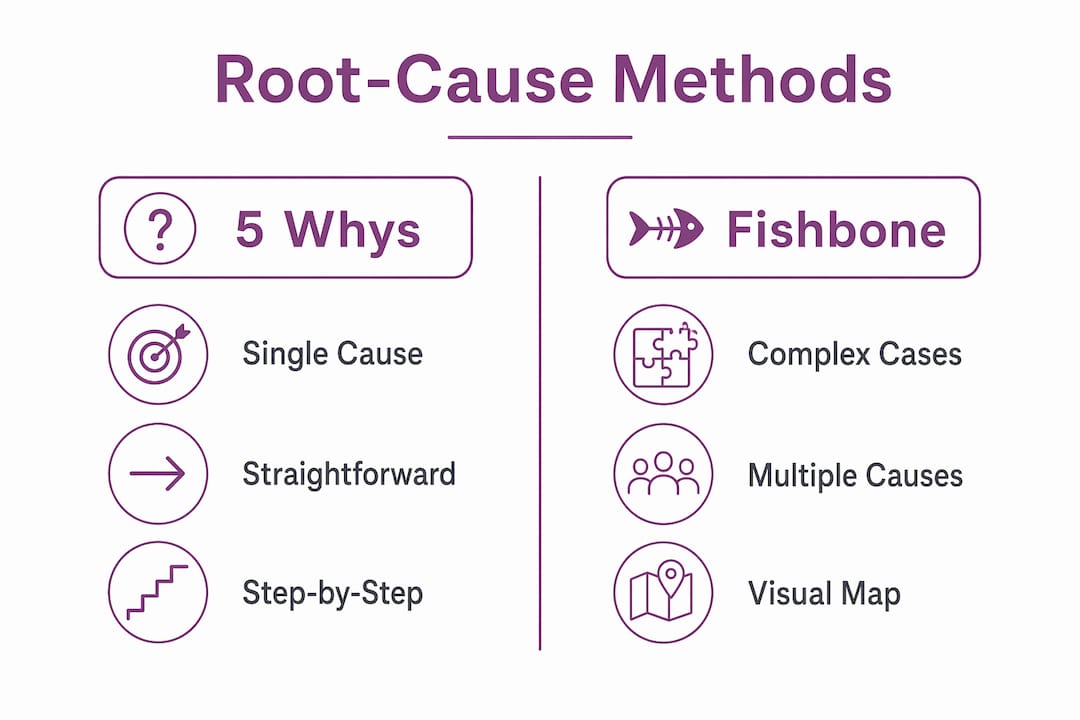
The method you choose should match the complexity of the incident. Common investigation form elements include 5 Whys and fishbone diagrams as standard options; more complex incidents may warrant ICAM or Bowtie analysis.
| Method | Best use case | Typical output | Documentation tip |
|---|---|---|---|
| 5 Whys | Single-cause, straightforward incidents | Causal chain ending at systemic failure | Record each “why” question and answer verbatim |
| Fishbone (Ishikawa) | Multi-factor incidents with several contributing causes | Cause-and-effect diagram | Photograph or export the diagram; attach as evidence |
| ICAM | Complex incidents with organizational and human factors | Structured causal tree | List all participants and their roles in the analysis session |
| Bowtie | High-consequence risk scenarios; barrier analysis | Threat/consequence map with barrier status | Document which barriers failed and why |
Record the method name, the date of the analysis session, the facilitator, all participants, and the evidence used at each step. This makes the findings reproducible and defensible if the investigation is reviewed later.
Pro Tip: Whatever method you use, create two explicit fields in the template: one for immediate cause(s) and one for root cause(s). Investigators who conflate the two produce shallow findings that fail under scrutiny. Document who validated each causal link.
Recommended timelines and US reporting considerations
Concrete time targets keep investigations on track and help you meet regulatory expectations. OSHA guidance sets specific notification requirements for severe injuries, hospitalizations, and fatalities; always verify current rules with your OSHA area office or state-plan equivalent.
| Milestone | Target timeframe |
|---|---|
| Immediate response and first aid | Within 2 hours |
| Scene preservation and evidence collection | Within 24 hours |
| Investigator assigned | Within 24 hours |
| Fact-finding completed | Several days (typical incidents) |
| Root-cause analysis and corrective actions documented | Several days depending on complexity |
| Verification and closure | within an appropriate timeframe depending on the complexity of fixes |
For OSHA-recordable cases, check whether the incident triggers a mandatory report. Fatalities must be reported within 8 hours; in-patient hospitalizations, amputations, and loss of an eye within 24 hours. State OSHA plans may have stricter timelines. Log every timeline entry in the template with a timestamp, the author’s name, and a brief rationale for any delay.
When the investigation closes, export a finalized, signed PDF and link that file to your training records and corrective-action tracker. A pre-task plan cross-referenced against the investigation record can also surface whether a task-level control failure contributed to the incident.
What a completed template entry looks like
The example below is anonymized. Use it as a model for phrasing and level of detail.
Report ID: INC-2026-047 | Date: April 11, 2026, 14:33 | Location: Warehouse B, Bay 3
Summary: A worker sustained an injury when a reversing forklift made contact in a shared traffic zone. The area lacked floor markings separating pedestrian and vehicle paths.
Timeline: 14:30 — Forklift operator begins shift in Bay 3. 14:32 — Operator begins reversing maneuver. 14:33 — Pedestrian enters bay from side corridor. 14:33 — Contact occurs. 14:34 — Supervisor notified; first aid administered.
Witness 1 (J. Torres, Warehouse Associate): “I saw the forklift reversing and the worker walk in from the side door. There was no warning sound.” Signed, April 11, 2026.
Witness 2 (M. Patel, Shift Supervisor): “I heard the collision and arrived within one minute. The floor markings in that bay have been faded for several weeks.” Signed, April 11, 2026.
Evidence: PHOTO_01–PHOTO_04 (scene); CAM3_2026-04-11.mp4 (CCTV Bay 3); MAINT_LOG_FK02 (forklift maintenance record).
5 Whys: Why did contact occur? No pedestrian separation. Why no separation? Floor markings absent. Why absent? Maintenance schedule did not include marking inspection. Why not included? No formal inspection checklist for shared zones. Why no checklist? Policy gap in traffic management plan.
Corrective actions: (1) Repaint pedestrian lanes — Facilities Manager, due April 18, 2026, Critical. (2) Add shared-zone inspection to monthly checklist — EHS Manager, due April 25, 2026, High.
Sign-off: Lead Investigator: [Name], April 12, 2026. Supervisor: [Name], April 12, 2026.
Redact personal medical details from any extract shared outside the investigation team. Full records stay in secure storage per your retention policy. For confidentiality guidance specific to human-services settings, sector-specific resources address victim support and privacy considerations in more depth.
How to store records and link them to training systems
Filing a signed PDF is not the end of the workflow. The real value comes from connecting investigation outputs to training assignments and certificate issuance so that corrective actions actually close competency gaps.
| Field | Purpose |
|---|---|
| Report ID | Primary key linking all related records |
| Evidence IDs | Cross-reference to physical/digital evidence log |
| Corrective action IDs | Track each action through to verified closure |
| Training module ID | Maps the corrective action to a specific course |
| Employee ID | Links the training requirement to the individual |
| Verification date | Confirms training completed and certificate issued |
Certicerts supports this workflow directly. When a corrective action requires remedial training, Certicerts generates the certificate, produces a matching wallet card, and records QR-verified completion in the compliance log. That verification date then closes the loop in the investigation record. For teams managing construction safety records, linking investigation outputs to training systems this way reduces the risk of a corrective action sitting open because no one tracked the training requirement.
Use consistent file naming: INC-[YEAR]-[NUM]_FINAL.pdf. Store evidence files in a subfolder named with the same report ID. Automate where possible: a closed corrective action flagged as requiring training should trigger a mandatory assignment in the training system without a manual step.
Using investigations to reduce recurrence and build safety culture
OSHA’s guidance is clear that the primary purpose of an investigation is proactive: prevent recurrence and demonstrate due diligence. A blame-focused investigation produces a scapegoat; a system-focused one produces a fix.
Practical steps that turn findings into culture change:
- Hold a team debrief within 48 hours of the investigation closing; share anonymized findings with the crew involved.
- Publish a one-page lessons-learned summary to the broader workforce and attach links to any required remedial training.
- Track three metrics post-investigation: corrective-action closure rate, repeat-incident frequency for the same hazard type, and training completion rate tied to the incident.
- Link investigation outcomes to supervisor performance metrics so accountability sits at the right level.
Avoid the trap of listing “retraining” as the sole corrective action. If the system allowed the incident, retrain the system. JHA best practices offer a useful framework for identifying where task-level controls failed before an incident occurs.
Pro Tip: Publish anonymized incident summaries quarterly. Teams that see their own near-misses reflected in organization-wide data report higher hazard-identification rates. Attach the relevant remedial training link directly to each summary.
Key Takeaways
A complete, signed incident investigation record with documented root-cause analysis, verified corrective actions, and linked training certificates is the minimum standard for US audit defensibility.
| Point | Details |
|---|---|
| Preserve scene and evidence early | Collect photos, CCTV, equipment logs, and multiple witness statements within 24 hours. |
| Document root cause separately | Use 5 Whys, fishbone, or ICAM; record immediate cause and root cause in distinct fields. |
| Assign every corrective action | Each action needs an owner, a due date, a priority level, and a verification field. |
| Export an immutable audit copy | Save a signed PDF with all attachments; retain per company policy and OSHA recordkeeping rules. |
| Link records to training | Use Certicerts to issue remedial certificates, produce wallet cards, and log QR-verified completion against the investigation record. |
What investigators actually get wrong
The most common failure in workplace investigations is not missing evidence — it is shallow root-cause analysis. An investigator writes “employee error” as the root cause and closes the file. That answer satisfies no auditor and fixes nothing. The wet floor is not the root cause; the absence of a spill-response protocol is. Templates that force separate fields for immediate cause, contributing factors, and systemic root cause make this harder to skip.
The second failure is evidence tagging. Photos land in a shared drive with names like “IMG_4821.jpg” and no collector, no timestamp, no link to the report. Six months later, no one can confirm which incident they belong to. Unique evidence IDs and a chain-of-custody entry take two minutes and save hours of reconstruction.
The third is closure. Corrective actions get assigned and forgotten. The investigation record shows “pending” indefinitely. Linking each action to a training requirement in a system that tracks completion changes that dynamic. When the certificate gets issued and the QR code scanned, the action is genuinely closed.
Certicerts connects your investigations to your training records
Once an investigation closes and corrective actions are assigned, the next problem is making sure the required training actually happens and gets recorded. That is where Certicerts fits.
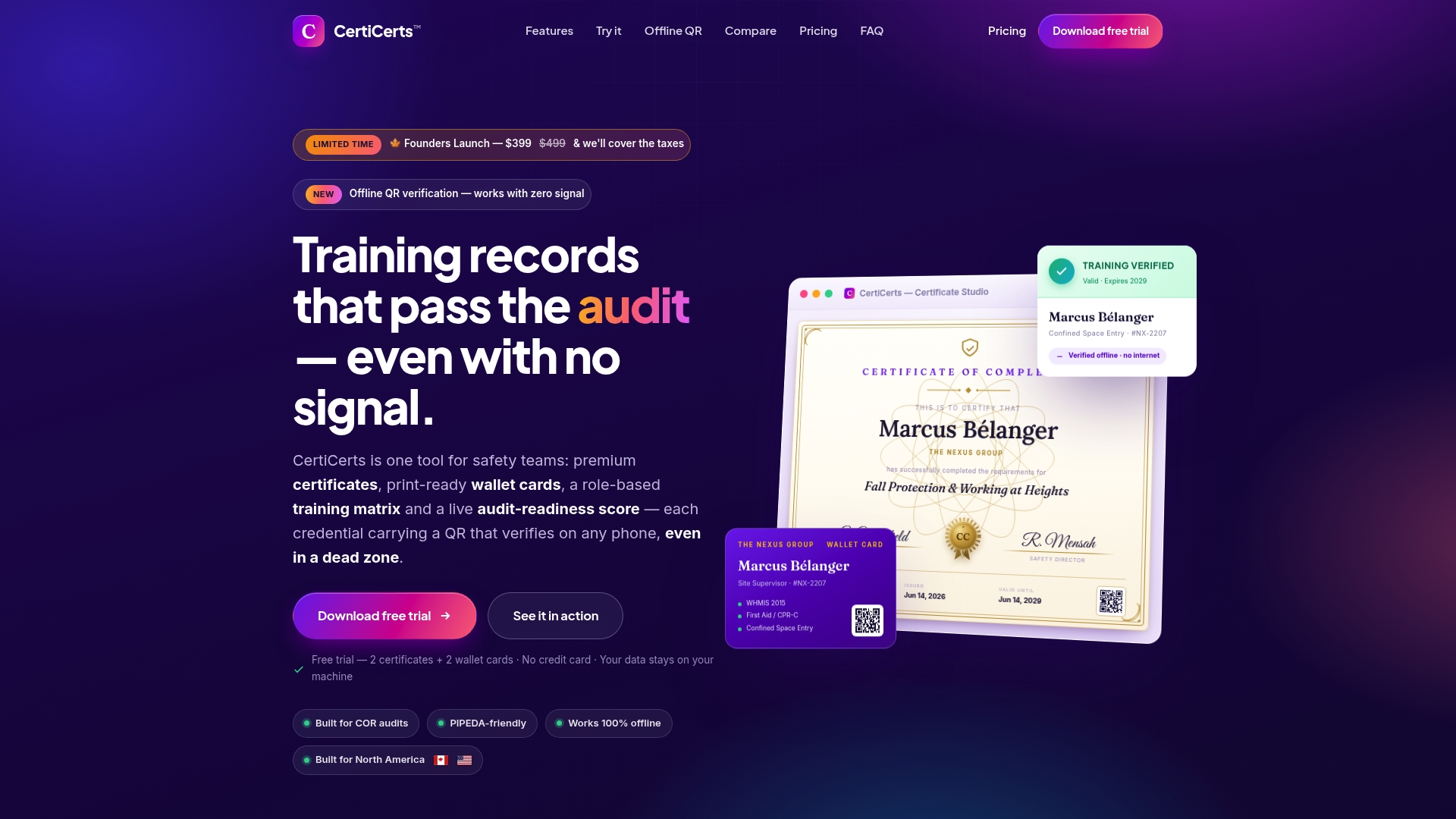
Certicerts is a Windows desktop application built for safety professionals and HR teams who need to issue remedial training certificates, produce wallet cards, and verify completion without depending on a cloud subscription. The workflow is direct: investigation closes, corrective action maps to a training module, Certicerts generates the certificate and wallet card, and the QR-verified completion date goes back into the compliance log. Every record stays on your system, exportable as a signed PDF for the next audit.
Start with a free trial and see how Certicerts handles certificate generation, training record management, and offline QR verification for your team.
Useful sources
- OSHA Incident Investigation guidance — primary US regulatory reference for investigation duties, evidence preservation, and reporting timelines
- Free Incident Investigation Form — MapTrack — downloadable template with 5 Whys and corrective-action fields
- Incident Investigation Report Template — The HSE Coach — practical sequence model: timeline, facts, evidence, analysis, actions, verification
- How to navigate evidence in workplace investigations — HR Acuity — guidance on evidence types and sign-off requirements for audit-ready records
- Employment Investigations Checklist — Mayer Brown — legal-practice checklist for tailoring investigation processes to circumstances
- Free Workplace Incident Report Templates — eForms — library of incident report forms covering the range from immediate reports to full investigation records