What Is a Swing Stage in Construction: 2026 Guide
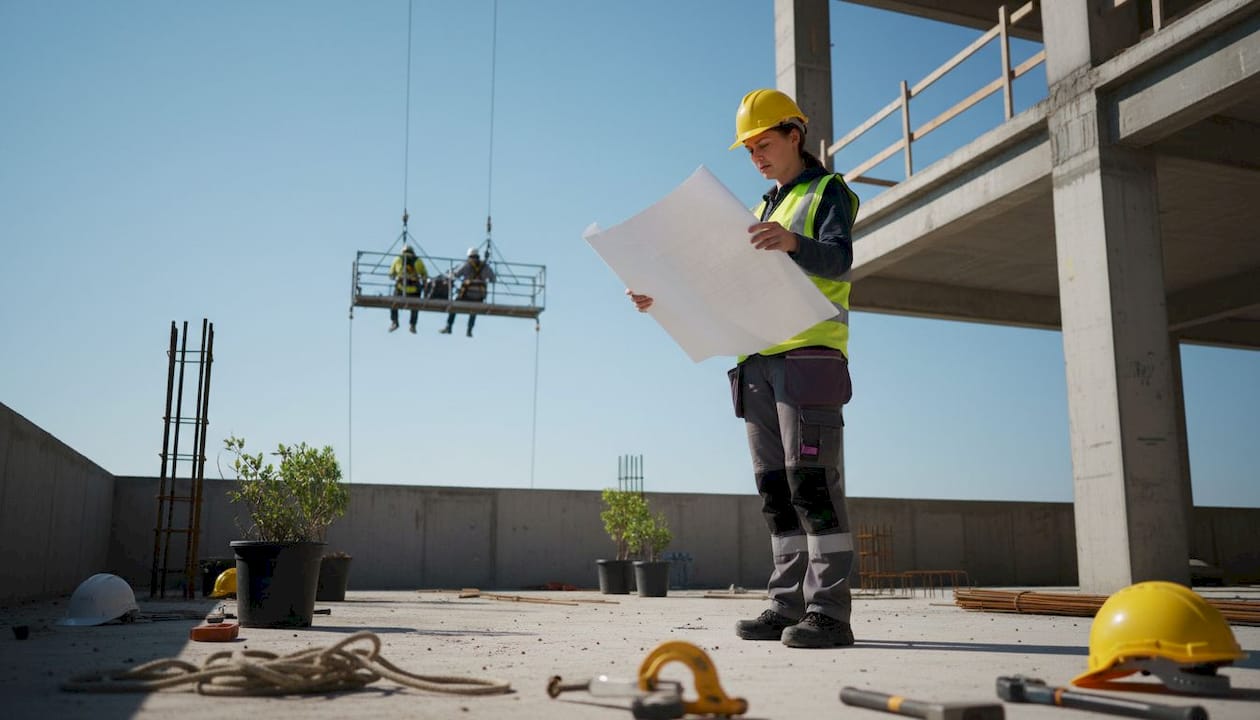
A swing stage in construction is defined as a two-point adjustable suspension scaffold: a platform hung by steel cables from overhead supports that gives workers a stable, vertically movable work surface on building exteriors. The industry term is “two-point adjustable suspended scaffold,” though “swing stage” is the phrase used universally on job sites. Suspended scaffolds typically use manual or motorized hoists to raise and lower workers safely along building facades for window cleaning, painting, and structural repairs. Understanding how these systems work, what OSHA requires, and how to certify your crew is not optional. It is the difference between a compliant job site and a fatal incident.
What is a swing stage in construction and how is it defined?
A swing stage is a suspended platform hung by two cables or wire ropes from overhead anchor points, allowing workers to move vertically along a building’s exterior. The platform itself sits inside a metal frame called a stirrup, which connects to the suspension cables above and the hoist mechanism on each end. Workers control their elevation by operating motorized or manual hoists, raising or lowering the platform as the task requires.
The system is purpose-built for high-rise access. Unlike fixed scaffolding that requires ground-level assembly and a large footprint, a swing stage deploys from the roof and reaches any floor below. That design makes it the preferred access method for glass curtain wall buildings, concrete towers, and steel-frame high-rises where ground-based alternatives are impractical.
Key components every project manager should know:
- Davit arms: Roof-mounted steel arms that extend over the building edge and carry the suspension cables
- Hoists: Motorized or manual devices that control vertical travel speed and position
- Stirrups: The metal end frames that hold the platform and attach to the hoist and cables
- Tiebacks: Steel cables or straps that anchor davit arms to the roof structure, preventing tip-over
- Lifelines: Independent vertical lines attached to the building for worker fall arrest, separate from the platform suspension
Each component carries a specific load rating and inspection requirement. Substituting or skipping any one of them creates a failure point that OSHA citations and incident reports consistently identify.
How does a swing stage work in construction projects?
Vertical movement is straightforward. Workers activate the hoists, and the platform travels up or down along the building face at a controlled rate. The cables remain taut under load, and the stirrups keep the platform level as long as both hoists operate in sync. Most motorized systems include automatic leveling controls that prevent one end from rising faster than the other.
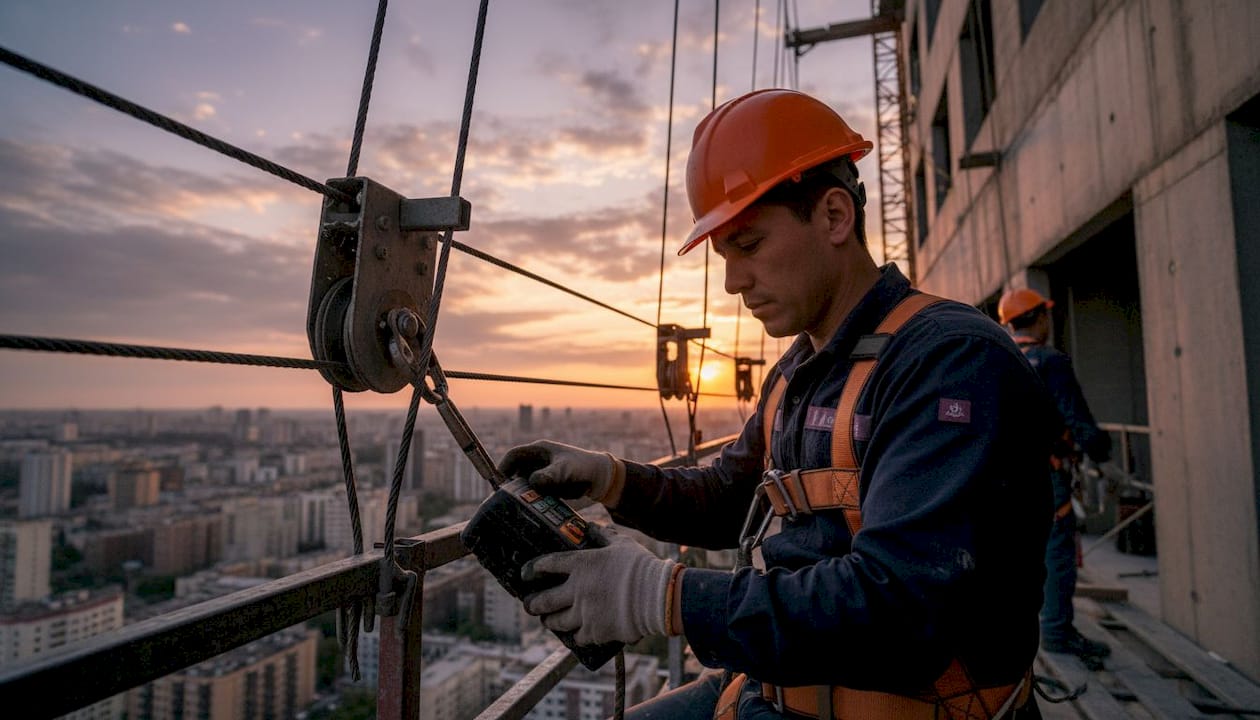
Lateral movement is where most planning errors occur. Each swing stage setup requires at least two dedicated davit arms mounted on the roof for secure platform suspension. To move the platform sideways to a new section of the building, workers must lower it to the ground, disconnect the rigging, and reposition the davit arms to new anchor points. Project managers must plan equipment logistics around this constraint. Assuming the platform can simply slide laterally while suspended is a common and dangerous misconception.
Pro Tip: Map your davit arm positions before the job starts. Identify every anchor point across the roof and sequence the work so lateral moves happen at natural break points, not mid-task. This cuts repositioning time and reduces the number of times workers handle live rigging.
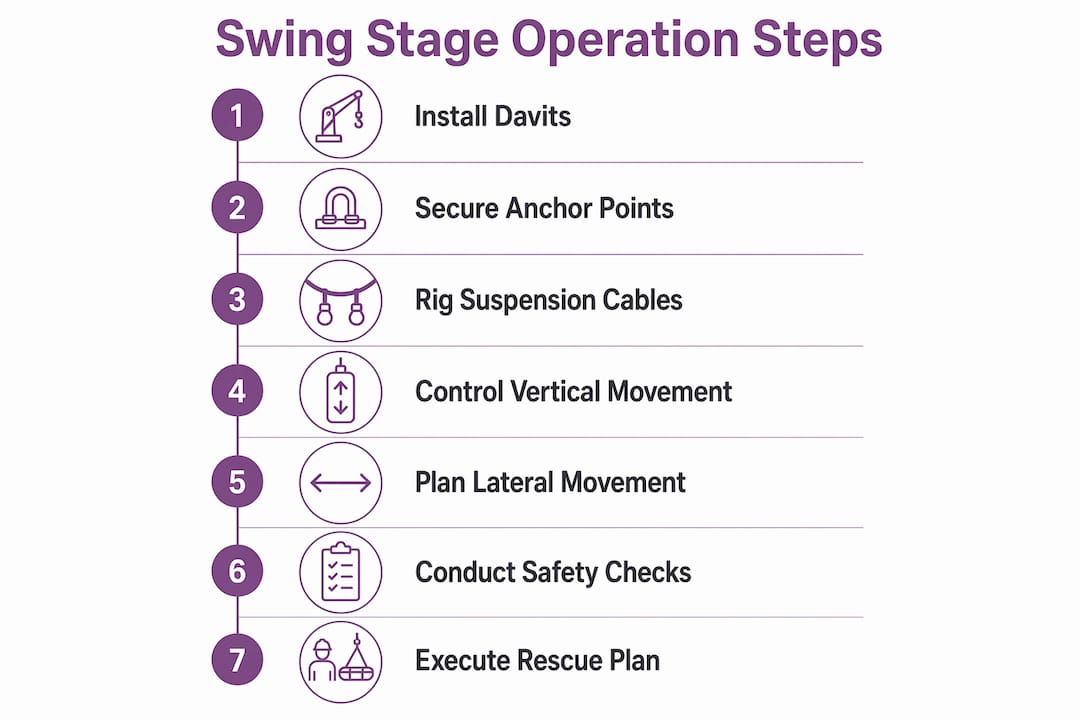
The rigging sequence matters as much as the hardware. Tiebacks must be secured before any load goes on the davit arms. Stirrups and tiebacks connect suspension cables to platforms and secure scaffolds to building structures, preventing excessive sway and maintaining platform levelness during operations. A platform that sways or tilts under load is not a minor inconvenience. It is a precursor to a suspension failure or a worker fall.
What are the essential safety considerations for swing stage use?
OSHA’s suspended scaffold standards under 29 CFR 1926.502 and 1926.451 set the minimum requirements for swing stage operation. Proper anchoring, guardrails, harnesses, lifelines, and emergency rescue planning are all mandatory. Regular inspection by a competent person before each shift is not a recommendation. It is a legal requirement.
Two hazards specific to suspended scaffolding kill workers that ground-level fall protection training does not address:
- Suspension trauma: A worker who falls and is caught by a harness while suspended can lose consciousness within minutes due to blood pooling in the legs. Without a rescue plan that retrieves the worker within that window, the outcome is fatal.
- The pendulum effect: If a worker falls from a platform and their lifeline anchor is not directly above them, they swing in an arc and strike the building facade at speed. The impact force can be severe enough to cause fatal injuries even when the harness holds.
- Platform overloading: Swing stages have rated load capacities. Exceeding them with tools, materials, or extra workers causes cable stress and hoist failure.
- Weather exposure: Wind above the rated threshold for the equipment makes the platform unstable. Most manufacturers specify maximum wind speeds for safe operation.
- Inadequate inspection: Worn cables, corroded fittings, and damaged hoist mechanisms are invisible to untrained eyes. A competent person inspection before each use catches these before they become incidents.
Swing stage certification programs ensure workers understand hazards like suspension trauma and the pendulum effect, both of which can be fatal without proper training and protocols. Certification is a life-saving barrier and the single most effective control for suspended scaffold risk.
Pro Tip: Write your emergency rescue plan before the first worker steps onto the platform. Identify who retrieves a suspended worker, what equipment they use, and how long retrieval takes. Practice it. A plan that exists only on paper has never saved anyone.
Competent person training covers inspection criteria, load calculations, rigging procedures, and emergency response. Safety officers who treat swing stage certification as a checkbox rather than a skill set create the conditions for the incidents they are trying to prevent. The JHA best practices for suspended scaffold work should include suspension trauma response as a named hazard with a specific control.
What are the stabilization requirements for high-rise swing stage operation?
Height changes everything about how a swing stage behaves. A platform working at the 5th floor of a building moves very differently from one at the 30th. Wind forces increase with altitude, cable length adds elasticity and sway, and the consequences of a pendulum event grow with every additional foot of fall distance.
Swing stages operating under 130 feet can use angulated roping for stabilization. Those operating between 130 and 300 feet must have Intermittent Stabilization Anchors (ISAs) installed to prevent dangerous sway. ISAs are anchor points fixed to the building facade at regular intervals that the platform ties into as it descends, limiting how far it can swing at any given height.
| Height range | Stabilization method | Key requirement |
|---|---|---|
| Under 130 feet | Angulated roping | Cables angled to reduce lateral movement |
| 130–300 feet | Intermittent Stabilization Anchors (ISAs) | Facade anchors at regular intervals |
| All heights | Secondary fall arrest anchors | Spaced no more than 12 feet apart |
Anchor spacing is a hard technical limit, not a guideline. Suspended access anchors must not be spaced more than 12 feet apart, and workers must maintain secondary fall arrest anchors within 15 degrees to reduce pendulum risk. That 15-degree rule is the geometry that determines whether a fallen worker swings into the building or drops cleanly.
Additional stabilization factors that affect every job:
- Wind speed limits: Check the equipment manufacturer’s rated wind speed and stop work when conditions exceed it
- Facade irregularities: Setbacks, balconies, and architectural features interrupt the platform’s travel path and require specific rigging adjustments
- Tieback angles: Tiebacks must be rigged at or below horizontal to the davit arm. An upward angle reduces holding force and increases tip-over risk
- Cable inspection: Suspension cables must be inspected for kinks, broken wires, and corrosion before each use. A single broken wire strand in a critical location is grounds for immediate replacement
How are swing stages applied in construction and maintenance projects?
Common applications for swing stages include window installation, high-rise cleaning, facade repairs, bridge maintenance, and interior ceiling work on tall structures. Their versatility makes them the access method of choice across construction, maintenance, and restoration work at height.
The urban advantage is significant. Swing stages take up far less ground-level space than traditional scaffolding, reducing site disruption in dense urban settings. A high-rise window replacement project in a downtown core that would require lane closures and pedestrian detours with ground-based scaffolding can proceed with minimal street-level impact when a swing stage deploys from the roof.
Pro Tip: Track your work progress by building section, not by floor. Assign each davit arm pair a section number and log which sections are complete. This prevents crews from accidentally skipping areas and eliminates the need to remobilize equipment for missed spots.
The operational workflow follows a consistent pattern:
- Setup: Install and inspect davit arms, attach tiebacks, rig suspension cables, connect hoists, and perform a load test before workers board
- Operation: Workers board with harnesses connected to independent lifelines, descend to the work area, complete the task, and ascend
- Repositioning: Lower platform to ground, disconnect rigging, move davit arms to next anchor points, and repeat the setup sequence
- Teardown: Remove all rigging from the roof, inspect equipment for damage, and store components per manufacturer specifications
Swing stages also integrate with falling object hazard controls. Toe boards, debris nets, and exclusion zones below the platform are standard requirements when work occurs above occupied areas or public spaces.
Key Takeaways
A swing stage is a two-point adjustable suspended scaffold that requires proper rigging, certified operators, OSHA-compliant fall protection, and height-specific stabilization to operate safely.
| Point | Details |
|---|---|
| Core definition | A swing stage is a suspended platform hung by two cables from roof-mounted davit arms. |
| Lateral repositioning | Moving sideways requires lowering to the ground and relocating davit arms. Never slide laterally while suspended. |
| Height-based stabilization | Use angulated roping under 130 feet; install ISAs for heights between 130 and 300 feet. |
| Anchor spacing rule | Space suspended access anchors no more than 12 feet apart and keep fall arrest anchors within 15 degrees. |
| Certification is mandatory | Swing stage certification addresses suspension trauma and the pendulum effect, both of which are fatal without trained response. |
Why swing stage training is the most undervalued investment in construction safety
The construction industry treats swing stage certification the way it once treated hard hat rules: as a compliance formality rather than a genuine skill. That attitude costs lives. I have reviewed incident reports where workers with years of high-rise experience made basic rigging errors because no one had ever formally taught them the physics of what they were doing. They knew the steps. They did not understand why the steps existed.
The pendulum effect is a perfect example. Workers know they need a lifeline. Very few understand that the anchor point location relative to their body position determines whether a fall is survivable. That is not intuition. It is geometry, and it requires instruction.
The industry is improving. Certification programs now cover suspension trauma response, load calculations, and emergency rescue as core curriculum rather than footnotes. Equipment has also improved, with motorized hoists that include automatic leveling and overload cutoffs that older manual systems lacked. But technology does not replace judgment. A worker who understands why the 12-foot anchor spacing rule exists will catch a setup error that a worker following a checklist might miss.
Safety officers who invest in thorough swing stage training see fewer near-misses, faster job completion, and lower insurance exposure. The workers who receive that training go home. That is the only metric that matters.
— James
Certicerts and swing stage certification management
Construction companies that run suspended scaffold programs need more than a training event. They need a record that proves every worker on every platform holds a current, verified certification.

Certicerts gives safety officers and project managers a complete certification management system built for exactly this kind of high-stakes compliance work. Issue professional swing stage training certificates with QR verification that works offline in the field, generate wallet cards workers can carry on site, and track expiry dates across your entire workforce from a single compliance dashboard. When an auditor or client asks for proof of competency, you produce it in seconds, not hours. Certicerts also supports construction safety management workflows that keep your certification records current as your crew changes.
FAQ
What is the swing stage definition in construction?
A swing stage is a two-point adjustable suspended scaffold: a platform hung by two cables from roof-mounted davit arms that workers use to access building exteriors at height for maintenance, cleaning, and repair tasks.
What are the main swing stage safety requirements?
OSHA requires proper anchoring, guardrails, personal harnesses, independent lifelines, and a documented emergency rescue plan. A competent person must inspect the platform before each shift.
How does swing stage installation work?
Installation involves mounting davit arms on the roof, securing tiebacks to the building structure, rigging suspension cables through the hoists, connecting the platform stirrups, and performing a load test before any worker boards.
At what height do ISAs become required for swing stages?
Intermittent Stabilization Anchors are required for swing stages operating between 130 and 300 feet. Below 130 feet, angulated roping is an accepted stabilization method.
Why is swing stage certification required?
Certification trains workers to recognize and respond to hazards specific to suspended scaffolding, including suspension trauma and the pendulum effect, both of which can be fatal without proper protocols and trained emergency response.