Hot Work Permit Program: 2026 U.S. Safety Guide

What is a hot work permit program?

A hot work permit program is a formal, written safety management system that controls any operation involving heat, sparks, or open flames in areas not specifically designed for that work. Under NFPA 51B and current 2026 industry standards, the program requires a written permit that identifies specific hazards, the controls in place, and the communication responsibilities of everyone involved before, during, and after the work.
Typical hot work activities covered include:
- Welding, arc cutting, and flame cutting
- Grinding and brazing
- Torch soldering and plasma cutting
- Any spark- or heat-producing operation outside a designated safe area
The program’s core purpose is fire prevention. It creates a structured pause that forces hazard assessment before anyone strikes an arc or lights a torch. It also satisfies OSHA Standard 1910.252 requirements and aligns with NFPA 51B by ensuring clear communication flows between management, supervisors, fire safety teams, and workers at every stage of the operation.
Table of Contents
- How the hot work permit process lifecycle works
- What OSHA-aligned safety controls your program must include
- Common risks that permit programs are designed to prevent
- Best practices for managing permits and training compliance
- Key Takeaways
How the hot work permit process lifecycle works
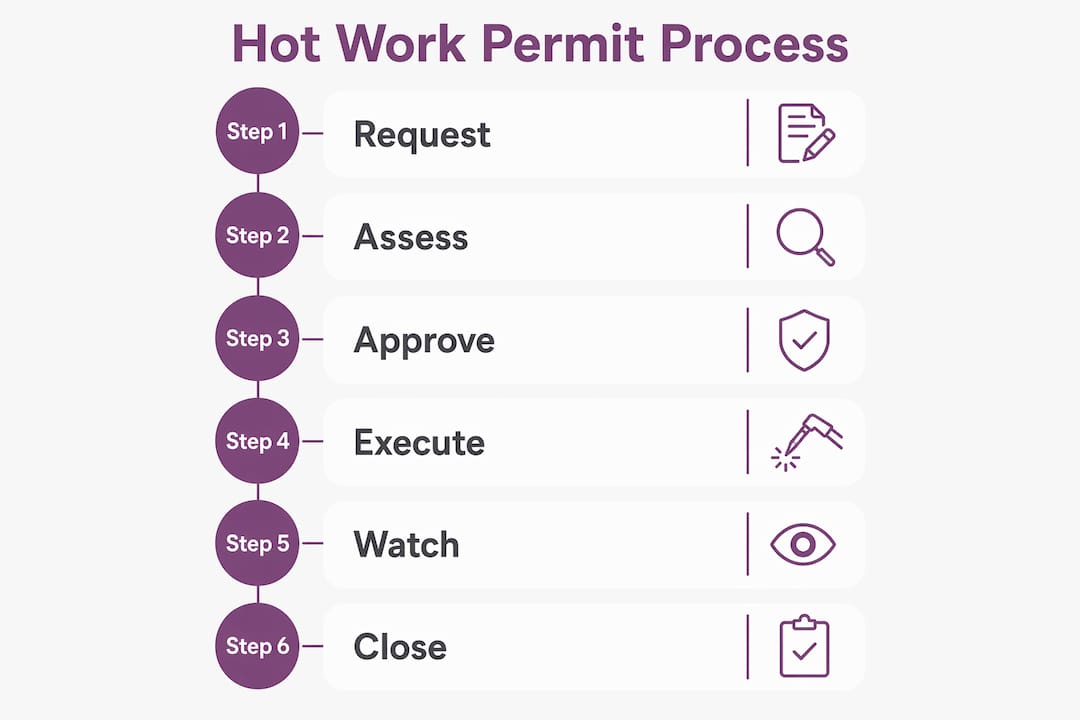
A well-run permit to work system follows a defined sequence. Skipping any step is where accidents start.
-
Submit the permit request at least 48 hours in advance. Per UCR Environmental Health & Safety, early submission gives the approving authority time to conduct a proper site review rather than a rushed sign-off.
-
Conduct a site-specific hot work hazard assessment. The requester inspects the area for combustibles, flammable atmospheres, sprinkler status, and nearby operations that could conflict with the hot work.
-
Permit Authorizing Individual (PAI) reviews and approves. The PAI inspects the site, confirms all controls are in place, and signs the permit. The document only becomes a valid permit after this signature.
-
Post the approved permit visibly at the job site. It must be accessible and conspicuous for the duration of the work. Supervisors and workers should be able to reference it without searching for it.
-
Execute the work within the permit’s authorized time window. Permits are typically valid for a single work period. Any extension requires written authorization from the PAI or fire safety authority.
-
Maintain fire watch throughout the work and after completion. Fire watch personnel must remain on-site for a significant period after work ends, with a minimum of 60 minutes required and extending up to three hours in environments with hidden cavities, insulation, or combustible wall assemblies. No other duties may be assigned during that period.
-
Formally close the permit with a verified sign-off. The requester contacts the fire safety team, confirms all conditions are safe, and the PAI closes the permit. Completed permits must be retained in department records for a minimum of one year.
-
Handle changes through suspension or amendment, not workarounds. If site conditions change mid-job, work stops, the permit is suspended, and a new assessment occurs before resuming.
What OSHA-aligned safety controls your program must include
OSHA’s hot work standards set the floor. Your program needs to meet or exceed these controls:
- 35-foot combustible clearance. Remove all combustible and flammable materials within 35 feet of the work area. Where removal is impossible, use fire-resistant shields or blankets to protect them.
- Trained fire watch, assigned exclusively. The fire watch person has no other duties. They monitor during the work and remain on-site for at least 60 minutes after completion, longer in complex environments.
- Fire extinguishing equipment immediately available. The right class of extinguisher must be at the work site before the permit is issued, not fetched after a problem starts.
- Atmosphere testing with calibrated equipment. Near flammable liquids, gases, or confined spaces, test with an approved, calibrated combustible gas detector before and periodically during the work. Record all readings on the permit form.
- Sprinkler systems must be operational. A permit should not be issued if sprinkler protection is impaired. Coordinate with facilities to confirm the suppression system is fully functional before work begins.
- Personal protective equipment for all exposed personnel. Welding helmets, appropriate filter lenses, and protective clothing are required for operators and any nearby workers.
Common risks that permit programs are designed to prevent
The leading cause of hot work fires is straightforward: someone decides a job is too quick to bother with a permit. The Canadian Centre for Occupational Health and Safety identifies skipping the permit for short tasks as the most frequent trigger for hot work fires. The permit exists precisely to interrupt that reasoning.
Beyond the “quick five-minute job” problem, several other failure patterns show up repeatedly:
- Designated hot work areas that have quietly become unsafe. Combustibles accumulate over time. An area cleared and certified months ago may not be safe today. Kennesaw State University EHS notes that frequent audits and re-verification of designated areas are necessary to prevent this drift.
- Conflicting hazardous activities running simultaneously. Without centralized coordination, two crews can create a dangerous interaction. A DNV permit management guide frames the permit system as a communication tool that prevents exactly this kind of conflict.
- Click-through digital compliance. Electronic permit systems can produce checkbox compliance with no real verification. The form gets completed, but nobody confirmed the actual site conditions.
- Delayed ignition after work ends. Embers lodge in wall cavities or insulation and ignite hours later. This is why the post-work fire watch period is not optional.
Pro Tip: The post-job fire watch period is the most neglected part of the process. Fires often ignite long after the last spark. Mandate fire watch for at least 60 minutes, and extend it to three hours in environments with hidden cavities, insulation, or combustible wall assemblies. Build this into your permit form as a required field, not a suggestion.
For practical hot work permit examples that show how these controls appear on real permit forms, reviewing completed templates helps teams understand what thorough documentation looks like.
Best practices for managing permits and training compliance
Effective permit management comes down to three things: verified documentation, trained personnel, and closed-loop accountability.
The UK Health and Safety Executive is direct on digital permits: capturing timestamped photos, digital signatures, and verifiable evidence is what separates genuine compliance from checkbox theater. A permit signed with a verified digital signature and a timestamped site photo is defensible in an audit. A PDF with a typed name is not.
Training requirements matter just as much as the permit form itself. Personnel issuing, approving, and performing hot work need documented initial training and refresher training on a defined cycle. Those records need to be retrievable on demand, not buried in a filing cabinet or scattered across spreadsheets.
“Zombie permits” are a real audit liability. Permits left open without formal closure skew your compliance records and signal to auditors that your closure process is not enforced. Requiring a digital sign-off with verification at closure stops this problem at the source.
Certicerts addresses the training record side of this directly. Safety managers can issue hot work training certificates with QR verification codes, manage expiry dates and recertification schedules through a compliance dashboard, and generate bulk certificates for large training events. The local-first architecture means records stay under your control, with offline QR verification that auditors and supervisors can use without an internet connection. For teams managing industrial safety deployment across multiple sites, centralized training records tied to verified credentials close the gap between permit compliance and workforce qualification.
Pro Tip: Use Certicerts’ digital signature features and timestamped certificate records to build an audit trail that covers both the training qualification and the permit authorization chain. When an inspector asks whether your fire watch personnel were certified, you can pull the record in seconds rather than searching through paper files.
For safety managers building or updating their program, a solid hot work permit template paired with a verified training record system covers both the operational and compliance sides of the requirement.
Key Takeaways
A hot work permit program requires a formal written process, OSHA-aligned safety controls, verified training records, and closed-loop permit accountability to prevent fires and pass audits.
| Point | Details |
|---|---|
| Submit permits 48 hours early | Early submission allows proper site review and PAI approval before work begins. |
| Enforce the 35-foot clearance rule | Remove or shield all combustibles within 35 feet before any permit is issued. |
| Fire watch lasts at least 60 minutes | Post-work fire watch must run a minimum of 60 minutes; extend to three hours in complex environments. |
| Close every permit with verified sign-off | Open “zombie permits” undermine audit compliance; digital signature closure is the standard. |
| Tie training records to permit authorization | Certified personnel records must be retrievable on demand to satisfy auditor and legal requirements. |

Certicerts gives safety managers a single platform to issue verified hot work training certificates, track expiry dates, and generate audit-ready compliance reports. Explore Certicerts to see how it fits your permit program.