PSIF Meaning: What It Is and Why It Matters

PSIF is defined as Potential Serious Injury and Fatality, a safety classification that identifies incidents or near misses with a credible likelihood of causing life-altering injury or death if conditions had been slightly different. The term carries formal weight: ASTM Standard E3519-26 formalizes PSIF classification, emphasizing the potential for lethal energy release or serious harm. Understanding the psif meaning is not just a vocabulary exercise. For safety professionals, it is the foundation of a prevention strategy that targets the incidents most likely to kill or permanently disable workers.
What is PSIF and how is it formally defined?
PSIF stands for Potential Serious Injury and Fatality. It describes a near-miss event or high-risk situation where the worst credible outcome would have been a fatality or permanent, life-altering injury. The key word is credible. Not every near miss qualifies. The incident must involve conditions where a realistic shift in timing, position, or control failure would have produced catastrophic harm.
The Campbell Institute defines serious injury as permanent or life-altering impairment. That standard draws a clear line between a bruised knee and a crushed spine. PSIF classification requires that the potential outcome meets this severity threshold, not just that something went wrong.
PSIF sits within a broader family of safety terms. A Serious Injury and Fatality (SIF) is an event where severe harm actually occurred. A PSIF is the precursor: the event that could have produced a SIF outcome. This distinction is what makes PSIF so valuable as a safety tool. You can act on a PSIF before anyone gets hurt.
How is a PSIF incident identified and distinguished from other safety events?
The most common confusion in safety reporting is treating every near miss as a PSIF. Not all near misses are PSIFs. A PSIF requires two specific conditions: the presence of high-energy hazards, and failed or missing controls that would likely have resulted in severe injury or death.
| Event type | What happened | Potential outcome | PSIF? |
|---|---|---|---|
| Near miss | Incident occurred, no injury | Minor or moderate harm possible | Not necessarily |
| PSIF | Incident occurred, no injury | Fatality or permanent injury credible | Yes |
| SIF | Incident occurred, injury resulted | Severe harm actually occurred | N/A (outcome confirmed) |
Energy level is the primary filter. Falls from height, struck-by incidents involving heavy equipment, electrical exposure, and confined space events all carry the energy needed to kill. A worker slipping on a wet floor in a hallway is a near miss. A worker nearly falling from an unguarded scaffold edge 20 feet up is a PSIF. The difference is the credible worst outcome.
Control effectiveness matters equally. If a safety barrier was in place and functioned correctly, the incident may not qualify as a PSIF even if the hazard energy was high. The PSIF assessment focuses on whether controls were compromised, absent, or bypassed at the time of the event.
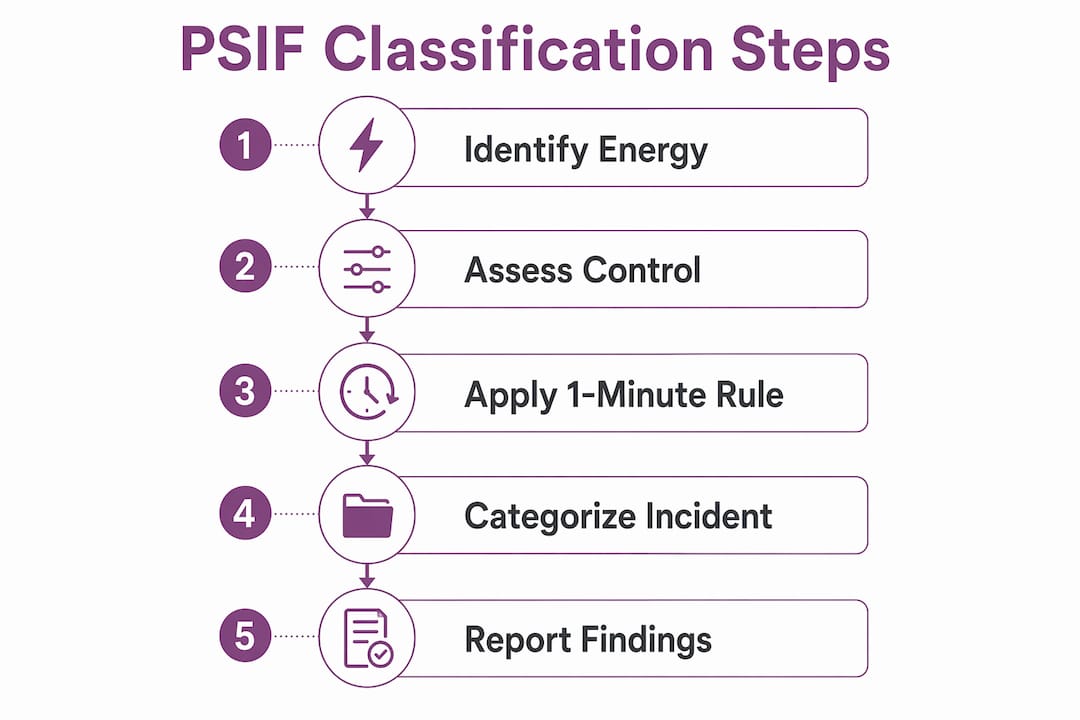
Pro Tip: Use the 1-minute rule when classifying incidents. If your team cannot agree within one minute that an incident has credible PSIF potential, it probably does not qualify. This practical classification rule prevents overclassification and keeps your safety focus sharp.
Why PSIF tracking matters: PSIF as a leading safety indicator
Traditional safety metrics count injuries after they happen. Total Recordable Incident Rate (TRIR) and Lost Time Injury Frequency (LTIF) are lagging indicators. They tell you what went wrong last quarter. PSIF tracking is a leading indicator. It tells you where the next fatality is most likely to come from before it happens.
Only about 20% or less of reported incidents contain genuine PSIF risks. That means more than 80% of incident reports describe routine events that carry little risk of catastrophic harm. Without PSIF filtering, safety teams spend equal time on a sprained wrist and a near-electrocution. That misallocation of attention costs lives.
“Safety programs that focus on potential outcomes rather than actual events improve prevention. Objective PSIF identification methods shift attention from what did happen to what could have happened, which is where the real prevention opportunity lives.”
The challenges are real. Many organizations overload on incident data that lacks PSIF risk, missing critical hazards without effective filtering methods. Subjective classification leads to inconsistent results. One supervisor flags a forklift near-miss as a PSIF. Another dismisses an identical event as routine. That inconsistency destroys the metric’s value.
The benefits of a well-run PSIF program include:
- Focused resource allocation: Safety teams direct investigation time toward the incidents most likely to kill.
- Earlier intervention: High-energy hazards get corrected before a fatality forces the issue.
- Better training priorities: PSIF data reveals which tasks and locations carry the highest catastrophic risk.
- Stronger audit evidence: Documented PSIF tracking demonstrates proactive safety management to regulators and clients.
- Cultural shift: Workers and supervisors start thinking about what could happen, not just what did happen.
AI-supported incident management systems now analyze incident descriptions and hazard data to accurately classify PSIFs, reducing the subjectivity that undermines manual classification. This technology is becoming a practical tool for large organizations managing thousands of incident reports annually.
Practical strategies for identifying and managing PSIF risks
Effective PSIF management starts with consistent classification criteria. Without a shared definition applied uniformly across your organization, PSIF data becomes noise. The following steps build a reliable PSIF identification and response process.
-
Establish written PSIF criteria. Document exactly what qualifies as a PSIF in your organization. Reference ASTM E3519-26 as your baseline. Include examples from your specific industry and work environment so supervisors can apply the standard without debate.
-
Train supervisors on the worst credible outcome test. Every incident report should prompt the question: “What is the worst realistic outcome if conditions had been slightly different?” If the answer is a fatality or permanent injury, the event is a PSIF candidate. Pair this with job hazard analysis best practices to build the habit into routine safety work.
-
Flag high-energy hazard categories automatically. Falls from height, energy isolation failures, heavy equipment proximity events, and confined space incidents should trigger automatic PSIF review. This removes the burden of judgment from the initial report and ensures high-risk events get proper scrutiny.
-
Verify critical control status at the time of the event. A PSIF investigation must confirm whether the relevant safety controls were functioning, bypassed, or absent. This is the most important step. A falling object hazard with all controls intact is a different risk profile than the same hazard with barriers removed.
-
Treat PSIF investigations with higher urgency than standard near-miss reports. High-performing safety teams treat PSIF investigations with urgency and cross-functional collaboration to verify control effectiveness. A 24-hour response window for PSIF events is a reasonable standard.
-
Review PSIF data monthly at the leadership level. Trends in PSIF location, task type, and energy source reveal systemic hazards that individual incident reports obscure. Monthly review keeps leadership engaged with the highest-risk areas of the operation.
Pro Tip: Avoid “indicator fatigue” by keeping your PSIF criteria strict. Failing to distinguish low-consequence near misses from genuine PSIFs dilutes focus and makes your safety metrics feel meaningless to the people using them.
PSIF meaning beyond safety: Other contexts and common misconceptions
PSIF does not carry a single universal meaning across all fields. Readers encountering the acronym outside a workplace safety context may find a completely different definition. The most common alternative is medical.
In medical contexts, PsiF denotes Posterior Sacroiliac Fusion, a spine surgery technique used to treat sacroiliac joint dysfunction. The procedure is unrelated to safety incident classification. A surgeon referencing PsiF and a safety manager referencing PSIF are using entirely different terms that happen to share the same letters.
Common misconceptions about PSIF include:
- PSIF equals near miss. Near misses are a broader category. PSIF is a specific subset requiring high-energy hazards and credible catastrophic potential.
- PSIF only applies to manufacturing. PSIF classification applies to any industry where high-energy hazards exist, including construction, utilities, healthcare, and transportation.
- PSIF is a lagging indicator. PSIF is a leading indicator. It captures potential before harm occurs, which is the opposite of a lagging measure.
- Any serious-sounding incident is a PSIF. The classification requires objective criteria, not subjective severity perception. A frightening event with low actual energy is not a PSIF.
The safest way to identify the intended meaning of PSIF is to check the context. Safety management documents, EHS dashboards, and incident investigation reports use PSIF in the Potential Serious Injury and Fatality sense. Medical device catalogs, surgical procedure guides, and spine surgery literature use PsiF in the Posterior Sacroiliac Fusion sense. The surrounding vocabulary makes the distinction clear in almost every case.
Key Takeaways
PSIF is a leading safety indicator that identifies near-miss incidents with credible potential for fatality or permanent injury, enabling prevention before harm occurs.
| Point | Details |
|---|---|
| Core PSIF definition | PSIF means Potential Serious Injury and Fatality, covering near misses with credible catastrophic potential. |
| Formal classification standard | ASTM E3519-26 provides the recognized framework for PSIF identification and recording. |
| PSIF as a leading indicator | Only about 20% of incidents carry genuine PSIF risk, making focused identification critical. |
| Classification discipline | The 1-minute rule and strict coding criteria prevent overclassification and indicator fatigue. |
| Context matters | In medical settings, PsiF refers to Posterior Sacroiliac Fusion, a spine surgery unrelated to safety. |
Why PSIF recognition is the most underused tool in safety management
I have spent years watching safety programs collect mountains of incident data and then wonder why their fatality rates do not improve. The answer is almost always the same: they are treating every near miss as equally important, which means nothing gets the attention it deserves.
PSIF recognition changes that calculus. When a team genuinely commits to identifying the 20% of incidents that carry real catastrophic potential, the whole safety program sharpens. Investigations get faster. Corrective actions get more specific. Leadership starts asking better questions. The culture shifts from reactive paperwork to genuine prevention.
The hardest part is not the classification criteria. It is organizational discipline. Keeping PSIF thresholds strict when supervisors want to flag everything as high-priority takes real management commitment. The 1-minute rule is not just a time-saving trick. It is a discipline tool that forces teams to be honest about what actually carries lethal potential.
Technology will make this easier. AI classification tools are already reducing the subjectivity that undermines manual PSIF coding. But the underlying logic, focusing on what could have happened rather than what did happen, is a human judgment call that no algorithm fully replaces. Safety professionals who master that judgment are the ones who actually prevent fatalities.
— James
Certicerts supports safety training and PSIF certification
Safety professionals managing PSIF programs need more than good data. They need documented proof that their teams have been trained on high-energy hazard recognition, critical control verification, and incident classification.
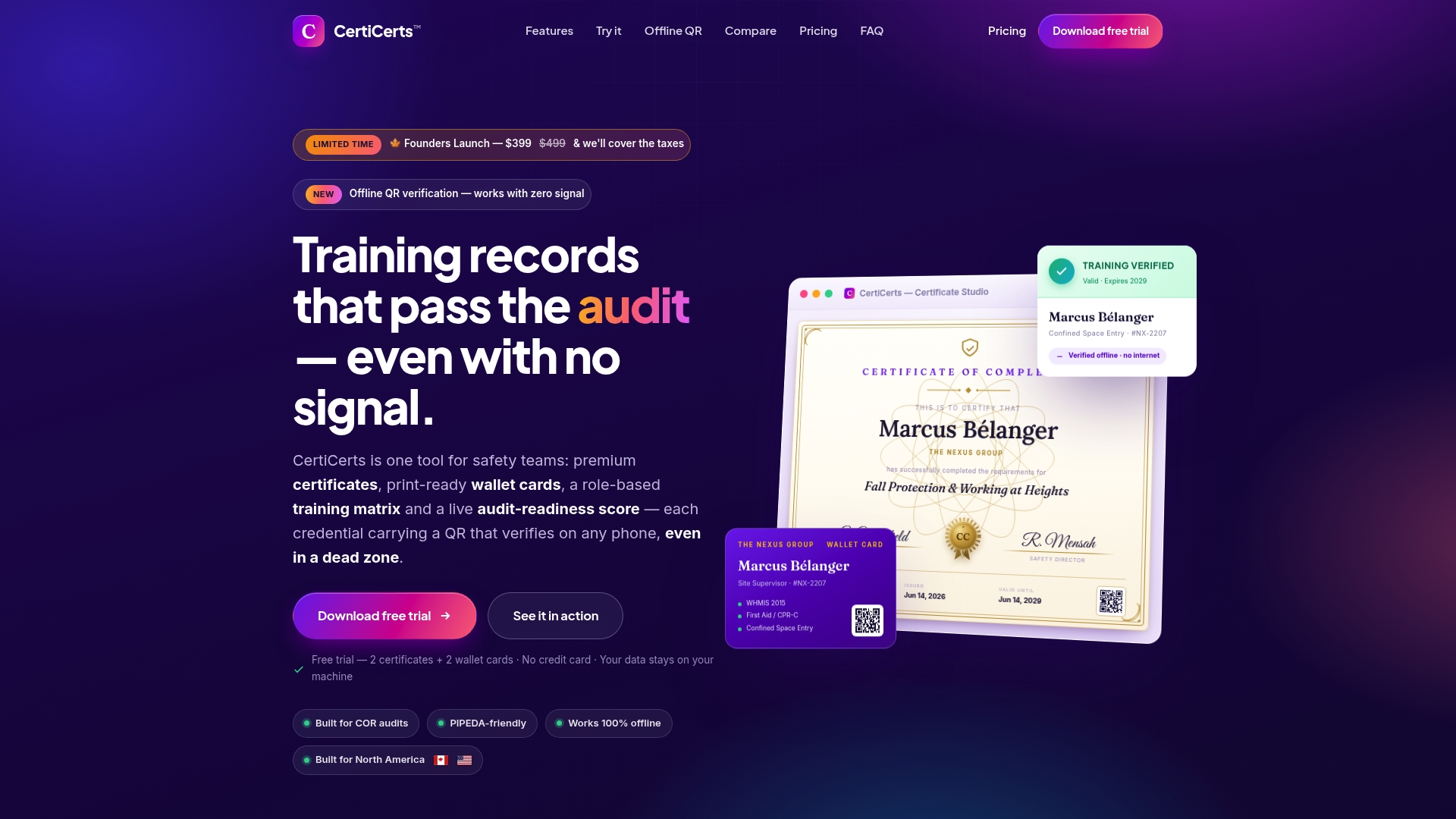
Certicerts makes that documentation straightforward. The platform generates professional training certificates and wallet cards for PSIF awareness programs, complete with offline QR verification so credentials can be confirmed on any job site without an internet connection. Whether you are running a single safety session or certifying an entire workforce, Certicerts handles the certificate lifecycle from issuance through renewal tracking. Safety compliance does not stop at the training room door, and neither does Certicerts.
FAQ
What does PSIF stand for in safety?
PSIF stands for Potential Serious Injury and Fatality. It identifies near-miss incidents or high-risk situations with a credible likelihood of causing fatality or permanent injury under slightly different conditions.
How is PSIF different from a near miss?
A near miss is any unplanned event that did not result in injury. A PSIF is a specific subset requiring high-energy hazards and compromised controls where the worst credible outcome would have been a fatality or life-altering injury.
What is the ASTM standard for PSIF classification?
ASTM Standard E3519-26 is the formal guide for recording Serious Injury and Fatality events, including PSIF classification criteria focused on lethal energy release potential and severity of credible outcomes.
Can PSIF refer to something other than workplace safety?
Yes. In medical contexts, PsiF refers to Posterior Sacroiliac Fusion, a spine surgery technique for treating sacroiliac joint dysfunction. The intended meaning depends entirely on the professional context in which the term appears.
Why is PSIF considered a leading safety indicator?
PSIF captures potential harm before it occurs, unlike lagging indicators such as injury rates that measure past events. Tracking PSIFs allows safety teams to address the highest-risk hazards before a fatality forces the issue.